GPT 6.1 Terra Document Parsing Review: Strong on Tables, Weak on Layout and Charts
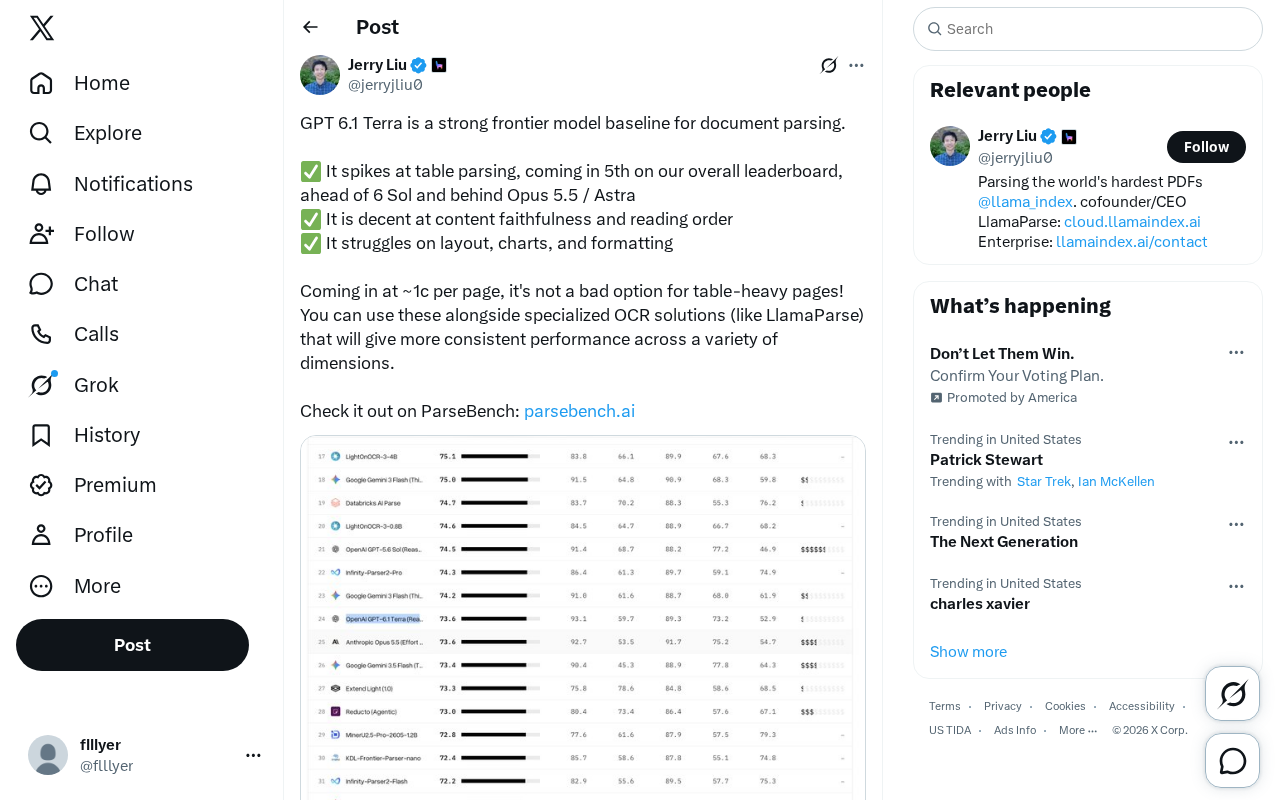
ParseBench review: GPT 6.1 Terra excels at table parsing but is weak on layout, charts, and formatting.
ParseBench published its document parsing evaluation of GPT 6.1 Terra. The model ranks fifth overall, above 6 Sol and below Opus 5.5 and Astra. Its standout strength is table parsing, with decent content faithfulness and reading order, but it falls short on layout understanding, chart parsing, and formatting, making complex layouts and charts unreliable. At about 1 cent per page, it is cost-effective for table-heavy pages. The evaluation recommends combining it with dedicated OCR solutions like LlamaParse for consistent performance across dimensions while leveraging the model's strengths on tables.
Introduction
In the document parsing space, whether general-purpose large models can handle complex layouts, tables, and charts has long been a focus for developers. Recently, ParseBench published its evaluation of GPT 6.1 Terra, showing that the model has solid capabilities in document parsing, especially standing out in table parsing, though it still has clear shortcomings in layout, charts, and formatting.
Evaluation Results Overview
According to ParseBench's evaluation, GPT 6.1 Terra ranks fifth on the overall leaderboard, above 6 Sol and below Opus 5.5 and Astra. Specifically, the model performs impressively on table parsing, extracting table content effectively; it also does reasonably well on content faithfulness and reading order. However, it falls short in layout understanding, chart parsing, and formatting.
Strengths: Table Parsing and Content Faithfulness
Table parsing is GPT 6.1 Terra's strong suit. The evaluation notes that the model "spikes" on table parsing, making it a good choice for table-heavy pages. In addition, the model performs well on content faithfulness and reading order, preserving original information and outputting it in a reasonable order.
Weaknesses: Layout, Charts, and Formatting
Despite strong table parsing, GPT 6.1 Terra performs poorly on layout understanding, chart parsing, and formatting. This means that for documents with complex layouts, charts, or specific formatting requirements, the model may not deliver stable and reliable results.
ParseBench is a public benchmark platform for document parsing tasks, and its evaluation dimensions typically cover table structure reconstruction, layout element recognition, chart semantic extraction, reading order restoration, and content faithfulness. Scores across these subtasks are aggregated into an overall ranking, so "ranked fifth" means GPT 6.1 Terra is in the upper-middle tier for overall balance rather than being a champion in any single category. This is important to understand: leaderboard rankings reflect multi-dimensional weighted results, and a "spike" in one subtask does not necessarily translate into overall leadership. Developers should review detailed metrics based on their own document types rather than looking only at the overall ranking.
Layout understanding refers to the model's ability to recognize and reconstruct the spatial structure of a page, including headings, paragraphs, columns, headers and footers, and image regions; chart parsing requires the model to read axes, legends, and data series from bar charts, line charts, pie charts, and similar graphics and convert them into structured data; formatting concerns whether the output preserves the original hierarchy, lists, bold text, and other stylistic information. Together, these three capabilities determine whether document parsing results can be used directly for downstream retrieval or data ingestion. General-purpose large models tend to be strong on plain text and tables but weaker than dedicated OCR pipelines on layout and chart tasks that require precise coordinate localization and visual semantics—which is exactly why this model underperforms in the evaluation.
Cost and Positioning
According to ParseBench, GPT 6.1 Terra's processing cost is about 1 cent per page (~1c per page). For pages with many tables, this price makes it a cost-effective choice. Note, however, that the model is not a jack-of-all-trades and still relies on specialized OCR solutions across multiple dimensions.
Complementing Dedicated OCR Solutions
The evaluation suggests combining GPT 6.1 Terra with dedicated OCR solutions such as LlamaParse. Dedicated OCR tools provide more consistent performance across various dimensions, while GPT 6.1 Terra can play to its strengths in specific scenarios such as table parsing. This combined strategy helps balance cost and performance.
LlamaParse is a document parsing service from LlamaIndex designed for complex PDFs and layouts. It includes built-in pipelines for layout analysis, table recognition, and reading order restoration, and its output can be used directly for retrieval-augmented generation (RAG). Compared with general-purpose large models, dedicated OCR solutions are more balanced and stable across dimensions, though cost and flexibility involve trade-offs. A common approach to combining the two is to first use a dedicated parser for layout segmentation and routine text extraction, then hand table-dense or structurally complex pages to a large model for secondary refinement—achieving a balance between parsing quality and per-page cost.
Conclusion
As a frontier model, GPT 6.1 Terra demonstrates solid table-handling capabilities in document parsing but still has limitations in layout, charts, and formatting. For table-dense documents, it is an economical choice, but fully stable parsing still requires pairing it with dedicated OCR tools. Developers can choose flexibly based on their specific needs.
(Note: This article is based on evaluation information published by ParseBench on Twitter. For more details, visit the ParseBench website.)
Related articles

LLM Application Development: A High-Paying Career Guide for Ordinary People
LLM application development offers fresh graduates up to 35K/month, with SP offers reaching 600K. This article explains the core skills, how to break in, and how ordinary people can seize AI opportunities through learning by doing.

Say Goodbye to AI Influencer Faces: A Complete Guide to Creating Visual Assets for AI Comic Dramas from Scratch
Bilibili creator shares a full workflow for zero-basics AI comic drama visual assets: use Doubao Work skills with script-first, visual references, and real-person texture to escape AI influencer faces, then lock character and scene consistency with asset sheet layouts, weapon detail images, scene nine-grids, and cinematic color palettes.

The AI Production Pipeline Behind Great Videos: From Research to Agent Validation
AI video production isn't just a model race. This article breaks down a transferable four-step pipeline: researching professional workflows, organizing a skill checklist, configuring agents, and experimental validation—and explains how general-purpose LLMs like DeepSeek can replace paid tools to run the entire process.