GPT-6.1 Terra Launches on AI Gateway: A New Choice for Visual Reasoning and Computer Operation

OpenAI's fast model GPT-6.1 Terra launches on AI Gateway, focused on visual reasoning and desktop automation.
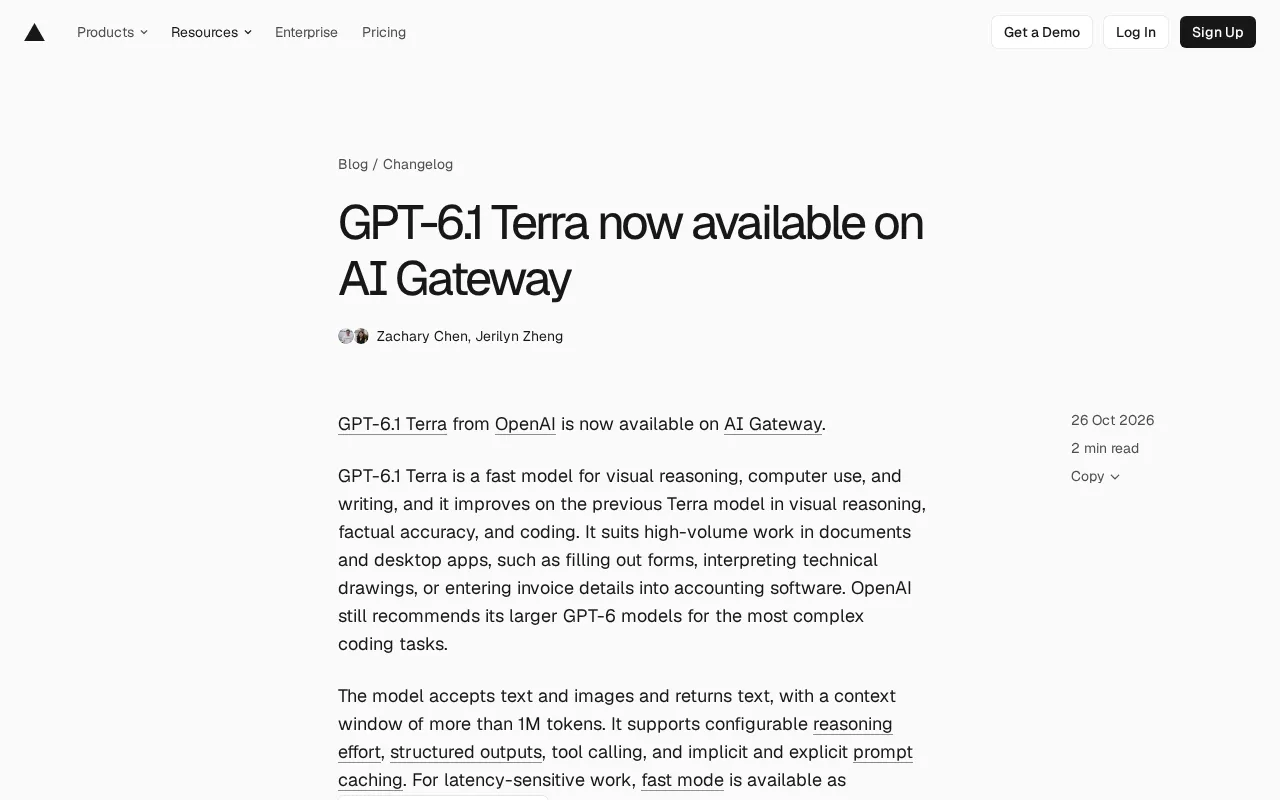
GPT-6.1 Terra is OpenAI's new "fast model," available via AI Gateway, focused on visual reasoning, computer operation, and writing, with clear gains over the prior generation. It accepts text and image inputs, has a 1M+ token context window, supports configurable reasoning effort, structured outputs, tool calling, and prompt caching, and offers a low-latency fast mode. OpenAI says the most complex coding tasks should still use the larger GPT-6.
OpenAI's GPT-6.1 Terra model is now available through the AI Gateway. Positioned as a "fast model," it focuses on visual reasoning, computer operation, and writing scenarios, and shows clear improvements over the previous Terra generation in visual reasoning, factual accuracy, and coding ability.
Model Positioning: Fast-Paced Visual Reasoning and Desktop Automation
The core selling point of GPT-6.1 Terra is speed. It targets high-throughput document and desktop application scenarios, such as filling out forms, interpreting technical drawings, or entering invoice line items into accounting software. These tasks typically require the model to simultaneously understand image content and produce structured output, and Terra's visual reasoning capabilities are designed precisely for this.
OpenAI also makes clear that for the most complex coding tasks, the larger GPT-6 series models are still recommended. This means Terra is not an all-purpose flagship, but rather a trade-off between speed and complex tasks.
Technical Specifications and Developer Integration
The model accepts text and image inputs and returns text, with a context window exceeding 1 million tokens. It supports configurable reasoning effort, structured outputs, tool calling, and both implicit and explicit prompt caching. For latency-sensitive workloads, a fast mode is also available under the model name openai/gpt-6.1-terra-fast.
For integration, GPT-6.1 Terra is compatible with the AI SDK, the OpenAI-compatible Chat Completions API, the Responses API, and coding agents connected to the AI Gateway. Developers can call it using openai/gpt-6.1-terra as the model name.
import { streamText } from 'ai';

const result = streamText({
  model: 'openai/gpt-6.1-terra',
  prompt: 'Draft a one-page proposal for migrating our docs site to Next.js.',
});
To use it in agents such as Codex or Cursor, install the latest Vercel CLI and run npx vercel ai-gateway setup, then select openai/gpt-6.1-terra in the agent.
Structured Outputs refer to constraining the model to generate results according to a predefined JSON Schema rather than free-form text. For tasks such as entering invoice line items into accounting software or extracting fields from technical drawings, structured outputs ensure that field names, types, and required fields meet downstream system requirements, reducing parsing failures and post-processing validation. Tool Calling, meanwhile, allows the model to request external functions or APIs during reasoning—for example, querying a database or submitting a form—which is a foundational capability for "computer operation" scenarios. Combined, the two enable Terra to first understand an image and then call tools to write into systems within a single workflow, forming an end-to-end automation chain.
The Added Value of AI Gateway
The AI Gateway provides a unified API for calling models, tracking usage and costs, and configuring retries, failover, and performance optimization to improve availability beyond the provider level. It also includes built-in custom reporting, zero data retention support, API key budgets, routing rules, and more.
On pricing, the AI Gateway reflects provider prices as-is, with no markup and no platform fee for inference, including bring-your-own-key (BYOK) requests.
Prompt Caching is a mechanism that caches the computed results of repeated prompt prefixes (such as system instructions, long documents, or tool definitions) to avoid reprocessing the same tokens on every request. OpenAI's implicit caching automatically identifies reusable prefixes on the server side, while explicit caching allows developers to manually mark cache breakpoints. For document processing scenarios involving "long context + high-frequency calls," caching can significantly reduce latency and cost. Terra supports both modes, meaning that for batch form filling or repeatedly referencing the same technical drawing, subsequent requests can return faster.
Failover and routing rules are key means by which the AI Gateway adds reliability above the provider layer: when the primary model or primary provider experiences timeouts, rate limiting, or errors, the gateway can automatically retry requests or switch to a backup model/key. Routing rules allow decisions about which model to use based on request characteristics (such as budget, latency targets, or content type)—for example, routing simple tasks to Terra's fast mode and complex tasks to GPT-6. For production systems, this layer of abstraction means teams don't need to hardcode fault-tolerance logic in application code.
What It Means for Developers in Practice
For teams that need to batch-process documents, forms, and desktop operation automation, GPT-6.1 Terra offers a speed-first option while retaining production-grade capabilities such as structured outputs and tool calling. The context window exceeding 1 million tokens also alleviates some of the hassle of splitting long documents.
However, if your tasks involve highly complex coding logic, OpenAI's recommendation is still to turn to the larger GPT-6 models. Terra's positioning is clear: it is not meant to replace the flagship, but to cover high-frequency scenarios where "fast matters more than powerful."
One-line Summary
OpenAI's fast model GPT-6.1 Terra launches on AI Gateway, focusing on visual reasoning and desktop automation.
Paragraph Summary
GPT-6.1 Terra is the newest member of OpenAI's lineup positioned as a "fast model," now available through the AI Gateway. It focuses on visual reasoning, computer operation, and writing scenarios, with clear improvements over the previous generation in visual reasoning, factual accuracy, and coding ability. It accepts text and image inputs, has a context window exceeding 1 million tokens, supports configurable reasoning effort, structured outputs, tool calling, and prompt caching, and offers a low-latency fast mode. Developers can integrate it via the AI SDK, Chat Completions API, Responses API, and coding agents. The AI Gateway has no markup and charges no inference platform fee, and also provides retries, failover, budgets, and routing rules. OpenAI makes clear that the most complex coding tasks should still use the larger GPT-6 model.
Related articles

Last Week Tonight Exposé: The Dangerous Ties Between Politicians and White Supremacy
Last Week Tonight investigates Georgia Senate candidate Mike Collins and Florida candidate Marshall Rawson, exposing their multiple ties to white supremacists and the Republican Party's silent response.
AI Buzz Weekly: GPT-6.5 Leak, New Claude Model, and MiniMax's Cost-Effectiveness
This week's AI buzz roundup: suspected GPT-6.5 leak, Microsoft configs showing GPT-6.1 Tera, Anthropic's new model that can identify entire classes of bugs, disappointing early Gemini 4 Carbon results, and MiniMax M3.1 Flash beating Claude Opus 5 and GPT-5.6 Sol in benchmarks at extremely low cost.

AI Briefing: Gemini 4 Carbon Released, Ant Open-Sources Ling-3.1
AI Briefing: Google releases Gemini 4 Carbon qubit model, claiming to surpass Opus 5.5 with half-price tokens; Ant open-sources Ling-3.1-1019 for real-task Personal Agents; domestic AI drug discovery succeeds in 18 of 19 projects, hitting all 6 GPCR targets; zero-revenue company valued at $20B raises another $1B; Sichuan convenience store robot sales fail.