GPT-6 Sets New Record on Twin Prime Conjecture: The Century-Long Relay from Yitang Zhang to AI

GPT-6 sets a new record of 186 on twin prime gaps, continuing the relay Yitang Zhang began in 2013.
The twin prime conjecture — whether infinitely many prime pairs differ by exactly 2 — is one of mathematics' oldest unsolved problems. In 2013, Yitang Zhang, who had spent years washing dishes and sleeping in basements, stunned the world by proving infinitely many consecutive primes have a finite gap (under 70 million). Terence Tao's Polymath Project and mathematician James Maynard then compressed that bound to 246, and then 240. Now GPT-6, building on a new method by mathematician Natalie Stadlmann, has pushed the bound to 186 — the first time AI has contributed to a frontier number theory result.
The math world is buzzing. OpenAI's GPT-6 has achieved a major breakthrough on the twin prime conjecture, proving that there exist infinitely many pairs of consecutive primes with a gap of no more than 186. To appreciate what this means, you need to understand a mathematical relay race spanning more than a century — and the most inspiring leg of that race belongs to Chinese-American mathematician Yitang Zhang.
What Is the Twin Prime Conjecture
Prime numbers are integers greater than 1 that have no divisors other than 1 and themselves: 2, 3, 5, 7, 11, 13, 17, 19, 23, 29… The ancient Greek mathematician Euclid proved long ago that there are infinitely many primes.
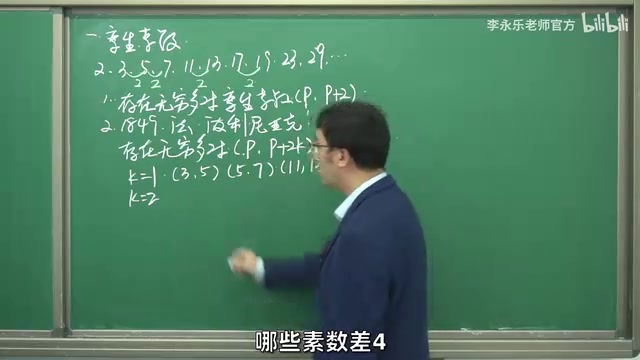
Twin primes are pairs of primes that differ by 2. The pairs (3, 5), (5, 7), (11, 13), and (17, 19) are all twin primes. As numbers grow larger, primes become increasingly sparse among the natural numbers — so the question is: can we still find infinitely many prime pairs that differ by exactly 2? This is the twin prime conjecture: there exist infinitely many pairs of twin primes.
In formal terms: there exist infinitely many primes P such that both P and P+2 are prime. Any elementary school student can understand the statement, yet it has defied the combined efforts of countless mathematicians for over a century. The twin prime conjecture, along with the Riemann hypothesis and Goldbach's conjecture, was embedded in the eighth of Hilbert's 23 famous problems presented at the 1900 International Congress of Mathematicians.
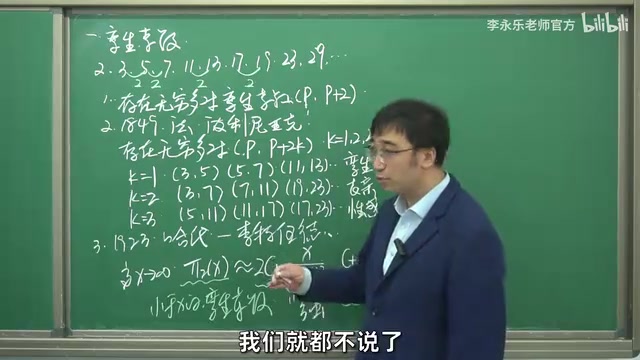
Worth mentioning are a few intriguing variants. In 1849, French mathematician Alphonse de Polignac proposed a stronger version: for every positive integer k, there exist infinitely many prime pairs P and P+2k. When k=1, the gap is 2 (twin primes); when k=2, the gap is 4 (known as "cousin primes"); when k=3, the gap is 6 (aptly called "sexy primes"). Sadly, not a single value of k has been proven to work.
Understanding why the twin prime conjecture is so hard requires familiarity with the Prime Number Theorem, which describes how primes thin out: among the natural numbers from 1 to N, the count of primes is approximately N/ln N. This means that near N, the probability of a random number being prime is roughly 1/ln N — a probability that shrinks as N grows. Consequently, the "average gap" between consecutive primes near N is about ln N, which grows without bound. The twin prime conjecture is striking precisely because of this tension: even as primes become globally sparser and their average spacing grows to infinity, the conjecture asserts that infinitely many prime pairs remain "glued together" with a gap of just 2. This interplay between local clustering and global sparsity is what makes the problem so deep and captivating.
From Hardy to the GPY Theorem: A Century of Closing In
In 1923, British mathematician G. H. Hardy and his collaborator J. E. Littlewood proposed the Hardy–Littlewood conjecture, often called the strong twin prime conjecture. It provides an asymptotic estimate for the number of twin prime pairs below x, roughly 2·C_t·x/(ln x)², where C_t ≈ 0.66 is the twin prime constant. Since x grows much faster than (ln x)², the right-hand side tends to infinity as x grows — meaning if this conjecture holds, the twin prime conjecture follows automatically. Empirically, the formula fits the data remarkably well, but no one has been able to prove it.
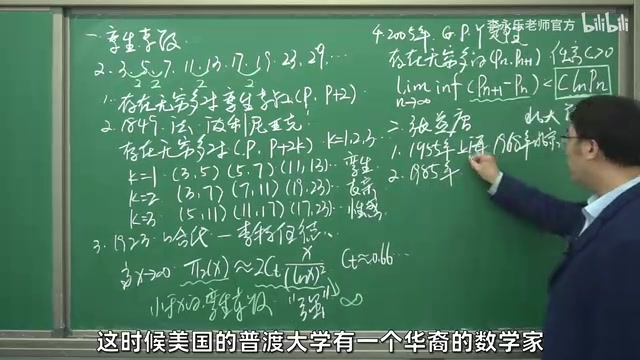
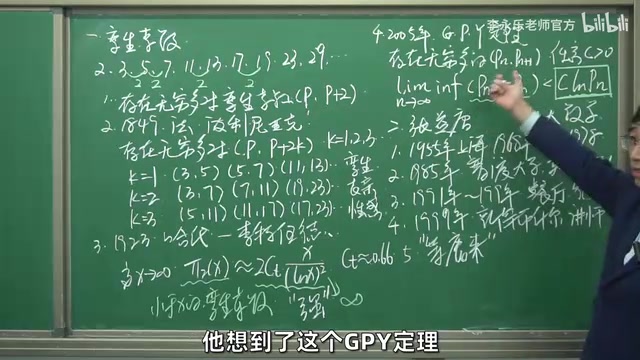
The first theorem-level progress came in 2005, when three mathematicians (whose initials spell GPY) applied sieve methods to prove the GPY theorem. It established that there exist infinitely many prime pairs whose gap is less than C·ln P, where the constant C can be made arbitrarily small. This means the gap between consecutive primes is of smaller order than ln P.
This was a major step forward — it imposed a concrete upper bound on the gap. Many felt the proof of the twin prime conjecture was just a hair's breadth away. But that last hair proved impossible to cross: the GPY method had reached its limits. Going further required a fundamentally different approach.
The GPY theorem (named after Goldston, Pintz, and Yıldırım) relies on sieve methods — techniques that study prime distributions by systematically eliminating integers that fail to meet certain criteria. The oldest sieve is the Sieve of Eratosthenes from the 3rd century BC, used to enumerate primes. Over the 20th century, mathematicians refined sieves into powerful analytic tools, but classical sieves face a fundamental obstacle known as the parity problem: they cannot distinguish between integers with an odd versus an even number of prime factors, leaving an unbridgeable "last step" no matter how the method is optimized. Having pushed sieve methods to their limits, Zhang was forced to find a new path — he introduced distributional estimates for primes (extending Bombieri–Vinogradov-type theorems via admissible tuples) to bypass the parity barrier, and for the first time turned an infinite gap bound into the finite number 70 million.
Yitang Zhang: From Dishwasher to World-Shaking Proof
Before 2013, no one in the mathematical world had heard of Yitang Zhang. After 2013, everyone had.
Zhang was born in Shanghai in 1955 and moved to Beijing with his father in 1968, attending a middle school affiliated with Tsinghua University for one year. From an early age he had a remarkable memory and was captivated by the mathematics volumes in the popular Chinese encyclopedia One Hundred Thousand Whys, developing a passion for math after encountering problems like Goldbach's conjecture and Fermat's Last Theorem. When his family was sent to rural Jiangxi during the Cultural Revolution, he dropped out of school to work the land, until the gaokao was reinstated in 1978 and he was admitted to Peking University's mathematics department.
After completing his master's degree in 1985, he traveled to Purdue University in the United States on the recommendation of his advisor Shisun Ding, where he studied algebraic geometry under Chinese-American mathematician Tzuong-Tsieng Moh — despite his true passion being number theory. When he finished his PhD in 1991, a dispute with his advisor over a flawed lemma rendered the core of his dissertation work invalid, and he left without a letter of recommendation.
Without a recommendation letter, academic jobs were out of reach. For the next eight years, Zhang delivered food and washed dishes at Chinese restaurants, worked at motels, sometimes slept in a friend's basement, sometimes in his own car. Friends urged him to go into computing — a comfortable, well-paying field — but he refused, choosing instead to keep doing mathematics on the side while working odd jobs.
A turning point came in 1999: a college friend working at Intel asked him for help with a computer science problem, which Zhang solved quickly. Impressed, the friend recommended him for a lectureship at the University of New Hampshire. The salary was modest, but Zhang was content — he had an office, paper, and pencil. He stayed in that position for fourteen years.
The breakthrough moment came during a visit to a friend's home. He had gone to the backyard hoping to spot a deer; no deer appeared, but a flash of inspiration did — he suddenly saw how to improve on the GPY theorem. Shortly after returning home, he wrote up his result.
On April 17, 2013, he submitted a paper to the prestigious journal Annals of Mathematics, proving that there exist infinitely many pairs of consecutive primes with a gap less than 70 million. Where the GPY theorem could only guarantee that gaps were of smaller order than an unbounded quantity, Zhang had turned that into a concrete finite number — a qualitative leap. The editors initially assumed the submission was from a crank, but found nothing wrong with it after reading. After senior mathematicians reviewed the paper, they found only two typos and one misplaced reference. The paper was accepted within three weeks — a record, given that the Annals' average review period exceeds a year. Nature called it a breakthrough; Zhang was promptly promoted to full professor and was awarded a MacArthur Fellowship.
The Relay: From 70 Million to 186
Zhang had not proven the twin prime conjecture itself — that would require a gap of exactly 2 — but he had opened a path that could be continuously refined.
Chinese-Australian mathematician Terence Tao launched the Polymath Project, inviting mathematicians worldwide to use Zhang's methods to push the bound lower. Within four months, the upper limit fell from 70 million to 4,680. Then James Maynard, a brilliant 26-year-old British mathematician, introduced an independent new approach that brought the bound down to 600; a subsequent Polymath collaboration between Tao and Maynard compressed it further to 246.
That record of 246 stood for many years — until 28-year-old mathematician Natalie Stadlmann opened a new avenue and pushed the bound down to 240. Just three days later, GPT-6, building on her method, compressed the bound further to 186.
In other words, we now know for certain: there exists some even number such that infinitely many prime pairs are separated by exactly that gap. We don't know whether that number is 2, 4, 6, or 200 — but we know it must be less than 186. For the first time, AI has stepped into the relay on a frontier number theory problem and carried the baton forward.
The Polymath Project launched by Tao represents an important experiment in open mathematical collaboration. It was first conceived by mathematician Timothy Gowers in 2009 to test whether large-scale networked collaboration could crack top-tier mathematical problems. Participants discuss and verify each other's ideas in real time on public blogs; anyone — from Fields Medal winners to enthusiastic amateurs — can contribute. The Polymath8 project targeting Zhang's result attracted dozens of researchers who, through meticulous optimization of every technical parameter in Zhang's method, reduced the bound from 70 million to 4,680 within months. Maynard's independently developed method took a different technical route, using higher-dimensional sieve functions. It not only lowered the bound to 600 but simultaneously proved the stronger result that there exist infinitely many prime k-tuples, dramatically improving efficiency and laying the foundation for subsequent reductions to 246, 240, and ultimately 186.
Two Lives: Terence Tao and Yitang Zhang
Placing Zhang and Tao side by side makes for a thought-provoking contrast. Tao enrolled in high school at age 7, university at 9, won bronze, silver, and gold medals at the International Mathematical Olympiad in three consecutive years, earned his PhD from Princeton at 21, became a full professor at UCLA at 24, and received the Fields Medal at 31. Zhang, by contrast, dropped out of school at 13 to work in the countryside, spent eight years unemployed and doing odd jobs in his 30s, and was still a lecturer at 58.
Most people would prefer Tao's trajectory — but not everyone is blessed with his mind or his circumstances. Zhang embodies a different kind of inspiration: the refusal to abandon a beloved pursuit even while washing dishes in restaurants or sleeping in a basement at night. When asked how he evaluated his own life, Zhang responded with a verse from the Tang dynasty poet Du Fu: "Yu Xin's life was most bleak and forlorn — yet in his twilight years his verse moved all between the rivers."
This relay — from Hardy to Zhang, then to Tao, Maynard, Stadlmann, and now GPT-6 — captures what is most enchanting about mathematics: a problem simple enough for a child to understand can drive humanity's greatest minds, and its most advanced AI, to strive together for a century without regret.
Related articles

Microsoft Fabric Database Agent in Action: From Reactive Firefighting to Intelligent Detective
A deep dive into the Microsoft Fabric Database Agent: how to enable it, supported monitoring scenarios, a blocking-issue demo, and the roadmap from reactive to autonomous operations.

Zendesk Uses ChatGPT Enterprise to Build a Sales Agent with 1,000 Daily Active Users
Zendesk opened ChatGPT Enterprise to all employees, who built about 600 apps themselves, including a sales expansion agent with about 1,000 daily active users. This article analyzes how it turns internal data into sales opportunities and its "don't wait" implementation strategy.

Google Releases Gemini 4 Carbon: Its Strongest Model Yet, Debuting with a Cybersecurity Focus
Google releases Gemini 4 Carbon, calling it its strongest model, with a cybersecurity focus. It tops the third-party composite ranking at 59 points but leads by only one or two. This article analyzes its security test results, staged rollout, token pricing, and the divergence between self-reported and third-party tests on hallucinations.