GPT-Rosalind: How AI Discovered a New Target for Neurodegenerative Disease in 32 Minutes

GPT-Rosalind used thousands of AI agents to propose a new cholesterol transport hypothesis from brain data in 32 minutes.
OpenAI's GPT-Rosalind showcases a new drug discovery paradigm: with PerturbAI and Scripps Research, thousands of AI agents worked in parallel to mine a new hypothesis linking DCTN1 disruption to impaired cholesterol transport from millions of mouse brain cells' gene expression data in just 32 minutes. The hypothesis suggests neurodegeneration may stem from cholesterol failing to reach neurons rather than overproduction, pointing to transport-restoring therapies. It remains a hypothesis needing wet-lab validation, but marks AI's shift from data analysis to hypothesis generation.
OpenAI's GPT-Rosalind is changing the game in drug discovery. Recently, it mined a new hypothesis about cholesterol transport and neurodegenerative disease from gene expression data of millions of mouse brain cells—and the entire process took only 32 minutes. This is not just a victory for speed, but a demonstration of how AI can transform massive data into verifiable biological mechanisms.
From Perry Syndrome to the Cholesterol Transport Hypothesis
The DCTN1 gene is closely associated with Perry syndrome—a rare neurodegenerative disease. While analyzing mouse brain data, the GPT-Rosalind research team found that disrupting this gene increases the expression of genes related to cholesterol synthesis. But the AI proposed a counterintuitive explanation: the problem may not be that too much cholesterol is produced, but that cholesterol cannot reach where neurons need it.
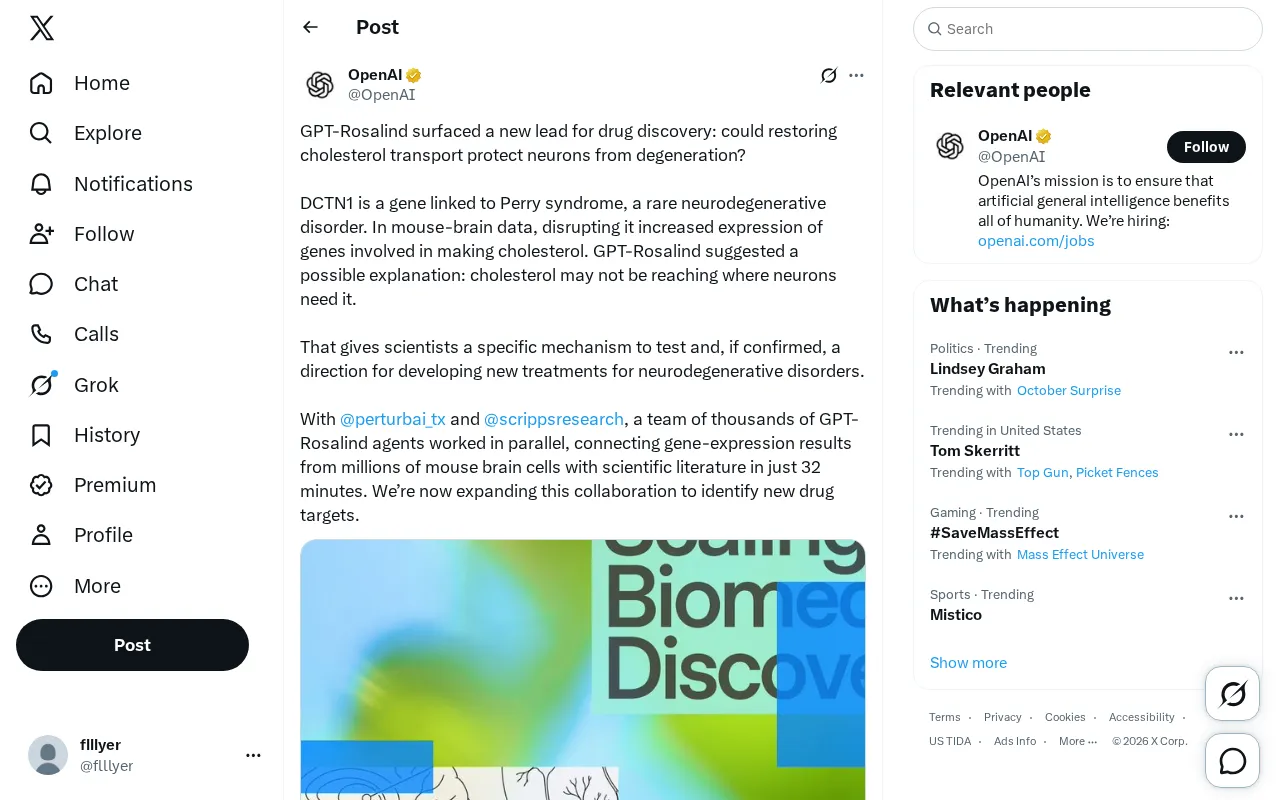
This hypothesis provides scientists with a clear, testable mechanism. If impaired cholesterol transport is indeed a driver of neurodegeneration, then restoring transport function could become a new therapeutic direction. According to an announcement on Twitter, GPT-Rosalind collaborated with PerturbAI and Scripps Research, with thousands of AI agents working in parallel to connect gene expression results from millions of mouse brain cells with scientific literature—all in just 32 minutes.
The DCTN1 gene encodes the p150glued subunit of the dynactin complex, a key cofactor for dynein-mediated retrograde transport along microtubules. DCTN1 mutations are known to cause Perry syndrome (an autosomal dominant early-onset parkinsonism) as well as neurodegenerative diseases such as amyotrophic lateral sclerosis (ALS). Its pathogenic mechanism is typically associated with axonal transport defects: neurons, especially motor neurons with long axons and substantia nigra dopaminergic neurons, are highly dependent on microtubule-mediated directional transport of organelles, mRNA, and lipids. Cholesterol, as an important component of cell membranes and myelin, is primarily synthesized in astrocytes and transported to neurons in the form of apolipoprotein E (ApoE) particles. Therefore, DCTN1 dysfunction may simultaneously affect axonal transport and neuronal cholesterol supply, providing a new connection point for understanding the pathological mechanism of Perry syndrome.
Thousands of Agents in Parallel: A New Paradigm for Drug Discovery
Traditionally, distilling hypotheses from gene expression data requires researchers to spend weeks or even months on literature comparison and logical reasoning. GPT-Rosalind's approach is to decompose the task among thousands of agents, allowing them to search, connect, and verify in parallel. Each agent may focus on different genes, pathways, or literature fragments, ultimately converging into a coherent mechanistic hypothesis.
The advantage of this "swarm intelligence" model lies in scale. The number of potential associations between data points from millions of cells and the vast literature is enormous—manual exhaustive search is nearly impossible. AI agents can cover these combinations in a short time and output prioritized hypotheses. The involvement of PerturbAI and Scripps Research ensures data quality and biological plausibility.
The thousands-of-agents-in-parallel architecture is an application of multi-agent systems. In such systems, each agent is typically assigned a specific role or search space (e.g., a particular gene set, pathway, or literature subset) and collaborates through shared memory or message-passing mechanisms. Compared to a single large model processing all data at once, parallel agents can divide and conquer the combinatorially explosive association space and reduce bias from a single reasoning path through redundant verification. In biomedical discovery, this pattern resembles "swarm hypothesis generation": multiple independent agents propose candidate associations, and an aggregation layer performs consistency ranking and priority filtering. Its advantages are scalability and coverage, but the challenge lies in ensuring knowledge consistency among agents and avoiding cascading errors.
Implications for Neurodegenerative Disease Research
The drug development failure rate for neurodegenerative diseases is extremely high, partly due to insufficient target validation. The cholesterol transport hypothesis proposed by GPT-Rosalind is valuable because it points to a specific, actionable biological process. If subsequent experiments confirm this mechanism, scientists can screen for small molecules or gene therapies that restore cholesterol transport, rather than blindly inhibiting cholesterol synthesis.
More broadly, this case demonstrates AI's potential in generating hypotheses rather than merely analyzing data. AI is no longer just a statistical tool but a research partner capable of asking "why." The OpenAI team says they are expanding this collaboration to identify new drug targets.
Limitations and Points to Be Validated
It should be clear that this is still a hypothesis. Gene expression changes in mouse brain data are only clues; whether impaired cholesterol transport directly causes neuronal death still requires validation through cell experiments and animal models. Moreover, the 32-minute metric only covers the data connection and hypothesis generation phase, not subsequent experimental validation. AI accelerates hypothesis generation, but the long cycle of drug discovery still depends on wet-lab experiments.
Regardless, GPT-Rosalind's attempt provides a new direction worth tracking for neurodegenerative disease research, and shows us that AI's practical role in basic biological discovery is shifting from assisting to driving.
One-line Summary
GPT-Rosalind used thousands of AI agents to propose a new cholesterol transport hypothesis from brain data in 32 minutes.
Paragraph Summary
OpenAI's GPT-Rosalind demonstrates a new paradigm in drug discovery: in collaboration with PerturbAI and Scripps Research, thousands of AI agents worked in parallel to mine a new hypothesis linking DCTN1 gene disruption to impaired cholesterol transport from gene expression data of millions of mouse brain cells in just 32 minutes. The hypothesis suggests that the problem in neurodegenerative diseases such as Perry syndrome may be that cholesterol cannot reach where neurons need it, rather than being overproduced, pointing to a testable therapeutic strategy of restoring transport. The article also notes that this is still a hypothesis requiring wet-lab validation, and the 32 minutes only covers data connection and hypothesis generation, but it marks AI's shift from a data analysis tool to a research partner in hypothesis generation.
Related articles

WebMCP Security Guide: Three Hints That Make AI Agents Safer
The Chrome team demonstrates three security hints for WebMCP tools: readOnlyHint eliminates invalid confirmation dialogs, consequentialHint forces human confirmation for high-risk operations, and untrustedContentHint defends against indirect prompt injection—improving AI agent security with one or two lines of code.

Why Turbulence Is the Hardest Problem in Fluid Mechanics — and How AI Could Crack It
Why is turbulence the hardest problem in fluid mechanics? This article, based on a Lex Fridman podcast conversation, explores turbulence's multi-scale nature, comparisons with classical thermodynamics, and how AI might simplify turbulence description by discovering coordinate transformations — examining the intersection of vortex formation with mathematics and physics.

R.L. Stine Google Talk: How the Master of Horror Ignites Kids' Passion for Reading
At a Google talk, R.L. Stine shares his accidental pivot from comedy to horror, his principles for children's horror, how phones impact storytelling, and how Goosebumps motivates kids to read.