Gradium Phonon Checkpoint GA Format Support: v0.40.9-rc3 Update Analysis

v0.40.9-rc3 switches Gradium Phonon checkpoints from prerelease to GA format, with version constraints and tests.
The open-source speech project v0.40.9-rc3 completes a format switch for Gradium Phonon checkpoints, replacing the prerelease path with the GA format. Changes include default voice import, speech conditioning adaptation, a 0.40.9 minimum version, documentation updates, and explicit rejection of old checkpoints. Tests cover import, inference setup, and old-checkpoint rejection, demonstrating a typical engineering path for handling upstream format changes.
Title
Gradium Phonon Checkpoint GA Format Support: v0.40.9-rc3 Update Analysis
Meta Description
An analysis of v0.40.9-rc3's GA format support for Gradium Phonon checkpoints: replacing the prerelease path, default voice import, speech conditioning, the 0.40.9 minimum version constraint, rejection of old checkpoints, and the migration impact on downstream users.
Article Content
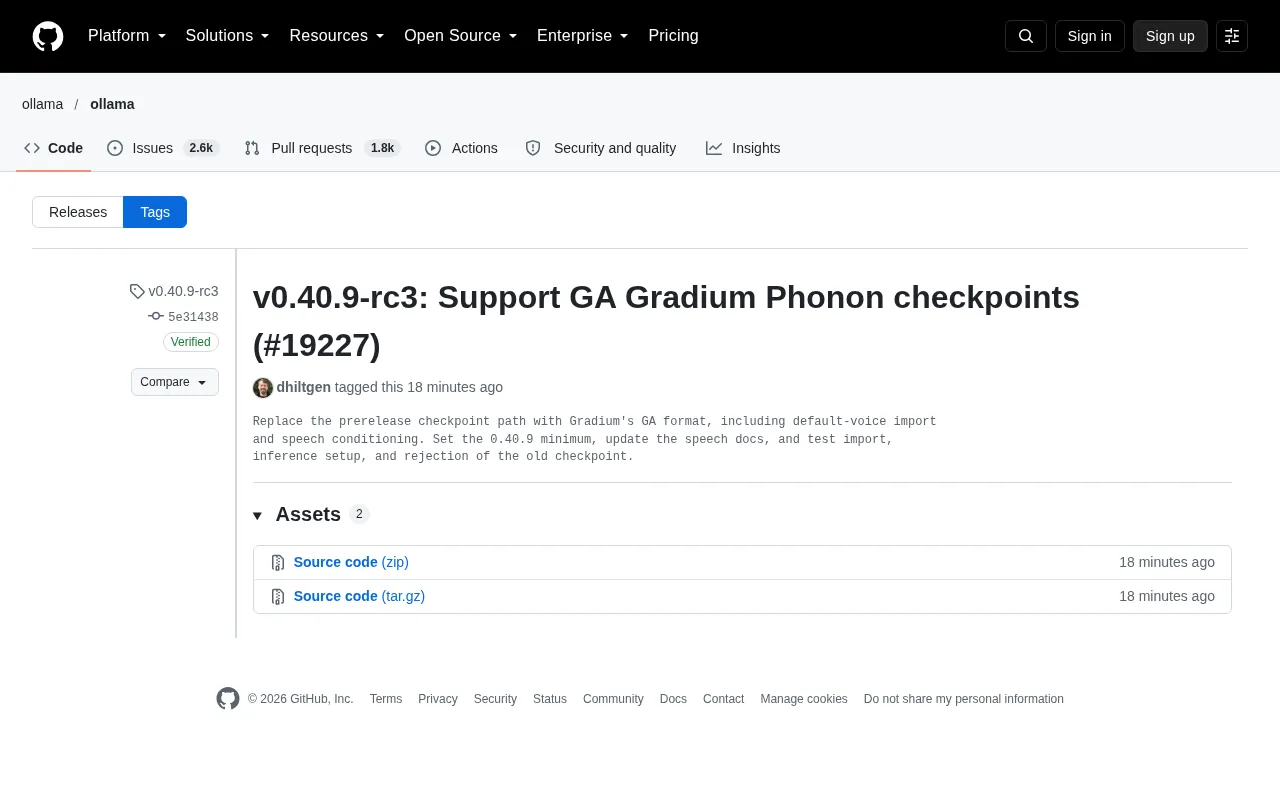
Open-source speech projects' version iterations often hide engineering decisions worth paying attention to. The v0.40.9-rc3 prerelease focuses on Gradium Phonon checkpoints and makes a format switch, replacing the original prerelease path with Gradium's GA (General Availability) format. Judging from the commit notes, this change is not just a path rename; it also involves default voice import, speech conditioning, a minimum version constraint, documentation updates, and rejection logic for old checkpoints.
From Pre-release to GA: What the Checkpoint Format Switch Means
The commit message (commit 5e31438, tagged by dhiltgen) clearly describes the scope of the change: replacing the prerelease checkpoint path with Gradium's GA format, while also including default voice import and speech conditioning. When a model checkpoint moves from prerelease to general availability, it usually means the upstream has converged on how weights are organized, metadata fields, and the loading interface—these changes propagate directly to downstream inference code.
Doing this kind of switch in a patch release (0.40.9) rather than a major version suggests the project considers the change gradual for users, but the action of "setting 0.40.9 as the minimum version" also requires environments using the new checkpoints to upgrade to that version or above, avoiding load failures caused by mixing old and new.
Model Checkpoint is a snapshot of weights saved during deep learning model training, typically containing model parameters, optimizer state, and metadata such as training configuration. In open-source projects, changes to checkpoint formats often involve adjustments to weight naming, tensor layout, serialization methods, or metadata fields. Prerelease checkpoints are often used for internal testing or early access, and their formats may not yet be stable; GA (General Availability) checkpoints, on the other hand, represent that the upstream has committed to a stable interface with complete documentation, suitable for production use. Therefore, switching from prerelease to GA format is not just a path change—it also means the loader needs to adapt to the new weight organization structure, bound information such as the default voice may be read from checkpoint metadata, and the input interface required for speech conditioning may also change accordingly. Downstream code must update its parsing logic in sync, otherwise weight loading failures or abnormal inference results will occur.
Three Explicitly Tested Scenarios
The commit notes list the validation scope: import, inference setup, and rejection of the old checkpoint. The three correspond to different failure modes.
- Import test: verifies that GA-format checkpoints can be parsed correctly and that the default voice is bound during the import stage.
- Inference setup test: confirms that speech conditioning takes effect during inference initialization, i.e., that conditional inputs can be correctly connected to the model.
- Old checkpoint rejection test: ensures that prerelease-era checkpoints are not silently accepted but instead produce a clear failure, reducing the chance that users waste time troubleshooting on the wrong format.
Actively testing "rejection of the old format" is an easily overlooked but very practical engineering habit: it exposes compatibility issues at the loading stage, rather than waiting until inference output is abnormal to discover them.
Speech Conditioning refers to injecting additional conditional information (such as speaker voice, emotion, speaking rate, or language identifier) as input into the model in speech synthesis or speech recognition tasks, in order to control the generated result. In the context of a checkpoint format switch, the conditioning mechanism may involve where conditional embeddings are stored, how input tensors are concatenated, or the parameter layout of the conditional encoder. The GA format may redefine the interface for conditional input, for example requiring condition vectors to be aligned along specific dimensions, or declaring condition types through new metadata fields. Therefore, inference setup tests need to verify that the conditioning logic can still be correctly initialized and take effect under the new checkpoint, ensuring that conditional inputs are correctly parsed and utilized by the model, and avoiding condition failure or degraded generation quality due to format mismatch.
Version Constraints and Documentation Sync
Beyond the code path, this change also includes "updating the speech documentation." If a checkpoint format change is not accompanied by documentation, users will almost certainly run into pitfalls—especially regarding how the default voice is imported and the configuration items for speech conditioning. Synchronously updating the documentation, together with the minimum version number constraint, forms a relatively complete migration guide: telling users what version they need, what format to switch to, and what will happen to the old format.
For downstream applications that depend on this project, a relatively safe approach is to write 0.40.9 as the lower bound in the dependency declaration, and then follow the documentation to go through the import and inference configuration process again.
Minimum version constraint is a common practice in software dependency management. By declaring the minimum version required by the project, it ensures that the user's environment has the necessary interfaces and functionality. In this case, setting 0.40.9 as the minimum version means that the code paths that use GA-format checkpoints (such as the new loader and the default voice import logic) exist only in that version and above. If users still use an older version, loading the new checkpoint will fail due to the lack of corresponding parsing code, or silently fall back to incompatible old logic. This constraint and "rejection of old checkpoints" form a two-way protection: the new version rejects the old format, and the old version cannot load the new format, thereby forcing users to upgrade and migrate, avoiding runtime errors caused by mixed use that are difficult to troubleshoot.
A Small but Complete Release Engineering Effort
Based on public information, the scope of this rc version's changes is focused on checkpoint format adaptation and does not spill over into unrelated modules. It demonstrates a typical path for an open-source project handling upstream format changes: replace the path, add import and conditioning logic, set a version floor, update documentation, and use tests to lock down the old/new boundary. For users, the two things most worth remembering are—upgrade to 0.40.9 or above, and migrate old checkpoints to the GA format as soon as possible.
One-line Summary
v0.40.9-rc3 switches Gradium Phonon checkpoints from the prerelease format to the GA format, with accompanying version constraints and tests.
Paragraph Summary
The open-source speech project v0.40.9-rc3 completes a format switch for Gradium Phonon checkpoints, replacing the original prerelease path with the GA (General Availability) format. The change involves not only path replacement but also default voice import, adaptation of speech conditioning logic, setting 0.40.9 as the minimum version requirement, updating the speech documentation, and explicitly rejecting old checkpoints. The commit notes list three test scenarios: import, inference setup, and old checkpoint rejection, respectively verifying new format parsing, conditioning taking effect, and compatibility boundaries. This patch release, with a relatively small change surface, demonstrates a typical engineering path for open-source projects handling upstream format changes: locking down the old/new boundary through version constraints and tests, and guiding users to upgrade and migrate.
Related articles

AI Comic Drama with WorkBuddy from Scratch: A Step-by-Step Skill Pack Installation Guide
Learn how to create AI comic dramas with WorkBuddy from scratch. This guide covers installation, Skill pack import and invocation, plus a script generation demo with manual revision tips to get you through the first step from script to storyboard.

WorkBuddy Agent Runs the Entire GEO Database Mining Pipeline with a Single Prompt
WorkBuddy agent automates GEO database mining: from data search and curation to batch correction, differential analysis, co-expression networks, feature gene screening, and immune infiltration—a single prompt generates a complete bioinformatics report, greatly lowering the barrier to bioinformatics analysis.

PC Memory Wasted? Hacker News Debates Centralized Data Centers
Hacker News users argue that personal computer memory is wasted and should be centralized in data centers, sparking debate on centralized vs. distributed computing resource allocation. This article analyzes the logic behind the claim, the costs of centralization, and new tensions in memory resource allocation in the AI era.