Growing Vegetables in Takeout Paper Bags: A Real-World Test with 24 Upcycled Containers

48 discarded takeout bags became 24 planters for a full vegetable garden — here's what actually grew.
Mark from Self-Sufficient Me double-layered 48 discarded Uber Eats takeout bags into 24 planting containers and grew over a dozen vegetable varieties — from spinach and tomatoes to potatoes and broccoli — testing whether you really need to spend money on pots to start a garden. Over roughly three months, he found that with quality potting mix, raised placement to deter pests, and regular liquid fertilizing, paper bags hold up surprisingly well for a full growing season. Salad crops like lettuce, arugula, and chicory were standout performers; tomatoes required dwarf varieties; fennel failed completely. When the bags finally decompose, they can be buried directly in the garden — turning takeout trash into organic food and then into soil amendment in a true zero-waste loop.
Takeout Bag Gardening: Brilliant Hack or Total Gimmick?
Mark from the Self-Sufficient Me channel ran a fascinating experiment with what most people would consider trash: he transformed 48 discarded food takeout paper bags into 24 double-layered planting containers, building a complete vegetable garden in the process. The idea came from two simple motivations — making the most of waste to save money, and showing beginners that you don't need to spend anything on fancy pots to start growing food.
Mark had previously grown potatoes successfully in paper bags, but had never attempted a full high-yield vegetable garden in takeout bags. This time he planted spinach, radishes, broccoli, onions, kale, coriander, cabbage, cauliflower, tomatoes, zucchini, lettuce, beetroot, carrots, potatoes, peas, and more — covering most of the vegetables you'd find at a supermarket.
Experiment Rules and Setup
To keep things comparable, Mark set a few ground rules: only real takeout paper bags collected from Uber Eats orders or supermarkets could be used; each bag had to be double-layered for added strength; all containers would use quality potting mix; and each bag would sit in a shallow tray to act as a small water reservoir.
Choosing the right potting mix was a key recommendation. Mark specifically warned beginners not to cut corners by using free fill dirt or regular garden soil, because container growing has completely different soil requirements from in-ground planting. Cheap soil almost always leads to poor results in pots. Since you're already saving money on the containers, investing in decent potting mix is well worth it.
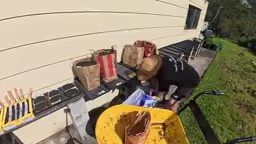
He also built a waist-height workstation from reclaimed floorboards and Besa bricks. Raising the planting surface not only saved his back, but more importantly created an effective barrier against slugs and snails. Damp paper bags sitting on the ground would be a perfect hiding spot for pests.
Seed Starting: Pizza Boxes Win, Burger Boxes Fail
Keeping with the reuse theme, Mark used discarded pizza boxes and burger boxes for seed starting — and the results were starkly different.
Pizza boxes performed excellently. The cardboard absorbed water and nutrients like a sponge, keeping seedlings moist without drying out. Burger boxes, however, were a disaster: likely due to waterlogging, seeds rotted rather than germinated, leaving him with no lettuce or zucchini and only two tomato seedlings.
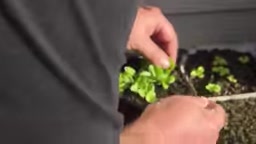
Undeterred, Mark replanted the burger boxes with fennel, chicory, lettuce, and arugula. Since salad crops grow so quickly, the second sowing still kept pace with the overall timeline, producing enough extra seedlings to fill four new bags and at least securing his salad supply.
Fertilizing and the Real-World Test of Paper Bag Durability
Around six weeks in, Mark noticed growth slowing across most containers — a clear sign of nutrient deficiency. Container growing, and paper bag growing in particular, has an inherent weakness: moisture escapes quickly, and nutrients get flushed down to the bottom of the bag away from the root zone. After applying liquid fertilizer, plants bounced back to normal growth within about a week.
This highlights a core consideration for anyone growing in paper bags or fabric grow bags: nutrients are depleted much faster than in conventional containers, so regular feeding is essential.
On durability, the double-layer design proved its worth. A single-layer bag would almost certainly split and leak. After three months, some rotting appeared at the base of the bags and a little potting mix leaked out, but the root balls remained firmly held together. Mark chose not to punch drainage holes in the bags, since the paper itself is permeable enough — adding holes would only create weak points and accelerate breakdown. The trays underneath effectively extended the time between waterings; on sunny days he watered roughly every two days.
Liquid fertilizer is particularly well-suited to thin-walled containers like paper bags because it penetrates directly to the active root zone with each watering, working far faster than slow-release granules. Common liquid fertilizer options include fish emulsion, seaweed liquid feed, or diluted balanced liquid fertilizer (around NPK 10-10-10), typically applied every 7–14 days. Because paper bags are highly breathable and drain quickly, soluble nutrients like nitrogen, phosphorus, and potassium are flushed out with every watering — the same challenge faced by fabric grow bags. Industry experience suggests container growing requires roughly twice the fertilizing frequency of in-ground planting. Pale, yellowing leaves and sluggish new growth are early signs of nitrogen deficiency; applying liquid fertilizer promptly usually shows visible improvement within a week.
Crop-by-Crop Results
Salad crops were the clear winners. Chicory, lettuce, and arugula thrived, continuing to produce new leaves after repeated harvests. Shallow-rooted, tolerant of some neglect, and fast-growing, they can be harvested within weeks — ideal for beginners and salad lovers alike.

Tomatoes require the right variety. Mark stressed that only micro, mini, or dwarf tomato varieties work in small containers like these. Indeterminate varieties are completely unsuitable, and even determinate varieties reaching four to five feet are not recommended.
Brassicas need space. Broccoli, cabbage, and cauliflower can only support one plant per bag. Mark admitted he initially planted three per bag intending to thin them down to the strongest. Kale, harvested frequently as a salad leaf, worked fine at three plants per bag.
Root vegetables — mixed results. Large daikon radishes grew too big and were overcrowded at three per bag — a mistake. Turnips were a surprising highlight, with two plants growing beautifully. Carrots were started in finer seed-raising mix in hopes of straighter roots. Beetroot was thinned after germinating in clusters. For potatoes, three 'Delaware' seed potatoes per bag produced a small harvest — enough for a family of four for one meal — and Mark suspects planting them deeper would improve yields.
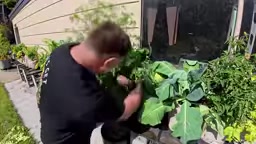
Fennel was a clear failure. It stalled and eventually died back. Mark suspects the timing was off or it simply doesn't suit the paper bag environment. Onions and some tomatoes were still ripening at the time of filming — which is entirely normal for any vegetable garden, where different crops mature at different times.
The distinction between determinate and indeterminate tomato growth habits is critical in container growing. Determinate varieties stop growing upward after setting a certain number of fruit clusters, typically reaching 60–120 cm in height and suiting smaller containers well. Indeterminate varieties, in theory, keep growing taller throughout the entire season, requiring extensive root space and structural support — in a container the size of a takeout bag, they're almost guaranteed to be stunted and low-yielding. The micro and dwarf/bush varieties Mark mentioned take this even further, with plants like 'Tiny Tim' and 'Tumbling Tom' staying under 45 cm tall with minimal root requirements, making them the top choice for balconies and small containers. Choosing the wrong variety is the most common — and hardest to recover from — mistake beginners make when growing tomatoes in containers.
Sustainability Is the Real Highlight
The experiment wasn't fully complete when Mark drew his conclusions, but they were already clear: most crops grew quite well in paper bags, especially salad greens. What makes this project genuinely compelling, though, is the closed-loop recycling logic — when the bags eventually decompose, they don't need to go to landfill. They can be buried directly in the garden as food for earthworms. Even the pizza boxes and burger boxes used for seed starting went straight into the compost.
For renters or apartment dwellers without a garden, the bags can go into the recycling bin. Going from a takeout package destined for the bin to organically grown food on the table is exactly the kind of value Mark believes matters right now.
This experiment proves that low-cost, zero-barrier home growing is entirely achievable. Choose good potting mix, stay on top of fertilizing, give the easy-win salad crops plenty of opportunities, and anyone can turn takeout packaging into fresh vegetables.
The compostability of paper bags comes down to the material itself. Food takeout paper bags are typically made from kraft paper, either uncoated or with only a thin plant-based coating, meaning soil microbes and earthworms can break them down into organic matter within weeks to months. This stands in sharp contrast to plastic or polypropylene grow bags, which can be reused for years but ultimately become solid waste. Burying a spent paper bag — along with its remaining root mass and potting mix — directly in the garden amounts to a small-scale "soil inoculation": the decomposing paper fibers provide carbon for earthworms, while the residual organic matter boosts soil humus, creating a genuinely zero-waste loop. For urban dwellers without garden access, kraft paper bags can go straight into a kitchen compost bin, breaking down at roughly the same rate as thick cardboard.
Related articles
Claude Code v2.1.316 Update Analysis: Enterprise Gateway and Multiple Stability Fixes
Claude Code v2.1.316 released: new enterprise gateway pooled group budgets, layered policy mode, subagent effort control, dozens of Shell, network, and session recovery fixes, and Opus 4.8 fast mode deprecated.

17th-Century British Floods and Doomsday Panic: A New Perspective on Weather History
Based on a Hacker News discussion of '17th-Century British Floods and Foreboding,' this piece explores how extreme weather was given divine and political significance, and what weather history teaches us about contemporary climate communication.

Salesforce Acquires Rune for $375M: AI Logistics Tech Bolsters Defense Business
Salesforce reportedly acquires defense tech startup Rune for $375M. Rune's AI logistics tech will strengthen Salesforce's Missionforce defense platform, continuing its M&A spree.