Hacker Reverse Engineers Samsung TV, Discovers On-Device AI Listening and OpenAI Account Ban

Hacker claims Samsung TV on-device AI listens in the background, and an OpenAI account ban sparks privacy and risk-control controversy.
A hacker posted on Hacker News claiming that reverse engineering Samsung smart TV firmware revealed an association between on-device AI components and the audio capture chain, suggesting audio may be processed locally and uploaded to the cloud beyond the wake word, with their associated OpenAI account banned during the exploration. The event quickly shifted from technical teardown to questions about vendor security policies and privacy boundaries. The article stresses the finding comes from a single source without cross-validation from firmware images, traffic captures, or official responses, and the community remains cautiously observant. It further analyzes the privacy dilemma of always-on smart TVs with microphones and offers practical advice for researchers, including isolated environments, separate accounts, complete evidence chains, and evidence-strength labeling, noting the core proposition that users have the right to know what AI hears and where data goes.
Event Origin: A Privacy Alarm Triggered by TV Reverse Engineering
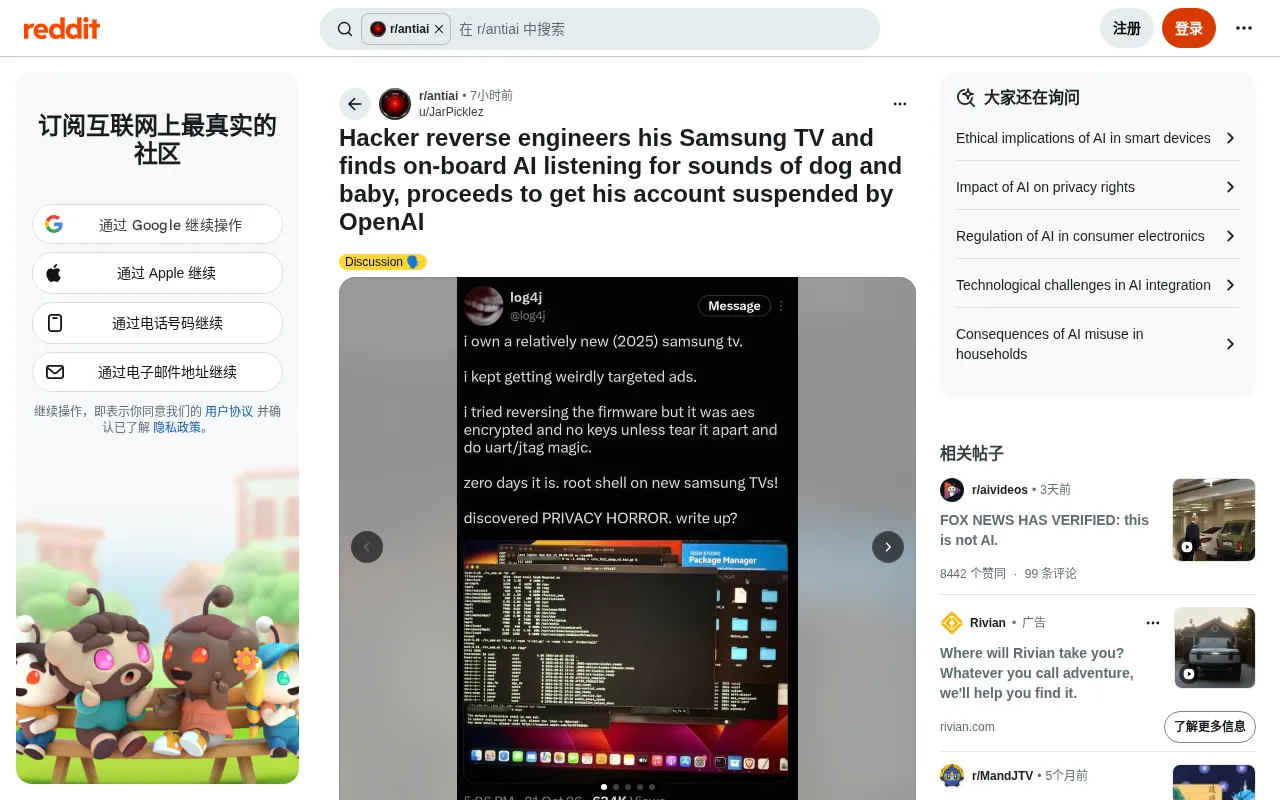
In a post that sparked discussion in the Hacker News community, a hacker conducted a reverse engineering analysis of a Samsung smart TV, claiming to have discovered a resident AI listening mechanism at the device firmware level. According to the post, the TV's built-in AI features do not work only after a wake word is triggered as officially advertised, but rather exhibit some form of background audio processing behavior. What drew even more attention from the community was that the OpenAI account associated with the hacker during the exploration was subsequently banned—a coincidence that quickly shifted the discussion from technical teardown to questions about vendor security policies and privacy boundaries.
It should be noted that this event currently consists only of a single-source post description, lacking cross-validation through firmware images, traffic captures, or official responses. The 53 points and 8 comments on Hacker News indicate the discussion is still in its early stages, with community reactions focused mainly on cautious observation and probing technical details rather than one-sided conclusions.
Technical Details Revealed by Reverse Analysis
On-Device AI and Audio Processing Path
According to the poster, the reverse engineering work focused on the TV's firmware and local service layers. The core finding is the presence of AI inference-related components on the device, and that these components are linked to the audio capture chain. Traditional smart TV voice assistants typically rely on wake word detection (such as a low-power DSP that continuously listens for specific keywords), but the hacker suggests Samsung's implementation may be more complex—audio data, after being processed by the local AI module, may be sent to the cloud for further analysis.
From an engineering perspective, always-on microphones in smart TVs are nothing new. The controversy lies in transparency and data flow: whether users are clearly informed about the scope of audio data processing, and where the boundary lies between local processing and cloud upload. The post does not provide a complete call stack or packet evidence, so this finding should be regarded as a technical lead awaiting verification rather than confirmed listening behavior.
Wake Word Detection is a common low-power always-on listening technology in smart speakers and TV voice assistants. Its typical implementation embeds a tiny neural network model (such as a keyword recognition model on the order of tens of KB) on a dedicated low-power DSP or coprocessor, which runs continuously at extremely low power and only performs local keyword matching on the audio stream (such as "Hi Bixby" or "Alexa"). When there is no match, the audio data does not leave the chip or enter the main processor. Only after a wake word is detected is the main SoC awakened and the full speech recognition and cloud upload process begins. Understanding this architecture is important because the core of the controversy is precisely: whether Samsung's implementation deviates from the industry convention that "audio does not leave the chip before the wake word," and whether the so-called "local AI module" expands the scope of audio data processing.
Chain Reactions from the OpenAI Account Ban
The poster mentioned that their OpenAI account was suspended during the exploration. This detail attracted attention because it suggests either that automated risk controls misjudged abnormal API calls, or that some linkage mechanism exists between the vendor and the AI service provider. Based on public information, OpenAI has a ban mechanism for accounts that violate usage policies, but this typically targets abuse, automated scraping, or prohibited content generation. Establishing a causal chain between TV reverse engineering and account banning is currently only the poster's speculation.
Some community comments suggest a more likely explanation is that abnormal requests generated during reverse engineering triggered risk control rules, rather than a targeted crackdown on research activity. Either way, this reminds researchers: when reverse engineering hardware involving networked AI services, use isolated environments and separate accounts to avoid personal accounts being accidentally affected by abnormal traffic.
API Risk Control and Abnormal Traffic Detection are common mechanisms used by cloud service providers to identify abusive behavior. Platforms like OpenAI score account request frequency, source IP, request patterns, concurrency, and other characteristics in real time. Once behavior deviates from normal usage baselines (for example, high-frequency calls from unfamiliar IPs in a short period, or request sequences with obvious automated script characteristics), automatic bans or rate limiting may be triggered. Such systems typically do not distinguish between "malicious attacks" and "good-faith research"—any abnormal behavior pattern may cause accidental impact. Therefore, if a personal account is reused to call cloud AI interfaces during hardware reverse engineering, being intercepted by risk controls is an expected technical consequence, not necessarily targeted retaliation against research activity. Using disposable accounts and isolated networks is the standard practice to avoid such misjudgments.
The Industry Dilemma of Smart TV Privacy
This incident is not an isolated case. Smart TVs, as devices that are always powered on in the home and equipped with microphones and cameras, have long been at the center of privacy controversies. From voice assistants accidentally waking up, to advertising tracking, to new data collection behaviors introduced by firmware updates, vendors have consistently struggled to balance feature innovation with users' right to be informed. Samsung has previously explained the collection and transmission of voice data in TV privacy policies in multiple markets, but the vagueness of policy text makes it difficult for ordinary users to judge actual behavior.
Reverse engineering plays a dual role in this context: it is both a means for security researchers to discover vulnerabilities and a practice that may touch the technical boundaries set by vendors. When researchers publicly disclose findings, vendors often face a dilemma—acknowledging the problem may trigger a trust crisis, while denying it may be refuted by further technical evidence. For users, the practical significance of such incidents is: they should proactively check TV privacy settings, disable unnecessary voice capture features, and pay attention to descriptions of data processing in firmware update logs.
Automatic Content Recognition (ACR) is a frequently overlooked but widely impactful technology in smart TV privacy controversies. ACR periodically captures screen images and extracts feature fingerprints, comparing them against a content database to identify what the user is watching, for targeted advertising and ratings measurement. Unlike voice capture, ACR collects screen content rather than sound, and is often disclosed in privacy policies with vague wording that users find hard to notice. This makes "what the TV is watching" and "what the TV is listening to" two parallel data collection chains. When discussing listening issues in smart TVs, only by considering audio chains together with visual/content chains such as ACR can the device's actual data collection surface be fully assessed.
Implications for Developers and Researchers
Judging from reactions in the technical community, the value of this incident lies not in its conclusions but in its methods. It demonstrates how firmware reverse engineering and network traffic observation can be used to examine the AI behavior of consumer electronic devices, while also exposing operational risks in the research process. For developers focused on AI hardware security, several points are worth noting: use dedicated networks and disposable accounts when reverse engineering networked devices; record and preserve complete traffic and log evidence to distinguish local processing from cloud transmission; and clearly label the strength of evidence when publicly disclosing findings, avoiding presenting speculation as fact.
At the vendor level, the design of smart TV AI features needs greater transparency. Local AI inference could inherently be a privacy-friendly solution—if audio data is indeed processed on-device and not uploaded, this would actually be worth promoting as a selling point. The problem is that current product communication often emphasizes features while avoiding data flows, leaving room for speculation and panic to grow. Whether or not this hacker's findings are ultimately confirmed, they point to the same industry proposition: when AI enters the living room, users have the right to know what it hears and where that data goes.
Evidence Strength Grading is the methodological basis for distinguishing "speculation" from "confirmation" in security research. The industry typically classifies findings into several levels: behavioral observation (such as traffic anomalies), component identification (such as discovering relevant binaries or services), call chain reconstruction (complete function calls and data flows), and reproducible end-to-end verification (packet captures proving data is actually transmitted externally). Labeling the level at which a finding sits when publishing publicly both protects researcher credibility and prevents the community from misreading leads as conclusions. The event in this article currently remains at the "component association" level, lacking packet capture and call stack evidence—this is precisely the fundamental reason the community remains cautiously observant, and also the premise in Responsible Disclosure processes that vendor communication should precede public disclosure.
One-line Summary
Hacker claims to have found on-device AI listening after reverse engineering a Samsung TV, and an OpenAI account ban sparks privacy and risk-control controversy.
Paragraph Summary
A hacker posted on Hacker News claiming that after reverse engineering Samsung smart TV firmware, they found an association between on-device AI components and the audio capture chain, suggesting audio may be processed by local AI and uploaded to the cloud beyond the wake word, and that their associated OpenAI account was banned during the exploration. The event quickly shifted from technical teardown to questions about vendor security policies and privacy boundaries. However, the article emphasizes that the finding is described by only a single source and lacks cross-validation through firmware images, traffic captures, or official responses, with community discussion focused mainly on probing details and cautious observation. The article further analyzes the long-standing privacy dilemma of smart TVs that are always powered on and equipped with microphones, and offers practical recommendations for researchers, including using isolated environments, separate accounts, preserving complete evidence chains, and labeling evidence strength. It points out that the core proposition is that users have the right to know what AI hears and where the data goes.
Related articles

LLM Application Development: A High-Paying Career Guide for Ordinary People
LLM application development offers fresh graduates up to 35K/month, with SP offers reaching 600K. This article explains the core skills, how to break in, and how ordinary people can seize AI opportunities through learning by doing.

Say Goodbye to AI Influencer Faces: A Complete Guide to Creating Visual Assets for AI Comic Dramas from Scratch
Bilibili creator shares a full workflow for zero-basics AI comic drama visual assets: use Doubao Work skills with script-first, visual references, and real-person texture to escape AI influencer faces, then lock character and scene consistency with asset sheet layouts, weapon detail images, scene nine-grids, and cinematic color palettes.

The AI Production Pipeline Behind Great Videos: From Research to Agent Validation
AI video production isn't just a model race. This article breaks down a transferable four-step pipeline: researching professional workflows, organizing a skill checklist, configuring agents, and experimental validation—and explains how general-purpose LLMs like DeepSeek can replace paid tools to run the entire process.