Hamster Wheel Powers Local AI: A Dark Comedy About Compute Energy Consumption

An absurd hamster-wheel-powered AI post reflects local AI's energy anxiety and self-sufficiency demands.
Starting from a Reddit post about powering local AI with hamster Wally's wheel, the article notes a hamster's milliwatt output can't drive watt-level inference hardware and the readings are likely jokey simulations. Yet the absurd setup hits a real pain point: consumer GPUs at full load can draw hundreds of watts, while data centers consume staggering power and cooling water. The post's calls for no cloud fees, rate limits, or queuing symbolize local deployment's pursuit of control and self-sufficiency. Quantization, distillation, and inference optimization are the real paths forward.
When a Hamster Becomes the AI's "Power Director"
A hilarious post appeared on Reddit: a user claimed to be powering a local AI model with his hamster Wally's exercise wheel, thereby completely eliminating dependence on data centers. According to the post, the model runs while Wally runs on the wheel; when Wally rests, inference tasks pause accordingly. The current speed reading shows 0.1, the energy reading is 1019, and the AI load is about 22%. The user admits this is "not fast by any normal standard," but the upside is being fully offline, consuming no grid electricity—just keeping the water bottle and seeds topped up.
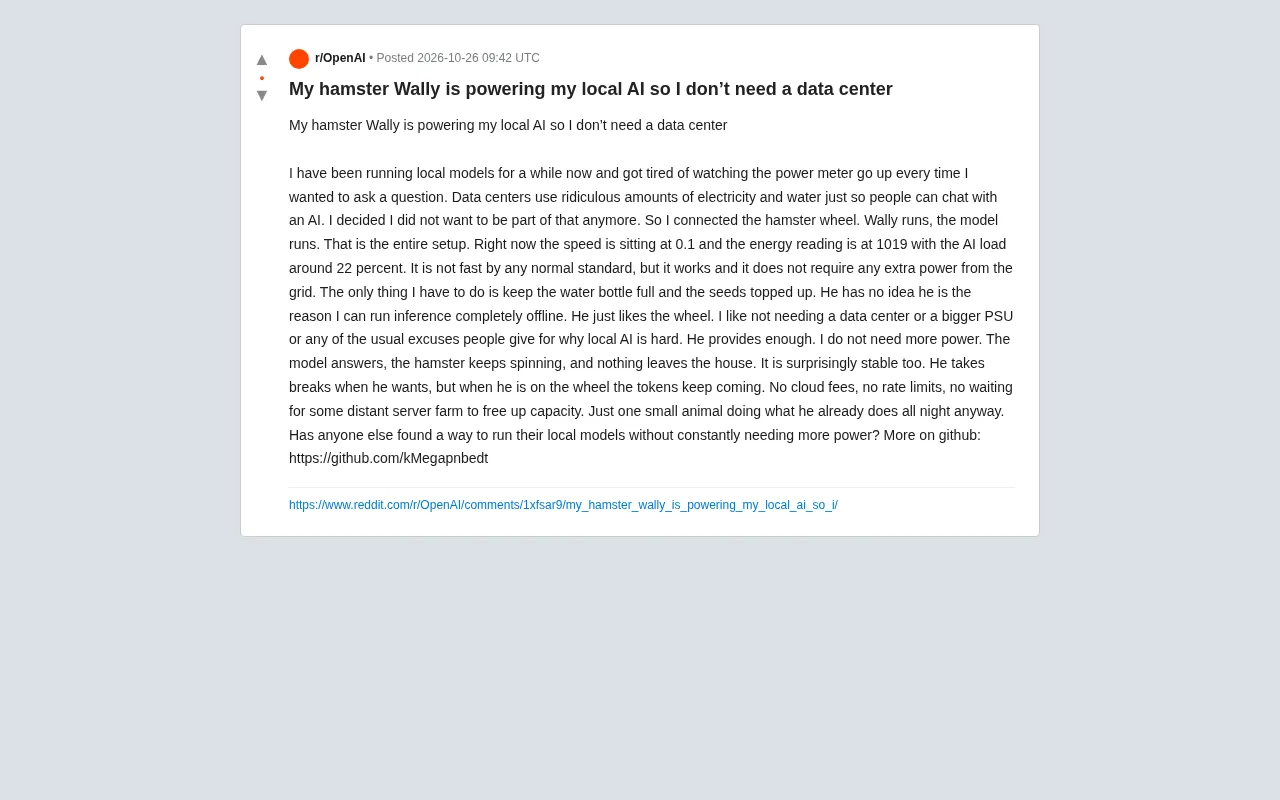
From a technical standpoint, a hamster's power output is on the order of milliwatts, while even a Raspberry Pi–class inference device needs several watts. The "speed 0.1" reading in the post is more likely some kind of simulated or jokey sensor mapping rather than real energy conversion. But the post drew attention precisely because it hits a real pain point in an absurdly extreme way: energy anxiety around local AI.
Where Does Local AI's "Electricity Bill Fear" Come From?
The post author mentions having run local models for some time, but feeling uncomfortable every time he asks a question and watches the meter numbers climb. This sentiment is not uncommon in the local AI community. LLM inference power consumption is directly tied to model size; consumer-grade GPUs running at full load can easily push whole-system power draw past several hundred watts, and long conversations or batch generation tasks make electricity bills visibly grow.
At the same time, energy consumption at the data center level is even more staggering. The post notes that data centers consume "an absurd amount of power and water" to support AI chat, a judgment that echoes ongoing industry discussion in recent years about the environmental costs of AI infrastructure. Cooling water, backup power losses, and the sustained high load of GPU clusters all make the hidden environmental cost of "one sentence with an AI" far exceed what ordinary users imagine. By comparing it to a hamster wheel, the author is essentially asking: do we really need to mobilize such massive infrastructure for every inference?
Model quantization refers to reducing the numerical precision of model weights and activations during inference or deployment (for example, converting common FP16/BF16 weights to INT8 or INT4), thereby reducing memory footprint, memory bandwidth requirements, and the amount of computation in matrix multiplication, usually with only minimal accuracy loss. For local deployment, quantization is one of the most direct engineering methods for lowering power consumption and hardware barriers: lower memory footprint means the same parameter-scale model can run on lower-power GPUs or unified-memory devices.
Knowledge distillation is when a small model (the student) learns the output distribution of a large model (the teacher) to approximate the large model's capabilities with fewer parameters. Unlike quantization, distillation changes the model architecture and parameter scale itself, thus enabling faster inference and lower per-generation energy consumption on consumer-grade hardware; it is often used to build chat models that can run on laptops or edge devices.
The Real Demands Behind the Absurd Solution
Setting aside the hamster's comedic effect, several details in the post are worth savoring. The author emphasizes "no need for a bigger power supply," "no cloud fees," "no rate limits," and "no waiting for remote servers to free up capacity"—these are precisely the core demands of local AI enthusiasts: controllable, offline, and free of subscription burdens. The "compute" Wally provides is negligible, but it symbolizes an ideal of self-sufficiency.
The post also mentions the system is "surprisingly stable": the hamster rests whenever it wants, but as long as it's running, tokens keep flowing. This description is clearly laced with anthropomorphic romanticism, but it also reflects another advantage of local deployment: no cloud service queuing or throttling, with response pacing entirely in your own hands. The author ends by asking the community: has anyone found a way to run local models without relying on constantly increasing power? That question itself is more worth discussing than the hamster wheel.
Cloud service rate limiting and quota queuing are a recurring source of pain cited by local AI enthusiasts. Commercial APIs typically limit calls by requests per minute, tokens per minute, or concurrency, and queue or degrade requests during peak periods; free or low-cost tiers may also trigger waits when capacity is insufficient. For users who frequently hold long conversations, generate in batches, or make experimental calls, these external constraints interrupt workflows and make cost and response time hard to predict. Local deployment returns control of inference pacing to the user, at the cost of upfront hardware investment and ongoing electricity bills.
Beyond the Joke: Real Solutions for Local AI Energy Consumption
Hamster power is of course not replicable, but directions for reducing local inference energy consumption do exist. Model quantization can substantially compress memory footprint and computation with almost no loss in quality; distilled small models let consumer-grade hardware produce usable conversation quality; and batch processing optimizations and memory reuse in inference frameworks reduce waste from redundant computation. These are the engineering paths truly worth attention beneath the post's joking shell.
As for the GitHub link included in the post, judging by the address format it looks more like a personal repository entry point and does not provide a reproducible hamster-power solution. It may be better to treat it as technical humor: while the entire industry discusses gigawatt-scale data centers and nuclear power supply agreements, someone uses a rodent's daily exercise to mock the absurdity of the compute arms race. Wally doesn't know it's running inference; it just likes the wheel—and that pure joy happens to be the gentlest rebuttal to the "more power, bigger clusters" narrative.
One-line Summary
An absurd post about a hamster wheel powering local AI reflects the energy anxiety and self-sufficiency demands of local AI.
Paragraph Summary
The article starts from a Reddit post claiming to power local AI with hamster Wally's exercise wheel, noting that a hamster's milliwatt-level output is far from enough to drive watt-level inference devices, and that the speed and energy readings in the post are more likely jokey simulated mappings. Yet this absurd setup precisely hits a real pain point in the local AI community: consumer-grade GPUs running inference at full load can draw hundreds of watts, making electricity bills visibly grow; at the data center level, power and cooling water consumption are even more staggering. The author analyzes the post's demands for "no cloud fees, no rate limits, no queuing" and sees them as symbolizing local deployment's pursuit of controllability and self-sufficiency. Beyond the joke, model quantization, knowledge distillation, and inference framework optimization are the realistic paths to lowering local inference energy consumption, and the hamster's pure joy is a gentle rebuttal to the compute arms race narrative.
Related articles

LLM Application Development: A High-Paying Career Guide for Ordinary People
LLM application development offers fresh graduates up to 35K/month, with SP offers reaching 600K. This article explains the core skills, how to break in, and how ordinary people can seize AI opportunities through learning by doing.

Say Goodbye to AI Influencer Faces: A Complete Guide to Creating Visual Assets for AI Comic Dramas from Scratch
Bilibili creator shares a full workflow for zero-basics AI comic drama visual assets: use Doubao Work skills with script-first, visual references, and real-person texture to escape AI influencer faces, then lock character and scene consistency with asset sheet layouts, weapon detail images, scene nine-grids, and cinematic color palettes.

The AI Production Pipeline Behind Great Videos: From Research to Agent Validation
AI video production isn't just a model race. This article breaks down a transferable four-step pipeline: researching professional workflows, organizing a skill checklist, configuring agents, and experimental validation—and explains how general-purpose LLMs like DeepSeek can replace paid tools to run the entire process.