Hands-On with a Research Simulation Agent: One Prompt Runs a Full NASA Airfoil Validation

A cloud host on a domestic network ran the full NACA 0012 airfoil CFD validation, with 8 hours of autonomous debugging.
The article documents how, on a domestic network, a single prompt let the CloscoScience research automation agent independently complete the full CFD validation of the NASA NACA 0012 airfoil. The platform uses an 8-core, 16 GB cloud host to bypass the three hurdles of overseas network access, account payment, and simulation environment, and its primary-secondary dual-model setup sustained a nearly 8-hour task using only 24% of context. The prompt defined only testable acceptance criteria (lift within 2% of CFL3D, mesh independence across three mesh sets); the agent autonomously handled mesh generation, debugging after the medium mesh diverged, the angle-of-attack sweep, and report delivery. Coarse-mesh lift deviation was on the order of one part in a thousand, while the SST model's deviation in predicting sudden stall was honestly recorded. The article frames its capability boundary accordingly: a junior researcher that can debug autonomously, not a system that replaces experts.
Overseas AI agents have already started provisioning their own computers—GrokBot can open a terminal and run programs, and code sandboxes everywhere are upgrading agent capabilities. But for researchers in China who want to use this stack, there are three hurdles: network access, account payment, and the simulation environment. Recently a research automation agent called CloscoScience claims to have sidestepped these problems. On a domestic network with a single cloud host, I wrote just one prompt and had it independently complete the entire CFD validation workflow for the NASA NACA 0012 airfoil. This article documents the whole process and the real capability boundaries it revealed.
Three Hurdles: The Real Friction of Doing AI Agents in China
Overseas agent tools are structurally unfriendly to research scenarios in China. First, the network: mainland China is not on OpenAI's official list of supported regions. Second, accounts and payment: an overseas phone number and credit card are hard requirements, and GrokBot additionally requires a SuperGrok subscription. Third, the environment: generic code sandboxes ship with no simulation software, and packages the agent installs itself may disappear after an update.
CloscoScience's answer is to make the execution environment a team-shared cloud host. This machine has 8 cores, 16 GB of RAM, and nearly 500 GB of disk; the system page shows Ubuntu 24.04 with more than 2,400 Python packages preinstalled, plus R and TeX. You can type commands directly into a terminal, access it over the domestic network, and no overseas account is needed. According to a demo in the original Bilibili video, you can register and claim a cloud host for testing.
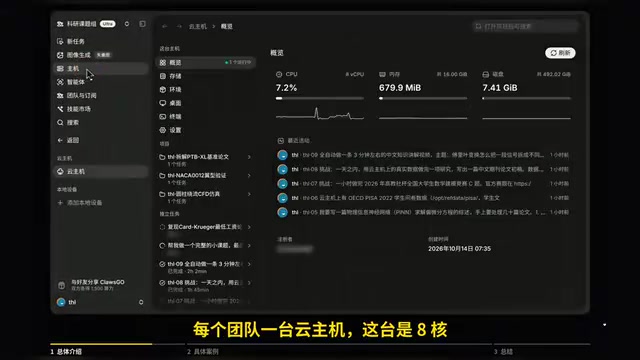
CFD (computational fluid dynamics) is the branch of study that numerically solves the governing equations of fluid flow (the Navier–Stokes equations), and it is widely used in aerospace, automotive, energy, and other fields. Its basic workflow includes geometry modeling, mesh generation, setting boundary conditions and solver parameters, numerical solution, and post-processing analysis. Mesh quality directly determines solver stability and accuracy: a coarse mesh converges easily but has low accuracy, while a fine mesh is accurate but may diverge due to numerical stiffness—which is exactly the technical root of the "medium-mesh divergence" discussed later. CFD validation typically requires comparison against wind-tunnel experimental data or the results of an authoritative solver (such as NASA's CFL3D) to confirm simulation credibility.
Turbulence models are a key approximation in CFD. Direct numerical simulation of turbulence across all scales is extremely expensive, so engineering practice commonly uses Reynolds-averaged (RANS) methods together with turbulence models to close the equations. The k-omega SST (shear stress transport) model combines the advantages of k-omega in the near-wall region with the stability of k-epsilon in the far field, making it a common choice for airfoil flow simulation. But RANS-type models are essentially statistical averages of turbulence and struggle to accurately capture unsteady phenomena such as large separation and abrupt stall—this is the fundamental reason the article notes that "the SST model cannot reproduce the sudden stall seen in the wind tunnel."
Mesh independence verification is a basic requirement for CFD result credibility: by progressively refining the mesh (e.g., coarse, medium, and fine sets), you observe whether key output quantities (such as the lift coefficient) converge. If the results change very little as the mesh is refined, the numerical solution is close to mesh-independent and the results are credible. The article writes "mesh independence verification across three mesh sets" into its acceptance criteria, precisely following this industry norm.
Model Configuration: A Primary-Secondary Dual-Model Setup, with Long Context Holding Up for 8 Hours
The model configuration on this cloud host uses a primary-secondary pattern. The primary model is Claude Opus 5.5, said to be Anthropic's latest flagship model, skilled at deep reasoning and complex tasks; the sub-agent follows the primary model with reasoning effort set to high. In the demo, the entire task ran for nearly 8 hours while context usage reached only 24%, enough to hold paper data, logs, and scripts.
That context usage rate is worth noting. CFD validation involves mesh files, solver logs, reference data, scripts, and reports; an 8-hour task consumed only a quarter of the context window, suggesting that the bottleneck for long tasks lies more in compute scheduling than in context capacity. The same cloud host, domestic network, no overseas account—once configured, that was the entirety of the compute for this validation.
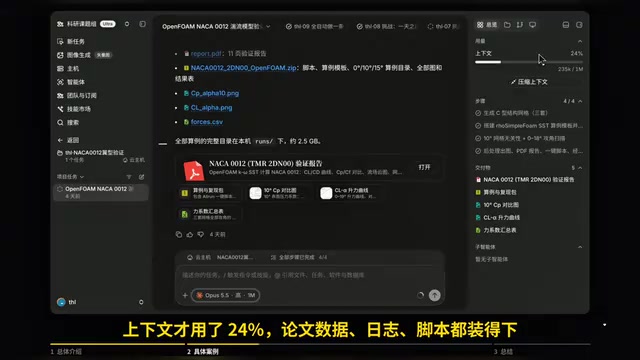
The context window refers to the total number of tokens a large model can hold in a single inference pass, covering the system prompt, conversation history, tool-call return results, and more. In long-horizon agent tasks, context grows rapidly as tool calls, log reads, and file contents accumulate; once it exceeds the window, truncation or summarization is required, which can cause the loss of key early information. The article notes that an 8-hour task used only 24% of the context, indicating that this configuration's window is large enough to hold the multimodal materials of the entire CFD validation process (mesh files, solver logs, reference data, scripts, reports)—the precondition for a long task to execute coherently without "losing its memory."
A primary-secondary dual-model architecture is a common division of labor in agent systems: the primary model handles overall planning, task decomposition, and key decisions, while sub-agents take on specific subtasks (such as executing commands or retrieving files) and report back to the primary model. This layered design both reduces the complexity of any single inference and makes cost control easier. Reasoning effort refers to how deeply the model reasons internally before generating a response; raising it usually improves success rates on complex tasks but consumes more compute and time.
Task Design: Writing Acceptance Criteria into the Prompt
The object of this validation was the NACA 0012 airfoil from NASA's turbulence modeling resources, at a Reynolds number of 6 million with the k-omega SST turbulence model; the airfoil coordinates and wind-tunnel data came from NASA's own CFL3D results, and 8 files were dropped in together.
The prompt stated only three things: what results were wanted, what to compare against, and what counted as done. The specific acceptance criteria included: lift within 2% of CFL3D, plus mesh independence verification across three mesh sets. Everything else the agent completed autonomously. This prompt design approach is worth borrowing—rather than writing operational steps for the agent, give it a testable objective function and let it find its own path through failure.
Process Review: Coarse Mesh Smooth, Medium Mesh Diverges and the Agent Debugs on Its Own
The agent first checked the airfoil coordinates, then generated three mesh sets using the same topology as NASA. The coarse mesh at 10 degrees angle of attack was computed first: lift 1.077 versus CFL3D's 1.0778, a deviation on the order of one part in a thousand.
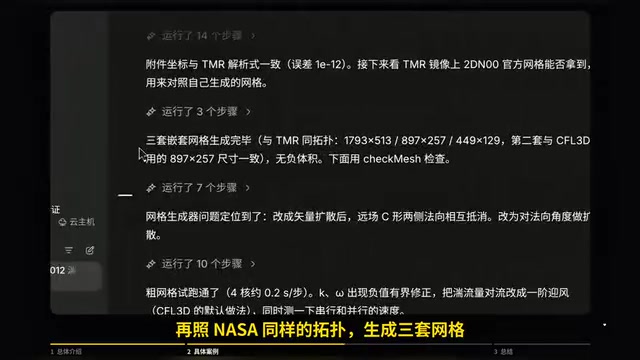
The medium mesh diverged right away. The agent investigated on its own: it first localized pressure oscillations above the airfoil surface, then switched numerical schemes, used an incompressible sphere case in air as a cross-check, and finally fixed the cold-start problem before the full angle-of-attack sweep could be queued up. It kept computing even after the browser was closed, finishing after nearly 8 hours and 197 steps, with all 6 acceptance criteria met.
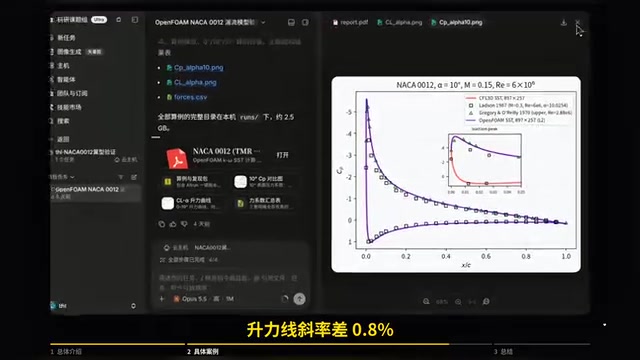
The deliverables included 5 files: a validation report, a reproducible compute package, comparison plots, and data tables. The lift curve essentially overlapped with the wind tunnel and CFL3D; the suction peak at 10 degrees differed by only 0.2%, and the lift-curve slope by 0.8%. The stall angle of 7 degrees matched the wind tunnel, but the maximum lift was noticeably lower. The agent wrote the reason in its report: the SST model cannot reproduce the sudden stall seen in the wind tunnel. It also recorded a few lessons for itself, such as how it would prioritize things next time it works on an airfoil.
Numerical schemes are the methods a CFD solver uses to discretize the convective term, such as first-order upwind, second-order upwind, and central differencing. Lower-order schemes are stable but have large numerical dissipation and low accuracy; higher-order schemes are accurate but prone to non-physical oscillations in shocks or high-gradient regions. The "pressure oscillations above the airfoil surface" described in the article are a typical manifestation of a higher-order scheme becoming unstable under specific mesh and flow conditions; the agent "switching numerical schemes" amounts to rebalancing stability against accuracy.
Cold start refers to a solver beginning iterations from an initial field (such as uniform inflow); when the initial field differs greatly from the final solution, early iterations may fluctuate violently or even diverge. Common mitigations include first obtaining a preliminary converged solution with a lower-order scheme or a smaller relaxation factor, then gradually switching to higher-order schemes and continuing to iterate from that solution as the initial field. The agent "fixing the cold-start problem" means it recognized that the divergence was not due to a mesh or physical setup error but to an inappropriate initialization strategy—a direction only an experienced CFD engineer would prioritize.
The stall angle is the turning point at which an airfoil's lift coefficient begins to drop after increasing with angle of attack up to a critical value. In wind-tunnel experiments, stall is often accompanied by rapid expansion of leading-edge separation and an abrupt drop in lift, whereas RANS turbulence models tend to predict a smoother stall process, leading to underestimated maximum lift and distorted post-stall behavior. This model limitation is a recognized industry difficulty, and the agent recorded it honestly in its report, demonstrating awareness of the boundaries of result credibility.
Capability Boundaries: It Can Debug Autonomously, but Physical Model Limitations Remain
The most informative part of this case is not "it finished" but how it handled failure. After the medium mesh diverged, it autonomously localized the pressure oscillations, switched schemes, ran a cross-check, and fixed the cold start—a genuine CFD debugging path, not a script replay. At the same time it honestly reported the SST model's stall-prediction deviation—showing that the agent's "acceptance" is not just about hitting numbers but also about explaining why certain metrics fall short.
The boundaries are clear too. Judgments such as numerical scheme selection and turbulence-model limitations still ultimately require review by domain experts; the agent's lessons learned are at the text level, and whether they transfer to the next airfoil has not been verified. It is more accurate to treat it as "a junior researcher who can independently run through a standard workflow" than as "a system that replaces experts."
Team Expansion: Existing Machines and a Skills Marketplace
Beyond this cloud host, the group's existing machines can also be connected: after registering a Fluent workstation or GPU cluster as an SSH server, the agent can log in directly during a task to run jobs; a personal computer can also be added to the team as a host. The skills marketplace has 860 skills, and installing one makes it available to the whole team. For a research group, this means you don't have to move all compute to the cloud—existing equipment can be brought into the same agent scheduling system.
Who Should Try It
Teams doing simulation work who already have standard validation cases on hand are worth spending a small amount of compute on a trial. Focus on observing two things: whether the agent can produce a reproducible debugging path after divergence, and whether the report it delivers includes honest explanations for metrics that fall short. These two points say more about whether it can truly enter a research workflow than "it ran successfully" does.
One-line Summary
On a domestic network, a cloud host ran the full NACA 0012 airfoil CFD validation workflow, with 8 hours of autonomous debugging.
Related articles

iPhone Duo Transformed into a Windows 98 Gaming PC: Hands-On Test and Experience
XDA tests turning the iPhone Duo foldable into a Windows 98 gaming PC using RetroArch and DOSBox Pure with virtual 3DFX, running Unreal Tournament, Half-Life, and Quake 3, plus Windows XP feasibility and limits.

Type-Safe Keep Rules in R8 and DEX Optimization in Practice
Google Play requires over 25% DEX optimization. This article explains the R8 configuration analyzer, Jetpack Keep type-safe annotations, and the Android CLI validation tool to help Android developers narrow keep rules, improve shrinking/optimization/obfuscation, and reduce ANRs.

Why Are Old Buildings More Beautiful Than New Ones? Pulitzer Prize-Winning Author Reveals an Overlooked Economic Truth
Pulitzer Prize-winning author Robert Caro found that poorer countries built more beautiful buildings. He reveals how cheap skilled craftsmen created the intricate details of old New York architecture, and how rising labor costs changed architectural aesthetics.