Hands-on with Claude: Practical Playbooks and Cost Control for Claude Code, Agents, and MCP
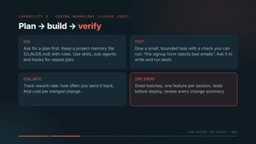
Breaking Claude's capabilities into testable, evaluable engineering steps—validate in small steps before opening up permissions.
Based on a hands-on Claude review on YouTube, this article focuses on three capabilities: coding workflows, agent development, and MCP integration, offering a four-step method of "use—test—evaluate—implement." The Claude Code section emphasizes proposing plans before touching code, using project memory files to lock in rules, and reusing constraints via skills/subagents/hooks, with rework rate and cost per production change as evaluation metrics. The agent section advocates building an eval set of twenty real cases first, then running full regression after every change. MCP is likened to the USB-C port for AI, and integration should start read-only with least privilege and separate keys. The article also lists five cost levers and three self-check questions, with the core attitude being "ask before you build."
Why This Round of Testing Matters
A hands-on Claude review from YouTube pulls the focus away from model benchmark scores and back to engineering execution. The content covers five capabilities, with emphasis on three major areas: coding workflows, agent development, and MCP integration, along with a four-step method of "use—test—evaluate—implement." The reviewer's core stance is clear: ask first before building, validate in small steps before scaling. This is the exact opposite of the common pitfalls enterprises hit when adopting AI today.
One detail worth noting: this methodology doesn't depend on any specific feature—it's built around "verifiability." Every capability introduced comes with a check you can run yourself, keeping AI's uncertainty within controllable bounds.
Claude Code: Templatizing the Coding Workflow
The first capability covered is the coding workflow, primarily executed directly within the code repository via Claude Code. The reviewer's practices are quite actionable:
- Have Claude propose a plan first, then touch the code—avoiding a large generated diff that's hard to review;
- Maintain a project memory file (Claude MD) with rules and tech stack written in, reducing the need to re-explain context each time;
- Use skills, subagents, and hooks for repetitive work—reusable instructions and automated checks that turn "a human watching" into repeatable constraints.
The testing phase emphasizes "small and bounded": start with a task that comes with a runnable check, such as "the registration form should reject invalid email addresses," then have Claude write tests and execute them. The evaluation phase focuses on two metrics—rework rate (how often work gets sent back) and the cost per actual production change. The implementation phase recommends incremental progress: one feature per session, test before every deploy, and always read the plain-English summary of changes.
"Read the summary" seems trivial but is actually the lowest-cost safeguard against the model "accidentally breaking something else." The larger the repository, the more valuable this habit becomes.
Claude Code is a command-line coding assistant from Anthropic that runs directly in the developer's terminal and code repository, able to read files, execute commands, run tests, and commit changes. Unlike the autocomplete mode of IDE plugins, Claude Code works as a "task-level agent": the user gives a goal, and it autonomously plans and executes multi-step operations. The Claude MD mentioned in the article is its project memory mechanism, typically named CLAUDE.md, placed in the repository root to record coding standards, tech stack, common commands, and other context. It loads automatically each session, avoiding the need to re-explain background. Skills are reusable instruction packages that encapsulate the steps and constraints of specific tasks into callable modules; subagents are sub-agents with independent context windows, suited for parallel handling of non-interfering subtasks; hooks are check scripts automatically triggered at specific events (such as before or after tool calls), used to enforce constraints like linting and testing. Together, these three turn "a human watching" into repeatable engineering constraints.
Agent Development: From Single Calls to Multi-Step Actions
An agent is defined as "a Claude that uses tools and acts across multiple steps." The review mentions that the Claude Agent SDK and Claude Code are driven by the same engine—just packaged for building custom agents. Anthropic also offers managed agents, where the platform handles the long-running runtime and its state.
On testing methodology, the reviewer suggests first building an evaluation set: twenty real cases, each with a clear definition of a good outcome, deliberately mixing in tricky and adversarial scenarios. Every time you change a prompt or tool, run the full set. Evaluation metrics include pass rate, steps per task, cost per task, and frequency of human intervention.
The implementation principles are equally restrained: start with a narrow task, require human approval for any irreversible operation, and log every action.
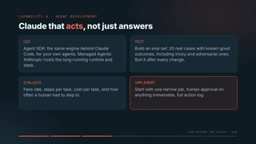
This order of "build the eval set first, then change prompts" contrasts with many teams that tune prompts first and add tests only after problems arise. An eval set is essentially an executable acceptance standard, and the dividing line for whether an agent can go to production.
Claude Agent SDK is a development toolkit from Anthropic that lets developers build agents with tool use and multi-step reasoning into their own applications. It uses the same underlying engine that drives Claude Code, just exposed as an SDK for custom tools, prompts, and runtime logic. Managed Agents is the platform-side solution for hosting long-running instances: developers don't need to maintain session state, tool execution environments, or persistent storage themselves—the platform handles the runtime lifecycle and state management, suited for production scenarios requiring long-running, cross-session context. The difference is like "self-hosted servers" versus "managed services": the former is flexible and controllable, the latter reduces operational burden. The eval set method emphasized in the article targets the uncertainty of multi-step agent actions—an error in a single call gets amplified across steps, so full regression testing with real case sets is needed, tracking pass rate, steps, cost, and human intervention rate.
MCP: The USB-C Port for AI
The reviewer describes MCP (Model Context Protocol) as "the USB-C port for AI": one standard to connect to Google Drive, Slack, GitHub, or databases, without custom integrations for each tool. There are already thousands of MCP servers, and other AI vendors are supporting the protocol as well.
The testing path is clear: first connect to a server in read-only mode and ask questions whose answers you can verify in the real application; once confirmed, enable write access, with writes requiring approval. During evaluation, ask three things—did it actually save copy-paste time, did it touch data it shouldn't have, and what data left the system at runtime. For implementation, stick to least privilege, connect only to trusted servers, and use separate keys for each integration.
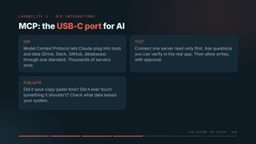
The reviewer also points out a bigger opportunity: build an MCP server for your own product so that others' AI assistants can call it. This opens your product's capabilities to the entire AI ecosystem—a path from "integrator" to "integrated."
MCP (Model Context Protocol) is an open-source protocol released by Anthropic in late 2024 to standardize connections between AI models and external tools and data sources. It uses a client-server architecture: AI applications act as clients, connecting to various MCP servers through a unified protocol, while servers encapsulate access to specific resources (such as Google Drive, Slack, GitHub, databases) and expose them to models as tools, resources, prompts, and more. Its value lies in eliminating the fragmentation of "one custom integration per tool," hence the USB-C analogy—connect once, use everywhere. MCP servers come in two types: local processes (stdio transport) and remote services (HTTP/SSE transport). The article's emphasis on read-only first, least privilege, and separate keys targets the risk that MCP servers may touch sensitive data: once write access is enabled, the model's multi-step actions could cause irreversible data changes, so permission boundaries must be explicitly designed.
Five Commonly Overlooked Cost Levers
Before implementing any capability, the reviewer lists five cost control points:
- Pick the right tier—use Haiku for sorting, tagging, and extraction tasks; only move to Opus when testing proves it necessary;
- Prompt caching—if every request starts with the same long instructions or documents, caching reuses them at a very low price;
- Batch processing—route non-urgent tasks through batch processing, which is cheaper and can return later;
- Shorten context—send only the relevant pages, not the entire knowledge base;
- Price per task, not per token—cost per task is the basis for pricing your product.

What these five share is shifting cost from "model unit price" to "engineering choices." Most cost waste doesn't come from unit price but from using entire knowledge bases and the strongest models in scenarios that don't need them.
Prompt Caching is a capability of the Anthropic API: when a request starts with the same long prefix (such as system instructions, documents, examples), caching can dramatically reduce the processing cost of that portion, typically billed at a fraction of the standard input price, and significantly reduce latency. It requires the prefix to be exactly identical and sufficiently long, so engineering-wise you should put stable, unchanging content at the front of the prompt and variable content at the back. Batch API allows non-urgent requests to be submitted in packages and processed asynchronously at a lower unit price, suited for offline tagging, bulk extraction, and similar scenarios. Together with "pick the right model tier," "shorten context," and "price per task," these form the core of cost engineering: shifting cost from uncontrollable model unit prices to controllable request structure and scheduling strategy. Understanding the billing prerequisites of these mechanisms is essential to judging which optimizations actually apply in real integrations.
Three Self-Check Questions
The review closes with three quick self-checks:
- How do you catch Claude fabricating content in a long document? Have it restate information you know doesn't exist, and require verbatim citations for the rest;
- What's the fastest way to tell if a spec is complete? Hand it to a fresh session and count how many clarifying questions it needs to ask;
- What's the first rule for connecting an MCP server? Read-only first, least privilege, trusted servers only.
These three questions map to hallucination checking, spec acceptance, and security boundaries—a condensed version of the methodology. The reviewer's parting words are "ask before you build"—before implementing, get the plan, boundaries, and acceptance criteria clear.
Summary
The value of this review isn't in listing features but in breaking Claude's capabilities into engineering steps that are testable, evaluable, and convergent. Claude Code addresses the controllability of the coding workflow, the Agent SDK and managed agents address the scalability of multi-step actions, MCP addresses the standardization of tool integration, and the five cost levers address sustainability. For teams preparing to bring AI into production workflows, this order of "validate in small steps first, then gradually open up permissions" is more worth copying than any single trick.
Related articles
 Tech Frontiers
Edge AI on Microcontrollers: When Is It Actually Worth Deploying?
Drawing on Reddit discussions and Arm case studies, this article analyzes the real-world use cases for edge AI on microcontrollers: when each device needs independent inference, when a gateway or cloud is more reasonable, and the costs and boundaries of specialized hardware.
 Tech Frontiers
Pushing the Limits of Extreme Sudoku on a 16GB GPU: Insights from Depth and Flow Matching
A researcher trained a 16.54M-parameter model on a 16GB GPU to solve extreme Sudoku, finding effective depth breaks the 60% plateau and flow matching with improved sampling pushes accuracy past 99% with ~50× lower layer-evaluation budget.
 Tech Frontiers
AI Agent Approval Workflows: Why Human Confirmations Always Get Mindlessly Clicked
Why do AI agent approval workflows always get mindlessly clicked? A Reddit discussion shows that separating rules from keys, low-frequency high-risk approvals, and GitHub Environments-style gates are the keys to effective approvals.