Harness²: Letting AI Agents Self-Evolve Their Exoskeleton So Weak Models Outperform Strong Ones

Google Research and Northwestern propose Harness², letting agents self-evolve their harness so weak models beat strong ones.
The article introduces Harness², a research project from Google Research and Northwestern University. AI agents currently rely on pre-built harnesses—fixed frameworks governing tool calls, instruction organization, and execution loops—that are hard to customize per task. Harness² lets agents build and evolve their own harness on the fly via two-level recursion: Level 1 adjusts tools and instructions for the current task in real time, while Level 2 learns at the meta level how to better build harnesses for future tasks. Its most striking finding: a smaller, weaker model with a self-evolving harness outperforms a stronger frontier model on a default harness, showing harness adaptability matters as much as or more than model scale. Still exploratory, it offers a new paradigm for agent design.
Introduction: The Limits of Pre-Built Harnesses
Today, almost every AI agent relies on a pre-built "harness"—a framework that determines which tools it can call, how it organizes instructions, and how it controls the execution loop. But the problem is straightforward: pre-built harnesses must be one-size-fits-all and cannot be tailored to each task. According to the YouTube video "Harness² Explained in 60 Seconds," a new project called Harness² from Google Research in collaboration with Northwestern University proposes a bold idea: when you hand an agent a task, could it build and evolve its own harness on the fly?
The core of this idea is "self-evolution"—the agent is no longer constrained by a preset framework but can rewrite its own instructions, create new tools, and even modify the control loop while working. If this idea holds, the adaptability and efficiency of agents would undergo a qualitative transformation.
What is an AI agent's "harness"
In the context of AI agents, a harness refers to the entire engineering scaffolding that wraps around a base large model. It contains at least four types of components: first, tool interfaces—the functions, APIs, or external services the model can call; second, prompt and instruction templates that determine how the model understands tasks and constraints; third, the execution loop (control loop), which specifies when the model thinks, acts, and stops; and fourth, memory and state management, used to store intermediate results and cross-turn context. Common implementations include the ReAct loop, LangChain AgentExecutor, and OpenAI's function calling wrappers. Pre-built harnesses are designed once by engineers and are universal across all tasks, making fine-grained adaptation to specific tasks difficult—this is exactly the limitation Harness² seeks to break.
Harness²'s Two-Level Recursive Mechanism
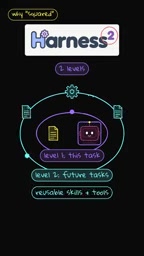
Harness²'s implementation relies on two levels of recursion. Level 1 evolves the harness in real time for the current task: the agent continuously adjusts its toolset and instructions during execution to better match task requirements. Level 2 evolves the way the system builds harnesses for future tasks—that is, the system not only solves the immediate problem but also learns how to design future harnesses more intelligently.

This two-level design allows the agent to both "improvise on the spot" and "accumulate experience." The video notes that Level 2 recursion means the system learns at the meta level, thereby improving long-term task adaptability.
What meta-learning and two-level recursion mean
What Level 2 describes—"evolving the way future harnesses are built"—is essentially meta-learning: learning "how to learn." In standard machine learning, a model learns a task mapping; in meta-learning, the system learns the learning algorithm itself or the initialization parameters, so that it can quickly adapt to new tasks with only minor adjustments. Harness² elevates this idea from the parameter level to the engineering architecture level: Level 1 is like an inner loop that adjusts the harness for the current task; Level 2 is like an outer loop that improves "the strategy for designing harnesses" based on experience from multiple tasks. This inner-outer two-level structure draws on the idea of recursive self-improvement, enabling the system to both adapt in the moment and accumulate cross-task meta-knowledge about "how to build a suitable harness."
Key Finding: Weak Model + Self-Evolving Harness Beats Strong Model
The project's most striking finding is that a smaller, weaker model, empowered by a self-evolving harness, completely surpasses a stronger frontier model running on a default pre-built harness. This result overturns the intuition that "model scale determines everything" and shows that the adaptability of the harness is as important as model capability—and in some scenarios even more critical.
The video calls this finding "wild" because it implies a paradigm shift in AI agent design: rather than single-mindedly pursuing larger models, it is better to let models learn to build a well-fitting "harness" for themselves.
Context on frontier models and benchmark comparisons
The "frontier models" mentioned in the article usually refer to the current batch of most capable closed-source large models, such as the GPT-4 series, Claude 3.5/4 series, or Gemini Ultra. They have large parameter counts and high training costs. "Smaller, weaker models" generally refer to open-source or lightweight models with one to two orders of magnitude fewer parameters. In standard evaluations, weak models usually lag significantly on tasks such as reasoning and tool-calling accuracy. Harness²'s experiment is called "wild" because it shifts the variable of comparison from "the model itself" to "the composite system of model plus harness": by having a weak model automatically generate more fitting instructions, tools, and loop logic for the task, it compensates for the model's capability gaps. This result echoes the "scaffolding effect"—appropriate external structure can significantly amplify the actual performance of limited compute.
Significance and Outlook
Harness² is still a research project, but its approach offers a new direction for the development of AI agents. Self-evolving harnesses could make agents more robust on complex, changing tasks while reducing dependence on model scale. According to the video description, the project's two-level recursive mechanism and the result of a weak model overtaking a strong one have already drawn attention from the research community.
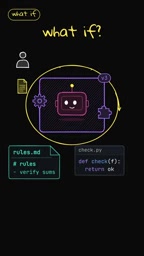
In the future, if agents can truly achieve real-time self-evolution, we may see more flexible and efficient AI assistants that no longer require engineers to pre-design every tool and instruction, but can instead grow autonomously while working.
Related articles

Fifty Years Studying Power: Robert Caro's Writing and Insights on Power
Robert Caro reflects on 50 years studying power: Lyndon Johnson's persuasion and leverage, Robert Moses's transformation from idealist to ruthless builder, the dilemmas of large-scale construction, and his methods of compressing themes and solitary focus in biography writing.

Can a $20,000 Robot Do Your Chores? The Test Results Are Surprising
A YouTube test video shows how a $20,000 robot responds to commands like washing dishes, turning off lights, taking out trash, and feeding the dog. This article analyzes its real capability boundaries, the state of voice interaction technology, and how far household robots are from mainstream adoption.
The Complete Guide to Running AI Models Locally: Inference Engines and Tool Stack Explained
A systematic breakdown of the complete local LLM tool stack: from PyTorch and GGML compute libraries to llama.cpp, vLLM, SGLang inference engines and Ollama, LM Studio wrapper layers, with benchmark data on performance differences and selection logic.