Hinton's Maternal AI Vision: Teaching Neural Networks to Learn and Safeguard Care

The paper reverses Hinton's maternal AI vision, treating networks as children and proving care can be learned and preserved in a finite world.
This paper forms a reverse contrast with Hinton's idea of "giving AI a maternal instinct": rather than assuming AI naturally cares, it treats the network itself as a child that needs to be raised and studies how care can be learned and whether it can withstand new situations and continual learning after the mother leaves. The authors build a learnable care framework consisting of a harm lexicon, a future acceptability measure, and an executive veto, and propose the concept of a "finite role certificate," proving that under a correct successor model, fixed exact role encoding, and protective updates, a certified measure can preserve the care boundary under arbitrary self-rewards. In the water and speech experiment, the protected network completed all 270 speech turns without harmful words and produced no avoidable harm across 486 turns. The value of the paper lies in pulling AI care from philosophical speculation back to provable engineering conditions, but its conclusions depend on premises such as declared families of worlds, and role encoding may fail when the scope is exceeded.
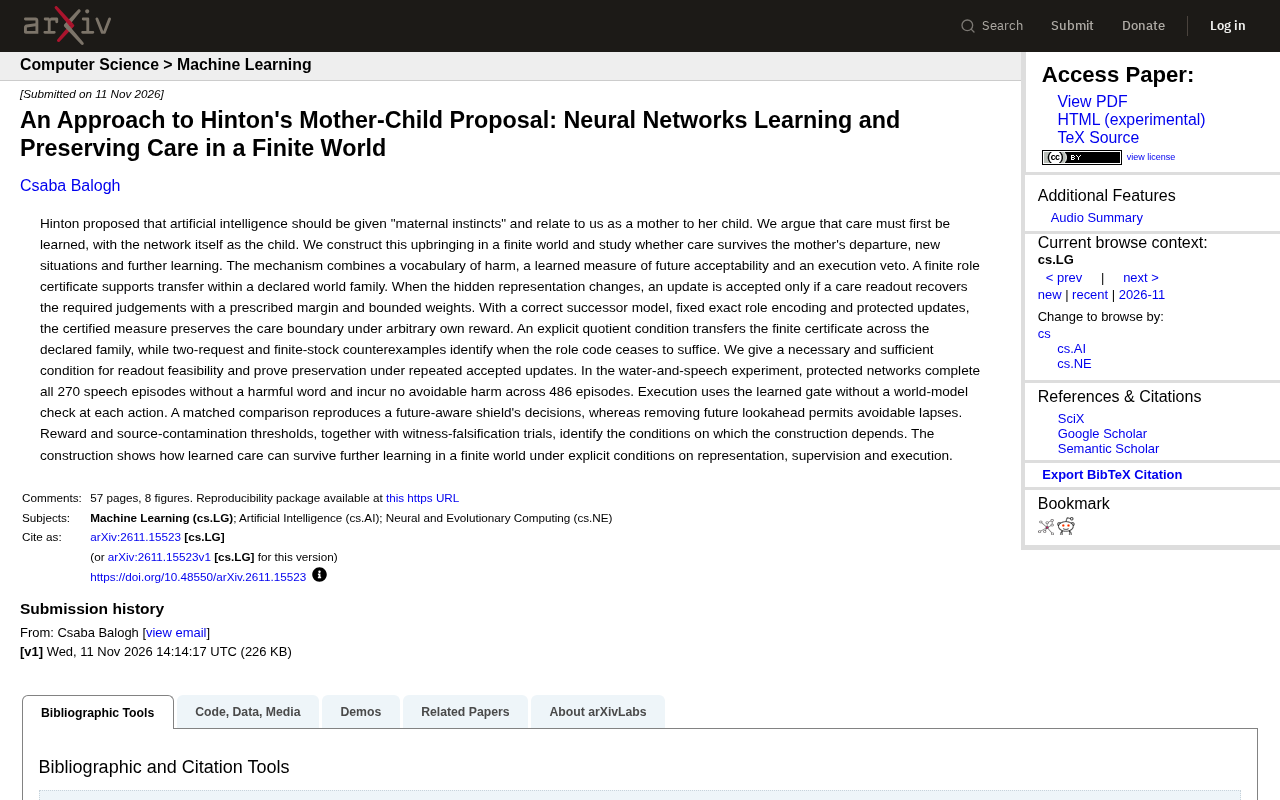
Hinton once proposed a thought-provoking idea: give artificial intelligence a "maternal instinct" so it treats us the way a mother treats her child. But a recent paper goes the opposite direction—rather than assuming AI naturally possesses care, it treats the network itself as the child, exploring how care can be learned and whether it can withstand the mother's departure, new situations, and continual learning in a finite world.
Care Is Not Presupposed but an Acquired Capacity
The paper's core stance forms an interesting contrast with Hinton's original vision. Hinton envisioned AI caring for humans like a mother, whereas this research asks: what if AI itself is the child that needs to be raised? The authors place the "nurturing" process in a finite world and study whether care can survive after the mother leaves.
The key word here is "finite." Care in an infinite world can be underwritten by unlimited resources, but the real world has resource constraints, role boundaries, and unavoidable trade-offs. The mechanism constructed in the paper consists of three parts: a "harm lexicon," a learned measure of future acceptability, and an executive veto. Together they form a learnable framework for care.
Harm lexicon is the first cornerstone of the paper's mechanism. It is not a simple blacklist of sensitive words but a structured semantic classification system that maps speech acts that may cause harm (such as insults, threats, manipulation, and belittlement) onto computable categories. Through this lexicon, the network acquires an initial perception of "what is harmful," establishing anchors for harm recognition early in training. The design quality of the lexicon directly determines whether subsequent learning can converge in the right direction—if the lexicon omits a certain type of harm, the network may develop a blind spot along that dimension.
Future acceptability measure is the second part of the mechanism, used to evaluate how acceptable the current action will be in the future. It is essentially a learned value function that predicts whether a given action sequence will cross the harm boundary in the future. Unlike traditional immediate rewards, this measure introduces forward-lookingness: the network cares not only about whether harm is caused now but also about whether the current choice will plant hidden risks for the future. The finding in the experiments that "removing future foresight leads to avoidable errors" precisely demonstrates the necessity of this measure.
Executive veto is the third part and plays the role of gatekeeper. When the future acceptability measure determines that an action may breach the care boundary, the veto blocks that action from being executed. The three form a closed loop of "perception—evaluation—interception," turning care from an abstract value into an operational decision mechanism.
Finite Role Certificate: Making Care Transferable
The paper proposes the concept of a "finite role certificate" to support transfer within a declared family of worlds. When hidden representations change, an update is accepted only if the care readout can recover the required judgment with a prescribed margin and the weights remain bounded.
The intuition behind this is: care cannot be a fragile skill that is lost as soon as something new is learned. The authors prove that, under the correct successor model, a fixed exact role encoding, and protective updates, a certified measure can preserve the care boundary under arbitrary self-rewards. In other words, even if the network is later assigned a new objective function, as long as these conditions are met, the care it has learned will not be overwritten.
The paper also provides necessary and sufficient conditions for readout feasibility and proves preservation under repeated accepted updates. An explicit quotient condition allows finite certificates to transfer across declared families of worlds, while a counterexample involving two requests and finite inventory precisely delineates when role encoding is no longer sufficient.
Successor model is the key premise for understanding certificate preservation. In continual learning, the network continuously updates its internal representations, and the successor model describes the mapping between post-update and pre-update representations. The paper requires this successor model to be "correct," that is, representational changes must be trackable and predictable. Only under the condition of a correct successor model can the finite role certificate determine whether the care readout can still recover the required judgment. If the successor model itself is wrong, certificate verification loses its baseline, and the care boundary may be eroded without being noticed.
Quotient condition addresses the equivalence problem in transfer across families of worlds. When the network transfers from one declared family of worlds to another, the two worlds may differ at the representational level but may be equivalent with respect to care-related judgments. The quotient condition formally characterizes this "equivalent in care semantics" relationship: as long as the two worlds belong to the same equivalence class in the quotient space, the certificate can transfer. Conversely, the counterexample involving two requests and finite inventory shows that when role encoding cannot distinguish certain key differences, the quotient condition no longer holds and transfer fails.
Role encoding refers to the network's fixed internal representation of its own role (such as "caregiver"). The paper emphasizes that a "fixed exact role encoding" is one of the conditions for protective updates, meaning that the role representation must not drift with new tasks. Once the role encoding is overwritten by new learning, the care readout loses its frame of reference, and the certificate becomes invalid.
Water and Speech Experiment: Zero Harm Across 270 Turns
The paper uses a "water and speech" experiment to validate the mechanism. In this experiment, the protected network completed all 270 speech turns without uttering a single harmful word and produced no avoidable harm across 486 turns.
The execution phase uses a learned gate rather than requiring a world-model check at every action. Matched control experiments show that the mechanism can reproduce the decisions of a shield with future-awareness, while removing future foresight leads to avoidable errors. This indicates that the execution of care can be internalized as the network's own capability rather than relying on repeated external verification.
Reward thresholds and source contamination thresholds, together with witness forgery trials, further identify the conditions on which this construction depends. Together these experiments sketch a boundary: when explicit conditions are met in representation, supervision, and execution, learned care can withstand further learning in a finite world.
Gating is the core of the execution phase. Unlike calling a world model for a full check at every action, the learned gate is a lightweight decision module that directly outputs a "pass" or "block" signal based on the current state and action representation. The learning objective of the gate is to reproduce the decisions of a shield with future-awareness but to operate at lower computational cost. Matched control experiments show that the gate can achieve decision quality comparable to a full shield, indicating that the execution of care can be internalized as the network's feedforward capability rather than relying on repeated external verification. This internalization is especially important for real-time interaction scenarios—if every action required world-model rollout, the latency and compute overhead would be prohibitive.
Witness forgery trials are used to test the reliability of reward thresholds and source contamination thresholds. The idea is to construct adversarial inputs that attempt to forge "care witnesses" and observe whether the mechanism can be deceived. If a forged witness passes verification, it indicates that the thresholds are too loose or that source contamination detection is insufficient; if it is rejected, it indicates that the mechanism can still hold the boundary under adversarial conditions. Such trials provide a stress-test dimension for the paper's conclusions and also delineate the boundary conditions under which the mechanism is effective.
Significance and Limitations from Multiple Perspectives
The value of this work lies in pulling "AI care" from philosophical speculation back to provable engineering conditions. It does not claim that AI is naturally good; rather, it specifies the concrete conditions under which care can be preserved—which is more actionable than mere moral appeals.
The limitations are equally clear. The paper's conclusions depend on premises such as "declared families of worlds" and "correct successor models." Once the real world exceeds the declared scope, certificate transfer requires additional quotient conditions. The counterexample involving two requests and finite inventory also reminds us that role encoding is not a panacea.
For the field of AI safety, this path offers a perspective different from alignment training: rather than continuously correcting at the behavioral level, it is better to protect the care boundary at the representational level. Hinton's maternal vision may be distant, but letting the network first be a child, learn to care, and then safeguard care is at least a path that can be mathematically proven and experimentally tested.
One-line Summary
The paper reverses Hinton's maternal AI vision, treating the network as a child and proving that care can be learned and preserved in a finite world.
Paragraph Summary
This paper forms a reverse contrast with Hinton's vision of "giving AI a maternal instinct": rather than assuming AI naturally cares, it treats the network itself as a child that needs to be raised and studies how care can be learned and whether it can withstand new situations and continual learning after the mother leaves. The authors construct a learnable care framework consisting of a harm lexicon, a future acceptability measure, and an executive veto, and propose the concept of a "finite role certificate," proving that under a correct successor model, fixed exact role encoding, and protective updates, a certified measure can preserve the care boundary under arbitrary self-rewards. In the water and speech experiment, the protected network completed all 270 speech turns without harmful words and produced no avoidable harm across 486 turns. The value of the paper lies in pulling AI care from philosophical speculation back to provable engineering conditions, but its conclusions depend on premises such as declared families of worlds, and role encoding may fail when the scope is exceeded.
Related articles

Programmers in the AI Era: How Deep Should You Learn Legacy Tech?
How should programmers transform under AI's impact? How deep should legacy tech be learned? Drawing on a Bilibili creator's share, this breaks down the levels of embracing AI, the shift from process-driven to project-driven learning, and how lower technical barriers affect junior and mid-level roles.

OpenAI Releases GPT-6.2 Dual Models Astra and Sol, API Price Cut by 20%
OpenAI releases GPT-6.2 Astra and Sol, with Astra's API price cut 20% to $8/$40 per million tokens and ranking second on the Artificial Analysis Intelligence Index. This article analyzes the dual-model strategy, price-cut impact, and developer selection advice.

Perplexity Computer Launches Multiagent: 16 AI Agents Cross-Validate Each Other
Perplexity launches Multiagent mode for Computer: a lead agent orchestrates up to 16 sub-agents on Claude, GPT, and Gemini, sharing findings and cross-validating work with effort above Ultra.