How an Unmade Film Shaped Hayao Miyazaki

An unmade film by Hayao Miyazaki profoundly shaped his later creative direction and long-term polishing style.
The article takes an early unmade film by Hayao Miyazaki as a starting point to explore how unfinished works continuously influence creators. It points out that the project was not simply a commercial failure but involved a deep tension between creative vision and production conditions, with its narrative structure, visual language, and thematic expression recurring throughout Miyazaki's later works. In an era of rapid AI content generation, the Miyazaki-style approach of spending years polishing a single work highlights its value all the more. Creation is not linear progress — unfinished concepts are not an endpoint, but the starting point of another creative path.
Before Hayao Miyazaki became the most influential director in global animation, there was one film he never managed to make. And it was precisely this unfinished film that profoundly shaped the direction of his later work.
An Unmade Film
According to sources cited in a Hacker News community discussion, Miyazaki had been preparing a film project early in his career, but it ultimately fell through for various reasons. This project was not simply a commercial failure or a scheduling conflict, but rather involved a deep tension between creative vision and production conditions.
When a film "fails to get made," it often leaves behind an unfinished obsession in the creator's mind. For Miyazaki, this unfinished concept did not simply fade away — instead, it resurfaced repeatedly in his subsequent works. From narrative structure to visual language, from character design to thematic expression, its traces can be seen throughout.
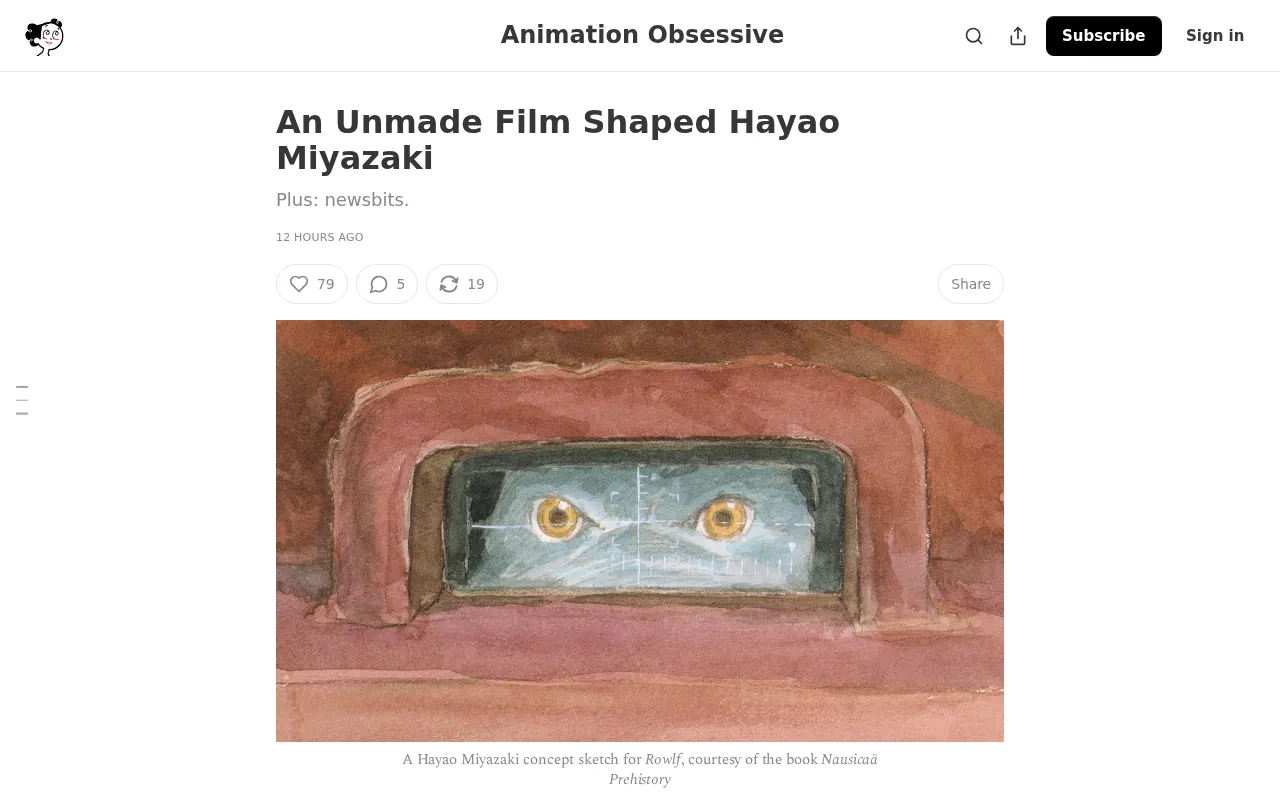
The most frequently mentioned unmade project from Miyazaki's early career is the Pippi Longstocking animation plan. In the early 1970s, Miyazaki and Isao Takahata planned to adapt Swedish author Astrid Lindgren's children's book into an animated film, but the author herself refused to grant permission, and the project was shelved. This experience had a profound impact on Miyazaki: the independent, stubborn, and vibrant little girl characters that recur throughout his later works are believed to be partly inspired by the character of Pippi. In addition, Miyazaki also participated in or prepared several projects that never came to fruition, such as different early versions of Nausicaä of the Valley of the Wind. Together, these unfinished projects form a hidden thread running through his creative career, and also explain why his works often carry the characteristic of "repeatedly polishing the same motif."
How Unfinished Works Shape Creators
In the creative industry, "failed" projects often teach creators more than successful ones. Miyazaki's case is not unique — many directors, writers, and designers have said that projects that were shelved or abandoned became a source of nourishment for their later work.
This influence manifests on several levels. On the production level, unfinished projects allowed Miyazaki to accumulate specific technical experience and working methods. On the thematic level, he repeatedly returned to certain core propositions, attempting to tell the same story in different ways. On the emotional level, the regret of unfinished work was transformed into creative motivation — this tension is faintly perceptible in his works.
What truly deserves attention is: to what extent does an abandoned project define the creative trajectory of the following decades? Judging from Miyazaki's career, the answer may be considerable.
Studio Ghibli, to which Miyazaki belongs, has a creative model that is itself closely tied to "unfinished projects." Ghibli is known for its director-centric system, hand-drawn animation, and high-intensity polishing — many projects are rejected or indefinitely shelved during the early development stage. Miyazaki himself has a habit of making extensive notes, sketches, and proposals, and these materials often circulate and transform across different projects. An abandoned setting may be reborn years later in the form of another film. This "material reuse" is not simple recycling, but rather an expression of the creator's continuous thinking on a particular proposition. For this reason, researchers often regard Miyazaki's unfinished projects as key clues to understanding his complete creative system, rather than isolated cases of failure.
Implications for Creators and the AI Era
Part of the reason this topic sparked discussion on Hacker News is that it also has relevance for today's AI-assisted creation. When AI tools make "rapid generation" effortless, the Miyazaki-style approach of "spending years polishing a single work" seems all the more precious.
Unfinished concepts, rejected proposals, dead-end technical paths — these are inevitable in any creative process. The key is how creators handle these "failures": do they completely forget them, or do they let them become the foundation for the next attempt?
Miyazaki's experience reminds us: creation is not linear progress. An unmade film is not an endpoint, but the starting point of another creative path.
The core logic of AI-assisted creative tools (such as text generation and image generation models) is "rapid iteration" and "low-cost trial and error." This stands in sharp contrast to the Miyazaki-style long-term polishing, but the two are not necessarily contradictory. In traditional creation, unfinished projects are often shelved due to resource, licensing, or technical constraints; in the AI era, creators can rapidly visualize old concepts at extremely low cost, thereby reassessing their value. In other words, AI may change the fate of "unfinished projects" — they are no longer just dust-covered notes, but may be reactivated, recombined, or validated. The key is whether creators possess the judgment and patience of a Miyazaki to discern which concepts are worth returning to again and again.
One-line Summary
An unmade film by Hayao Miyazaki profoundly shaped his later creative direction and long-term polishing style.
Paragraph Summary
The article uses an early unmade film by Hayao Miyazaki as a starting point to explore how unfinished works continue to influence creators. It points out that this project was not simply a commercial failure, but involved a deep tension between creative vision and production conditions, and its narrative structure, visual language, and thematic expression resurfaced repeatedly in Miyazaki's later works. The article further analyzes that failed or shelved projects often teach creators more than successful ones, and that the regret of unfinished work can be transformed into creative motivation. In an era of rapid AI content generation, the Miyazaki-style approach of spending years polishing a single work highlights its value all the more. The article argues that creation is not linear progress — unfinished concepts are not an endpoint, but the starting point of another creative path.
Related articles

AI Comic Drama with WorkBuddy from Scratch: A Step-by-Step Skill Pack Installation Guide
Learn how to create AI comic dramas with WorkBuddy from scratch. This guide covers installation, Skill pack import and invocation, plus a script generation demo with manual revision tips to get you through the first step from script to storyboard.

WorkBuddy Agent Runs the Entire GEO Database Mining Pipeline with a Single Prompt
WorkBuddy agent automates GEO database mining: from data search and curation to batch correction, differential analysis, co-expression networks, feature gene screening, and immune infiltration—a single prompt generates a complete bioinformatics report, greatly lowering the barrier to bioinformatics analysis.

PC Memory Wasted? Hacker News Debates Centralized Data Centers
Hacker News users argue that personal computer memory is wasted and should be centralized in data centers, sparking debate on centralized vs. distributed computing resource allocation. This article analyzes the logic behind the claim, the costs of centralization, and new tensions in memory resource allocation in the AI era.