How Does Graphormer Optimize Dynamic Lanes and Speed Limit Control?
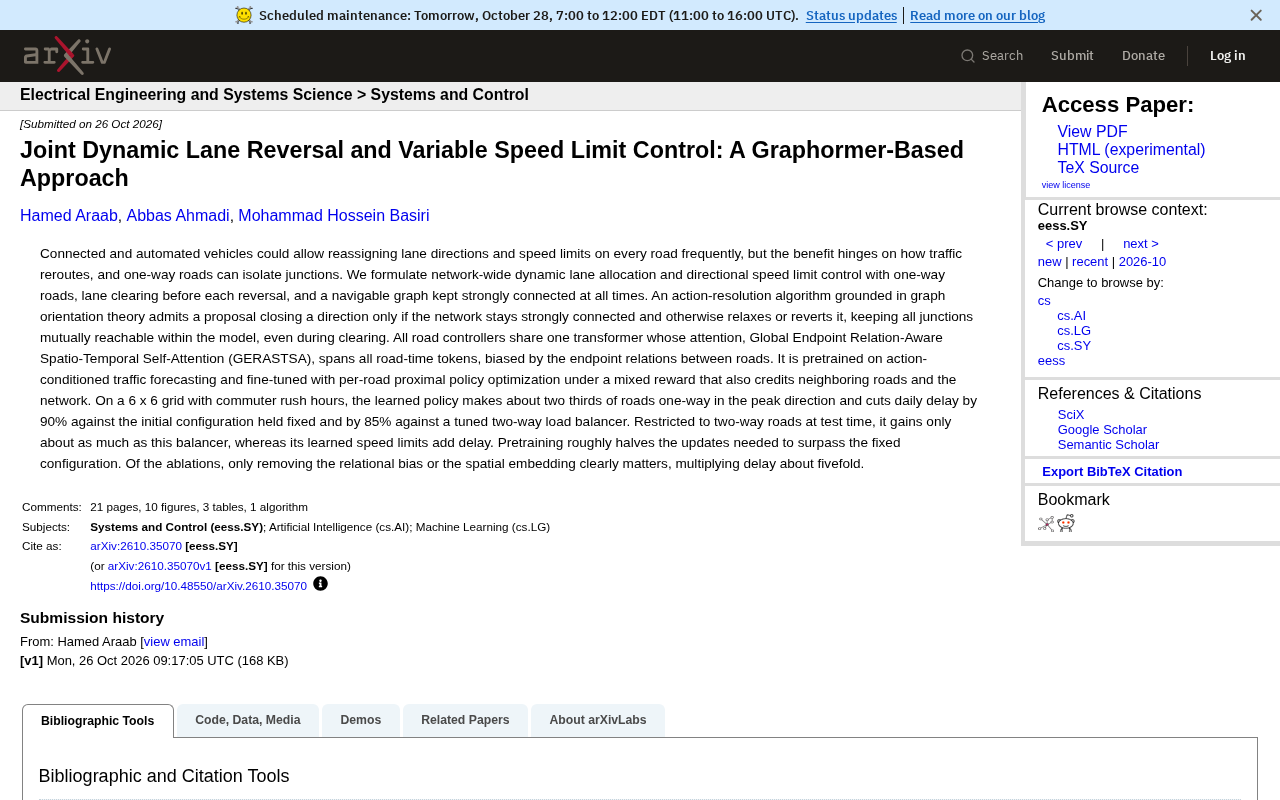
Study proposes Graphormer-based joint lane reversal and variable speed limit control that ensures strong connectivity and reduces delay by 90%.
This study addresses joint dynamic lane reversal and variable speed limit control for connected autonomous vehicles using a graph transformer (Graphormer) approach. The core challenge is that dynamic lane direction adjustments may break strong connectivity, making intersections unreachable. The authors design an action parsing algorithm based on graph orientation theory, ensuring lane changes are adopted only if the network remains strongly connected. The model uses a shared Transformer with the GERASTSA attention mechanism that introduces endpoint relation biases for global spatio-temporal modeling. In a 6x6 grid peak scenario, the learned policy makes about two-thirds of roads one-way, reducing delay by 90% vs. fixed configuration and 85% vs. a tuned load balancer. Pre-training significantly reduces fine-tuning updates, and ablation shows relational bias and spatial embedding are critical. However, the speed limit strategy increases delay in two-way testing, suggesting joint control needs further coordination.
Introduction
With the proliferation of connected and autonomous vehicles (CAVs), lane directions and speed limits are expected to be adjusted dynamically at high frequency. However, this flexibility hides a key challenge: how to ensure that the traffic network does not suffer from congestion shifts or even network fragmentation when lanes and speed limits are reallocated? A study titled "Joint Dynamic Lane Reversal and Variable Speed Limit Control: A Graphormer-Based Approach" proposes a joint control method based on a graph transformer (Graphormer) to address this problem.
Core Problem: One-Way Roads and Network Connectivity
Dynamic lane reversal allows some lane directions to be reversed to match the traffic flow direction during peak hours, while variable speed limits smooth traffic flow by adjusting speed limit values. But if roads are arbitrarily converted to one-way, some intersections may become unreachable, thereby destroying the connectivity of the entire road network. The study formalizes the problem as: jointly optimizing lane allocation and directional speed limits under the premise of ensuring that all intersections are mutually reachable (strongly connected).
To this end, the authors design an action parsing algorithm based on graph orientation theory, ensuring that any proposed lane direction change is adopted only if the network remains strongly connected; otherwise, relaxation or rollback is performed. This mechanism maintains network connectivity even during the lane-clearing phase.
Strong connectivity is a fundamental concept in graph theory: a directed graph is strongly connected if and only if there exists a path in both directions between any two vertices in the graph. In a traffic network, intersections are vertices, and lane directions determine the directions of edges. If a road is converted to one-way, intersections that could originally be reached in the reverse direction via that road may become unreachable, causing the network to be split into multiple disconnected subgraphs. Strong connectivity is stricter than weak connectivity (connectivity when directions are ignored) and is the key condition for ensuring that any two points in the road network can be traveled between. The action parsing algorithm adopted in the study essentially checks whether strong connectivity is broken at each lane direction change; if broken, the action is rejected or relaxed, thereby maintaining global reachability during dynamic adjustments.
Graphormer Architecture: Global Endpoint Relation-Aware Spatio-Temporal Self-Attention
Traditional traffic control methods often process each road segment independently, ignoring the spatial correlations between segments. This study employs a shared Transformer model, whose core is an attention mechanism called GERASTSA (Global Endpoint Relation-Aware Spatio-Temporal Self-Attention). This mechanism performs attention computation over all "segment-time" tokens and introduces relations between road segment endpoints as biases, thereby capturing the global influence of the road network topology.
The model is first pre-trained on an action-conditioned traffic prediction task and then fine-tuned using per-segment Proximal Policy Optimization (PPO), with a reward function that mixes local segment performance, neighboring segment performance, and network-wide performance. This design enables segment controllers to collaboratively optimize global objectives.
Transformer is a neural network architecture based on the self-attention mechanism, originally used in natural language processing. Its core advantage lies in its ability to model long-range dependencies between any two positions in a sequence. In traffic control, Transformer is used to process sequences of "segment-time" tokens, where each token represents the state of a road segment at a certain time. The self-attention mechanism allows the model to directly compute association weights between any two tokens, thereby capturing global spatio-temporal dependencies. However, standard Transformer lacks the ability to explicitly model graph structures (such as road network topology), so Graphormer enhances attention computation by introducing graph structure biases (such as endpoint relations and spatial embeddings), making it suitable for graph-structured data.
PPO (Proximal Policy Optimization) is a policy gradient algorithm widely used in reinforcement learning, known for its stability and sample efficiency. PPO avoids drastic fluctuations during training by limiting the step size of policy updates (using clipped importance sampling ratios), thereby performing well in continuous action spaces and high-dimensional state spaces. In this study, the authors use per-segment PPO for fine-tuning, where each road segment has an independent policy network but shares a global Transformer encoder. The reward function mixes local segment performance, neighboring segment performance, and network-wide performance. This multi-scale reward design encourages each segment's controller to consider global objectives while optimizing its own, achieving collaborative control.
Experimental Results: Significant Delay Reduction, but Speed Limit Effectiveness Questionable
In a commuting peak scenario on a 6x6 grid road network, the learned policy converts about two-thirds of roads to one-way in the peak direction, reducing daily delay by 90% compared to the fixed initial configuration and by 85% compared to a tuned two-way load balancer. However, when constrained to two-way roads at test time, the policy's gains are only comparable to the load balancer, and its learned speed limit values actually increase delay.
Pre-training significantly reduces the number of updates required to surpass the fixed configuration (roughly halved). Ablation experiments show that removing the relational bias or spatial embedding amplifies delay by about five times, indicating that these two components are critical to performance.
Implications and Limitations
The study demonstrates the potential of graph neural networks in dynamic traffic control, especially in avoiding negative effects by maintaining strong network connectivity. However, the negative impact of the speed limit strategy in the two-way scenario suggests that joint control requires more refined coordination mechanisms. Future work could explore better coupling between speed limits and lane reversal, as well as generalization capability in more complex road networks.
Overall, this study provides new ideas for dynamic lane management, and its combination of graph orientation theory and Transformer is worth attention.
Related articles

DeepSeek Harness: A Beginner's Installation and Testing Guide
A DeepSeek Harness tutorial for test engineers: set up Node.js, launch with one NPX command, configure official and third-party models, and explore web search, file I/O, and trace-view agent observability.
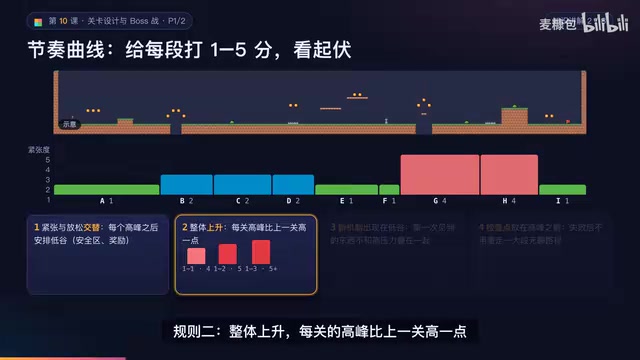
AI Game Development in Practice: Designing Levels with the Four-Step Method and Pacing Curves
AI game development lesson 10: design levels with the four-step method (teach, practice, combine, test) and a 1-5 pacing curve, plus sightline guidance and safety zones—implement Animatable Body 2D moving platforms and generate ASCII sketches for 1-2 Underground Cavern and 1-3 Guard Hall.

AI Game Development in Practice: Two-Phase Boss State Machines and Death Heatmap Tuning
AI game development lesson 10: implement a two-phase Boss with a state machine, guarantee fairness with color signals and a 0.4-second warning floor, locate difficulty cliffs with a death heatmap, and apply lightest-to-heaviest fixes one at a time, with an acceptance checklist and common pitfalls.