How Stanford Teaches AI-Native Engineering: Inside CS146S
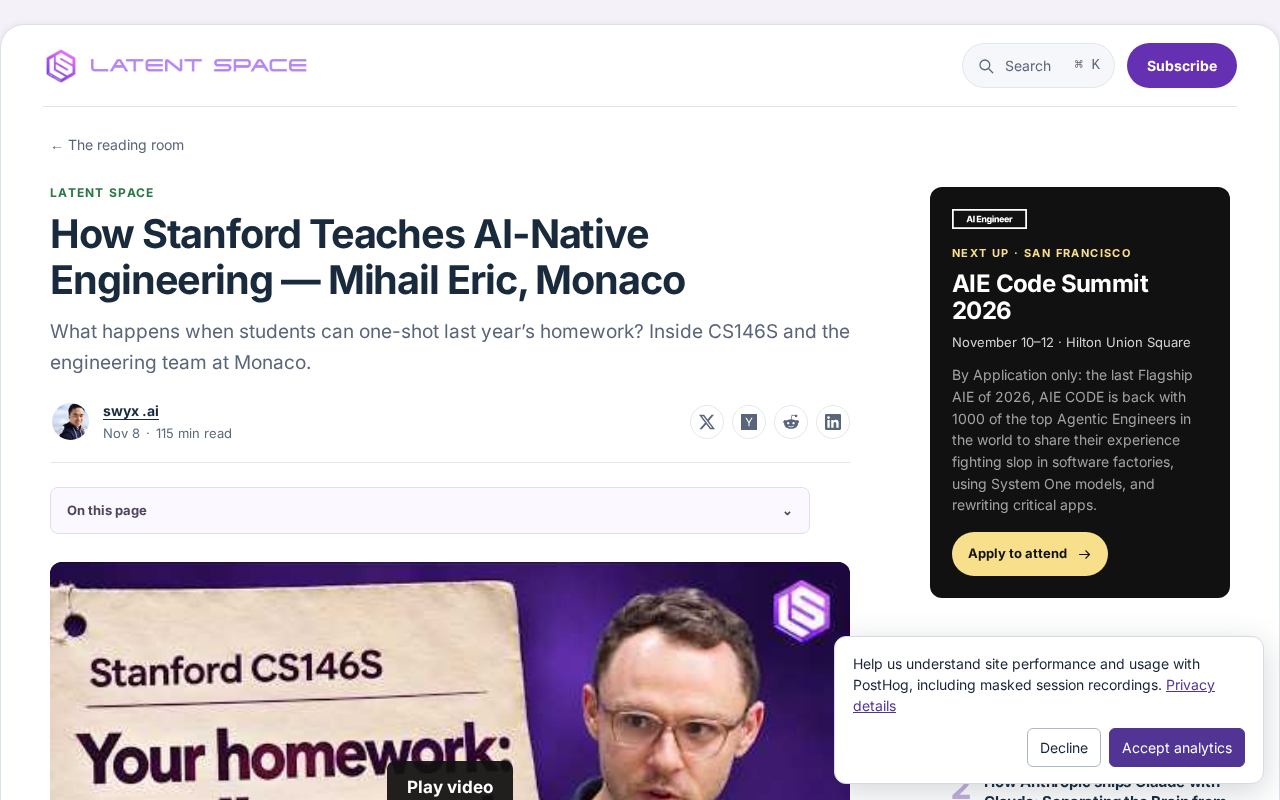
Stanford's CS146S course responds to one-click AI assignment generation by shifting toward system design and code review skills.
Stanford's CS146S course and the Monaco engineering team confront the reality of students using AI to one-click generate assignments by redesigning AI-native engineering education. The course no longer bans AI but shifts focus to system design, code review, and engineering thinking, emphasizing AI as an engineering partner rather than a replacement for hand-writing code. Students learn prompt engineering, evaluate AI-generated code quality, debug AI outputs, and cultivate critical thinking. Monaco practice shows AI boosts efficiency, but humans remain responsible for architecture and quality control. Engineering education must adjust assessment methods to emphasize project outcomes and collaborative processes.
When students can generate last year's assignments with a single click, how should traditional programming education respond? Stanford's CS146S course and the Monaco engineering team offer their answer.
Mihail Eric's experience on the Monaco engineering team, along with his practice teaching CS146S at Stanford, reveals the core philosophy of AI-native engineering education. The course confronts a reality: students can already use AI tools to easily complete past assignments, which forces teaching methods to evolve.
The Core Challenge of AI-Native Engineering: One-Click Assignment Generation
The first problem the course faces is that students can use AI models to one-click generate solutions to previous years' assignments. This is not an isolated case but a widespread phenomenon following the popularization of AI coding capabilities. Traditional assignments focused on syntax and algorithm implementation become fragile in the face of AI. CS146S's strategy is not to ban AI but to redesign course objectives, shifting focus to capabilities AI cannot easily replace—system design, code review, and the engineering mindset of using AI to build complex software systems.
Mihail Eric points out that AI-native engineering is not simply using AI to write code, but understanding AI's role in the software lifecycle and establishing workflows for collaborating with it. The course emphasizes that students need to learn to evaluate the quality of AI-generated code, debug AI outputs, and integrate AI tools within teams.
Prompt Engineering is a foundational skill in AI-native engineering, referring to carefully designing input instructions to guide large language models toward generating high-quality, expected outputs. In programming contexts, this includes defining task boundaries, providing contextual examples, decomposing complex requirements, and iteratively refining prompts. CS146S treats prompt engineering as one of the core capabilities for student-AI collaboration—good prompts can significantly improve code generation accuracy and maintainability, while vague instructions may lead to erroneous or redundant code. Unlike traditional programming syntax, prompt engineering emphasizes understanding the essence of the problem and clear expression, which is precisely a human advantage AI cannot fully replace.
CS146S Course Design Approach
CS146S is built around "AI as an engineering partner." Students no longer hand-write all code from scratch but learn to break requirements into manageable tasks and then use AI to assist implementation. Course content may cover prompt engineering, AI code review, and how to build reliable AI-augmented systems. This model simulates modern engineering team practice—at Monaco, engineers also rely on AI tools to boost efficiency, but core decisions and architecture design remain the responsibility of humans.
A key point of the course is for students to understand AI's limitations. Through practical projects, students need to identify errors and biases in AI-generated code and learn to correct them. This cultivates critical thinking and engineering judgment rather than mere coding skills.
AI Code Review refers to the process of using AI tools to assist in checking code quality, potential defects, and security vulnerabilities, but human engineers still bear ultimate judgment responsibility. In CS146S, students need to learn how to evaluate AI-generated code suggestions: identifying logic errors, understanding contextual bias, verifying boundary conditions, and deciding whether to adopt them. This review capability differs from traditional code walkthroughs because AI may produce plausible but actually incorrect outputs (i.e., "hallucinations"), and students must combine domain knowledge and testing to verify. Monaco team practice shows that AI code review can accelerate development workflows, but human control over architectural consistency and business logic is irreplaceable.
Implications for Engineering Education
Stanford's practice shows that AI-native education is not about teaching students to use a specific tool but cultivating an engineering methodology suited to the AI era. Students need the ability to quickly learn new tools, the habit of validating AI outputs, and the collaborative awareness to integrate AI into team processes. Monaco's engineering culture confirms this: AI tools boost development speed, but code quality, system reliability, and team communication remain core responsibilities of human engineers.
This shift in educational models means assessment methods also need adjustment. Traditional programming exams struggle to measure students' ability to collaborate with AI; courses may focus more on project outcomes, code review reports, and system design documents.
AI-Augmented Systems refer to integrating AI capabilities into software system architecture so that systems possess intelligent decision-making or automated processing functions, rather than being used only as external tools. In AI-native engineering education, students need to understand how to design reliable AI-augmented systems: including defining the boundaries of AI components, handling uncertain outputs, designing fallback mechanisms, and ensuring overall system observability. CS146S lets students experience this process through project practice—for example, building a system that uses AI for code completion or defect detection while ensuring human engineers can intervene and correct. This requires going beyond mere coding skills to integrate system design, quality assurance, and teamwork.
Future Directions
As AI coding capabilities continue to evolve, engineering education will keep adjusting. CS146S's exploration provides a model: embrace AI tools while strengthening the unique value of human engineers—architecture design, quality control, and complex problem-solving. For educators and learners, the key is not to resist AI but to redefine what "learning to program" means with AI assistance.
One-line Summary
Stanford's CS146S course responds to one-click AI assignment generation by shifting toward system design and code review skills.
Paragraph Summary
Stanford's CS146S course and the Monaco engineering team confront the reality of students using AI to one-click generate assignments by redesigning AI-native engineering education. The course no longer bans AI but shifts focus to system design, code review, and engineering thinking, emphasizing AI as an engineering partner rather than a replacement for hand-writing code. Students learn prompt engineering, evaluate AI-generated code quality, debug AI outputs, and cultivate critical thinking. Monaco practice shows AI boosts efficiency, but humans remain responsible for architecture and quality control. Engineering education must adjust assessment methods to emphasize project outcomes and collaborative processes.
Related articles
AI Detection False Positive Controversy: Writer Accused of Using AI, Who Should Bear the Burden of Proof?
A 2026 Commonwealth Short Story Prize regional winner was flagged by Pangram as 100% AI-generated but cleared after drafts were reviewed. The case exposes AI detection false positives and the burden-of-proof dilemma facing creators.
Stanford's AI-Native Engineering Course: How to Teach Programming in the Age of Agents
Stanford CS146S course reform: Mihail Eric brings open-source maintainers into the classroom, having students propose changes in unfamiliar real codebases, exploring AI-native engineering teaching in the age of agents, shifting from writing code to cultivating engineering decision-making skills.

Paul Ford's New Piece Sparks Discussion: The Web Itself Is Enough
Paul Ford's "The Web Is More Than Enough" sparks Hacker News debate, arguing Web standards already suffice for app development and warning against closed platforms.