Human-in-the-Loop: How to Put a Safety Brake on AI Automation

HITL puts a mandatory human checkpoint before irreversible AI actions, preventing uncorrectable mistakes.
This article explores why Human-in-the-Loop (HITL) is essential in AI automated workflows. Because AI models can hallucinate confidently, connecting them directly to irreversible operations like refunds or data deletion creates unacceptable risk. HITL physically freezes the workflow before high-risk steps, forces the AI to expose its reasoning, and requires human approval before proceeding. The key is applying it precisely — where actions are irreversible, errors are costly, or AI misjudgment is likely. HITL is becoming foundational safety infrastructure for enterprise AI deployments.
Why AI Shouldn't Be Left to Run Alone
One of the most dangerous traits of AI models is that they confidently make things up. When you connect a model that can "hallucinate with complete conviction" directly to real business tools, the risks multiply exponentially. Once an AI makes a decision, the underlying API fires immediately — money gets transferred, orders get cancelled, data gets deleted. These actions are often irreversible.
Imagine a typical scenario: an AI customer service agent is granted permission to read full emails and automatically process refunds. The task sounds reasonable and would certainly save a lot of manual work. But here's the problem — what happens if the AI misreads a poorly worded email and incorrectly determines that a large refund needs to be issued?

In a standard fully automated workflow, the answer is brutal: the money is already gone. The moment the AI makes its decision, the payment API has already executed — with no buffer whatsoever.

What Human-in-the-Loop Actually Stops
The core of Human-in-the-Loop (HITL) is inserting a mandatory checkpoint before the most critical and irreversible step in the process.
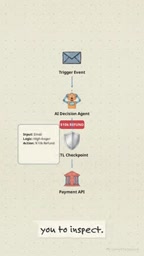
Back to the refund example. HITL places a hard barrier right before the "execute final payment" step. When the data flow reaches this point, it physically stops — not a notification, not a log entry, but the entire process genuinely freezing in place.
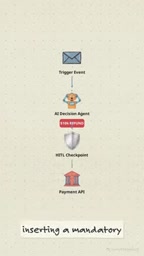
This "suspended" state has an added benefit: it forces the AI to fully expose its reasoning process for human review. You can see exactly why the AI made that judgment and which parts of the email it relied on. The entire workflow stays frozen until someone clicks "Approve" or "Reject" — only then does the subsequent path unlock.
The concept of Human-in-the-Loop (HITL) originated in the machine learning field, referring to a design paradigm that incorporates human intervention during model training or inference. In traditional machine learning, HITL was commonly used in Active Learning — having the model request human annotation on uncertain samples to improve training efficiency. With the rise of AI Agents, this concept has been extended to the workflow execution layer: AI no longer just produces predictions, but triggers real external actions (such as calling APIs or modifying databases). At this point, HITL's focus shifts from "assisting training" to "controlling execution risk." On the technical implementation side, modern workflow orchestration tools (such as n8n, LangChain's Human-in-the-loop nodes, and Temporal) typically implement this through a "pause and wait for external signal" mechanism: the process instance is persisted in storage, waiting for a human to send an approval signal via interface or API before resuming execution — consuming no compute resources during the entire waiting period.
Intercepting a Ten-Thousand-Dollar Mistake
Back to that erroneous $10,000 refund the AI was about to issue. With a HITL checkpoint, the fix is remarkably simple: you just click "Reject."
The workflow stays frozen at that moment, and not a single dollar actually moves. You've caught the error before any funds transfer. This is the fundamental difference between HITL and ordinary automation — it doesn't remediate after the fact; it establishes an unavoidable gate before the action ever happens.
This design philosophy reveals an important principle: the degree of automation should be inversely proportional to the reversibility of potential errors. For reversible, low-risk operations, AI can operate independently without issue. But for irreversible, high-risk actions like transfers, deletions, and outbound communications, the value of human review far outweighs the minor efficiency cost it introduces.
Where HITL Applies — and Where It Doesn't
HITL isn't a silver bullet. Its trade-off is sacrificing some of the speed that automation provides. If every minor decision requires human confirmation, automation loses its purpose entirely. The real skill in practice lies in precisely identifying which nodes need a checkpoint.
A practical framework is to ask three questions: Is this action irreversible? How severe would an error be? How likely is the AI to misjudge at this step? If even one answer points toward high risk, it's worth setting a human checkpoint there.
As AI agents become increasingly integrated into real business systems, HITL is evolving from an optional feature into foundational safety infrastructure for enterprise AI deployments. It acknowledges a straightforward truth: today's AI is powerful enough to be useful, but not yet reliable enough to independently manage operations where a single mistake cannot be undone.
An AI Agent is an AI system capable of perceiving its environment, planning steps, calling tools, and autonomously completing goals — distinct from ordinary large language models that only handle single-turn question-and-answer interactions. A typical AI Agent can sequentially read emails, query databases, call payment APIs, and send notifications within a single task, with no human intervention required along the entire chain. This capacity for "autonomous action" is precisely where its value lies — and where its risk originates — since every tool call can produce real, irreversible side effects. The industry has converged on several consensus principles for AI Agent safety: the principle of least privilege (granting only the minimum permissions needed to complete a task), sandbox isolation (validating in a test environment before going to production), and the HITL checkpoints discussed in this article. As OpenAI, Anthropic, and other major vendors continue adding native support for tool calling in their APIs, the barrier to deploying AI Agents keeps falling — making the development of corresponding safety frameworks increasingly urgent.
Final Thoughts
The concept of Human-in-the-Loop isn't complicated, but it touches on a core question in AI deployment — the balance between trust and control. Integrating AI into production systems doesn't mean handing over the steering wheel entirely. Keeping a human checkpoint that can halt the process at any moment lets you enjoy the efficiency of automation while maintaining a final line of defense.
In the rush to embrace AI automation, this may be the most important design principle for businesses to remember: never let AI go it alone.
Related articles

LangChain Retry Middleware Configuration: Practices and Selection Guide
Based on Reddit community discussion, this article analyzes LangChain ModelRetryMiddleware retry parameter configuration practices, covering the selection logic and alternatives for key options like max_retries, backoff_factor, and jitter.

Texas Senate Race in Trouble: Why Are Republicans Nervous?
Texas Senate race stirs Republican anxiety. Based on street interviews, this article analyzes the Democratic offensive in funding, organization, and running everywhere, and how Republicans are defending "Texas, Texas" amid the political pendulum effect.

Gemini Chat Now Generates and Edits Google Docs Directly, a New Breakthrough in Office Productivity
Google Gemini's chat interface now generates and edits PDF, Google Docs, Sheets, Slides, Markdown, TXT, and code files. Available to all users; web supports all formats, mobile only PDF for now.