Hybrid AI Patterns: 13 Ways to Couple Language Models with Rule Engines

The article defines 13 coupling patterns between language models and rule engines, along with invariants, failure modes, and a decision guide.
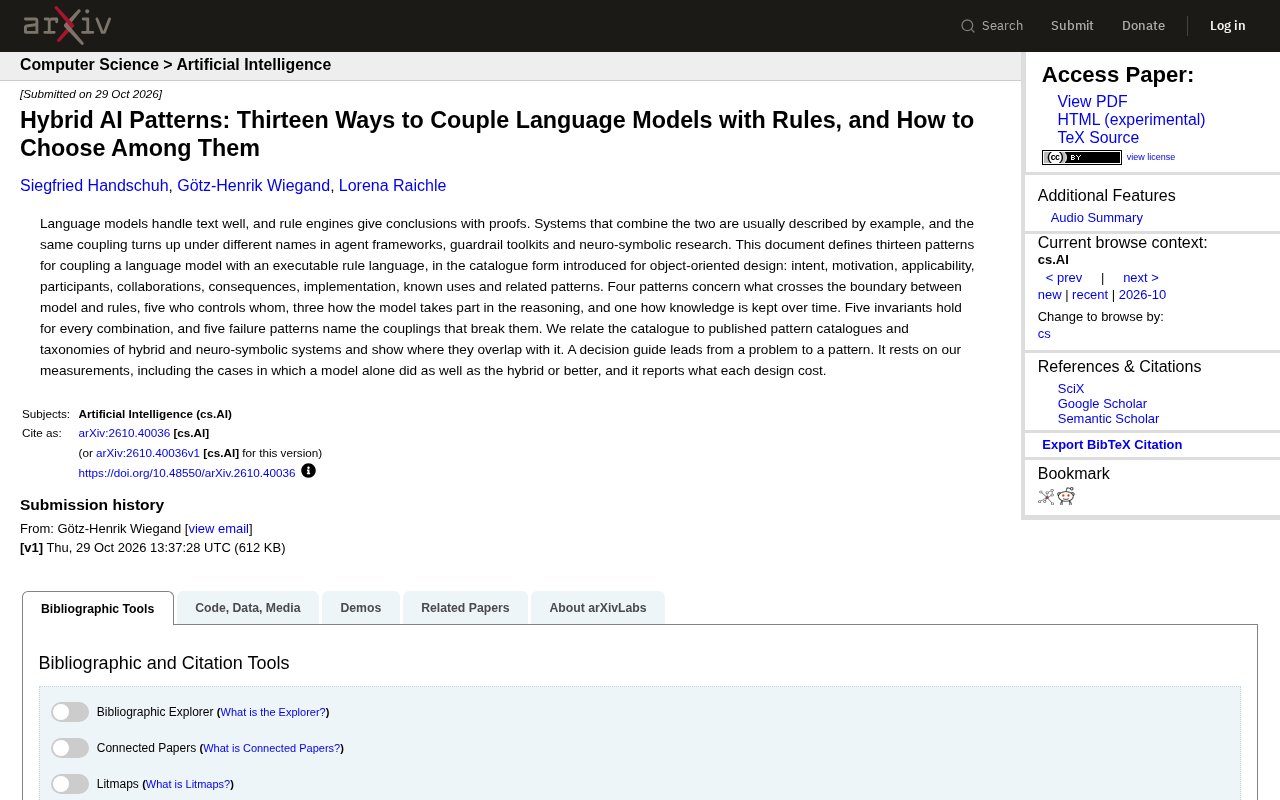
This article presents an object-oriented design pattern catalog that systematically defines 13 patterns for coupling language models with executable rule languages. The patterns are classified into four dimensions: boundary passing (4 patterns), control flow (5 patterns), reasoning participation (3 patterns), and knowledge maintenance (1 pattern). It also proposes five invariants and five failure modes to ensure system consistency and reliability. A decision guide based on empirical measurements helps developers select patterns according to problem characteristics and reports the cost of each design. Finally, the catalog is related to existing hybrid and neuro-symbolic taxonomies, highlighting overlaps and differences.
Language models excel at processing text, while rule engines can deliver conclusions backed by proofs. Systems that combine the two are often described through examples, yet the same coupling approaches appear under different names in agent frameworks, guardrail toolkits, and neuro-symbolic research. This article defines 13 patterns for coupling language models with executable rule languages in the form of an object-oriented design pattern catalog, covering intent, motivation, applicability, participants, collaboration, consequences, implementation, known uses, and related patterns. These patterns fall into four categories: four concern what is passed between the model and the rules, five concern who controls whom, three concern how the model participates in reasoning, and one concerns how knowledge is maintained over time. In addition, the article proposes five invariants that apply to all combinations, along with five failure modes that violate these invariants, and relates the catalog to published pattern catalogs and taxonomies for hybrid and neuro-symbolic systems, showing where they overlap. Finally, a decision guide leads from problem to pattern, grounded in empirical measurements (including cases where the model alone performs as well as or better than the hybrid system), and reports the cost of each design.
Pattern Categories: From Boundaries to Control
The pattern catalog divides the 13 coupling approaches into four dimensions, each addressing a different level of the problem.
Boundary Passing: What Flows Between Model and Rules
Four patterns focus on the types of information that cross the boundary between the model and the rules. This may include intermediate representations generated by the model, query results from the rule engine, or bidirectional constraint feedback. For example, one pattern might have the model generate structured queries that the rule engine executes and returns results for; another might have the rule engine provide constraints within which the model generates text. The core of these patterns lies in defining clear interfaces that ensure both sides understand the semantics of the exchanged data.
Intermediate Representation (IR) is a commonly used structured data form when crossing the boundary between language models and rule engines. Since language models output natural language text, while rule engines typically require formal predicates, facts, or query statements as input, an intermediate representation that both sides can parse is needed. Common IRs include: JSON-formatted intent slots, fact terms in logic programming languages (such as Prolog), or SQL query fragments. A well-designed IR should have clear syntax and semantics, making the model's generation process controllable (e.g., through constrained decoding) while allowing the rule engine to execute unambiguously. In the pattern catalog, the core task of boundary-passing patterns is to define the format and exchange protocol for this IR, thereby avoiding the failure mode where model output exceeds rule constraints.
Control Flow: Who Leads the Decision
Five patterns deal with the allocation of control. Some patterns are rule-driven, with the model serving only as a front-end parser; others are model-driven, with rules acting as post-processing filters; still others adopt equal collaboration, deciding the final output through a negotiation mechanism. Control flow directly affects the predictability and flexibility of the system, and must be chosen based on the task's requirements for determinism.
Neuro-Symbolic Systems refer to an AI paradigm that combines the perception and learning capabilities of neural networks (such as large language models) with the reasoning and interpretability of symbolic systems (such as rule engines and logic solvers). The core idea is to let neural networks handle fuzzy, high-dimensional raw input (such as natural language), while symbolic systems perform precise logical deduction and constraint checking. In the pattern catalog of this article, this combination is reflected in the division of control flow: when the rule engine leads the decision, the model serves only as a front-end parser; when the model leads, the rule engine degrades to a post-processing filter. Research goals of neuro-symbolic systems include improving interpretability, guaranteeing that outputs satisfy hard constraints, and using prior knowledge to reduce model hallucinations. Understanding this concept helps grasp the technical background of the "who controls whom" dimension in the pattern catalog.
Reasoning Participation: How the Model Intervenes in Logical Deduction
Three patterns describe the model's role in the reasoning process. The model may act as a fact generator, providing input to the rule engine; it may act as a rule selector, dynamically deciding which rules to apply; or it may act as an explainer, translating the rule engine's conclusions into natural language. These patterns affect the transparency and interpretability of the system.
Explainability in hybrid systems refers to the system's ability to articulate its reasoning process and conclusions in a human-understandable way. Rule engines naturally provide rule-based proof paths (such as derivation trees), whereas the internal reasoning process of language models is typically opaque. When the model acts as an explainer, it translates the symbolic conclusions of the rule engine into natural language explanations, thereby improving readability while preserving the transparency of symbolic reasoning. Conversely, when the model acts as a fact generator, the credibility of its output must be verified by the rule engine; otherwise, untraceable errors are introduced. The reasoning participation patterns in the catalog revolve around how to balance the flexibility of the model with the interpretability of the symbolic system, with the three patterns corresponding to different trade-offs between transparency and automation.
Knowledge Maintenance: Coupling in the Time Dimension
One pattern focuses on how knowledge changes over time, involving coordination between model updates and rule base evolution. For example, when rules change, how to ensure that the model's behavior adjusts accordingly, or how to use the model to extract rule updates from new data.
Invariants and Failure Modes
The article proposes five invariants that apply to all coupling approaches, ensuring consistency and reliability of system behavior. These invariants may involve data formats, control flow integrity, error handling, and other aspects. At the same time, five failure modes describe typical situations that violate the invariants, such as model output exceeding rule constraints, the rule engine being unable to handle fuzzy input generated by the model, or contention for control leading to deadlock. Identifying these failure modes helps avoid risks early in design.
Invariant in system design refers to a condition or property that must always hold true during system operation. In coupled systems of language models and rule engines, invariants may include: model output must be parseable by the rule engine (syntactic invariant), the rule engine's conclusions must not violate hard-coded safety constraints (semantic invariant), control transfer must follow a predefined protocol to avoid deadlock (control invariant), etc. These invariants provide clear targets for system verification and runtime monitoring. Failure modes describe typical manifestations when invariants are violated, such as the rule engine crashing due to fuzzy input generated by the model, excessive rule constraints preventing the model from producing valid output, or infinite oscillation caused by bidirectional feedback loops. Identifying invariants and failure modes helps embed checking mechanisms during design and quickly locate problems after deployment.
Decision Guide: From Problem to Pattern
The decision guide, based on empirical measurement data, helps developers choose the appropriate pattern according to problem characteristics. The measurements cover a variety of scenarios, including cases where the model alone performs as well as or better than the hybrid system, implying that not all tasks require a hybrid architecture. The guide also reports the cost of each design, including development complexity, runtime overhead, and maintenance burden. Developers should weigh task requirements against costs and avoid over-engineering.
Relation to Existing Taxonomies
The article compares the 13 patterns with published pattern catalogs and taxonomies for hybrid and neuro-symbolic systems, pointing out overlaps and differences. This helps researchers and engineers understand these patterns within the existing body of knowledge and promotes terminology unification across domains. For example, some patterns may correspond to common practices in agent frameworks, while others resemble specific methods in neuro-symbolic research.
Practical Implications
For teams building hybrid AI systems, this catalog provides a systematic design language and basis for selection. It is recommended to start by clarifying boundary-passing requirements, then gradually determine control flow and reasoning participation, and finally consider knowledge maintenance strategies. At the same time, pay attention to invariants and failure modes, and incorporate corresponding checking mechanisms into the design. The decision guide can serve as a tool for early architectural evaluation, avoiding blind adoption of hybrid solutions.
One-line Summary
The article defines 13 ways to couple language models with rule engines in the form of a design pattern catalog, and provides invariants, failure modes, and a decision guide.
Paragraph Summary
This article presents an object-oriented design pattern catalog that systematically defines 13 patterns for coupling language models with executable rule languages. These patterns are classified along four dimensions: boundary passing (4 patterns, defining the types of information exchanged between model and rules), control flow (5 patterns, allocating decision-making authority), reasoning participation (3 patterns, describing the model's role in logical deduction), and knowledge maintenance (1 pattern, addressing knowledge evolution over time). The article further proposes five invariants and five failure modes applicable to all combinations to ensure system consistency and reliability. A decision guide, based on empirical measurement data, helps developers select patterns according to problem characteristics and reports the cost of each design. Finally, the article relates the catalog to existing hybrid and neuro-symbolic taxonomies, pointing out overlaps and differences, and providing a systematic design language for building hybrid AI systems.
Related articles

RAG Interview Essentials: Breaking Down the Full Offline Indexing and Online Retrieval Pipeline
A complete breakdown of the RAG retrieval-augmented generation workflow: offline document loading, chunking, vectorization, and indexing; online query rewriting, vector retrieval, reranking, and generation, plus core interview points and system optimization directions.

AI Large Models for Absolute Beginners: Principles and API Calling in Practice
From AI's evolution to large model training principles and core concepts like Token, Temperature, and Top-P, this article explains system prompts, Function Call, RAG, and memory with hands-on examples and four API call scenarios—ideal for beginners.

Will GitHub Die? Open Source Maintainer Burnout and the Collaboration Crisis in the AI Era
Lex Fridman podcast discussion on open source maintainer burnout and GitHub's predicament: massive pull requests overwhelm core maintainers, and AI worsens code bloat. Using math journal peer review and Poincaré conjecture verification as analogies, the article analyzes why verification in knowledge production must be deliberately slow, and how open source communities can avoid the failure mode of maintainers exiting.