Hyper-Realistic Sand with WebGL2: A Technical Breakdown of the Safe Sandbox

Analyzing the instanced rendering, physics simulation, and advanced lighting behind the WebGL2 hyper-realistic sand project.
This article examines the hot Hacker News project "Hyper-Realistic Sand with WebGL2," analyzing the key technical path to rendering hyper-realistic sand in the browser. It highlights how WebGL2 features like instanced rendering, transform feedback, and 3D textures enable large-scale particle systems, while the implementation relies on procedural geometry, GPGPU-based physics, SSAO, and post-processing. Community discussion focuses on performance optimization and application prospects, affirming the browser as a powerful graphics platform.
Introduction: When WebGL2 Meets Hyper-Realistic Sand
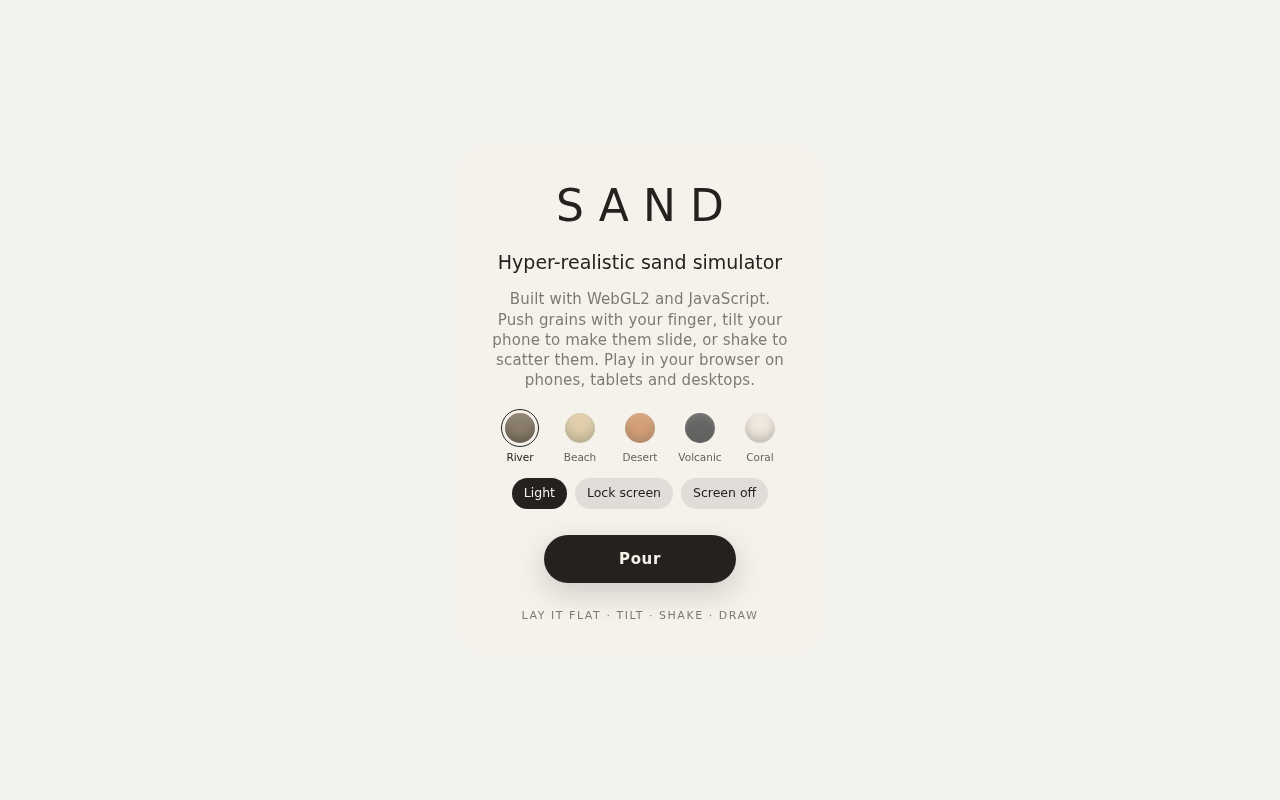
On Hacker News, a project called "Hyper-Realistic Sand with WebGL2" sparked extensive discussion, garnering 270 upvotes and 59 comments. Using WebGL2 technology, the project renders highly realistic sand particles in the browser, demonstrating the enormous potential of real-time graphics on the web platform. This article analyzes the implementation from a technical perspective, exploring the principles and significance behind it.
Core Technology: WebGL2 and Particle Rendering
As an upgraded version of WebGL, WebGL2 introduces many modern GPU features such as 3D textures, instanced rendering, and transform feedback, providing the foundation for complex visual effects. The hyper-realistic sand implementation likely leverages the following techniques:
- Instanced Rendering: Efficiently drawing large numbers of sand grains, with each grain as an instance, passing parameters such as position and size through vertex attributes to reduce draw call overhead.
- Physically Based Rendering (PBR): Simulating light reflection and shadows on sand grains to enhance realism.
- Particle Systems and Dynamic Simulation: Combining physics engines to compute sand grain trajectories, achieving natural behaviors like flowing and piling.
From the project name "safe-sand" (safe sandbox), we can infer that it may be a sandbox environment for experimentation and demonstration, emphasizing safety and interactivity.
Transform Feedback is one of the key features WebGL2 inherits from OpenGL ES 3.0. In the traditional rendering pipeline, vertex shader outputs can only enter the subsequent primitive assembly and rasterization stages; transform feedback allows these output vertex data to be written directly back to buffer objects, completing a "compute→store→redraw" loop without leaving the GPU. For sand simulation, this means updating each particle's position and velocity in the vertex shader, capturing the results to a buffer, and then using the same buffer as vertex input for the next frame, avoiding frequent data round-trips between CPU and GPU. This mechanism is often used in conjunction with GPGPU (General-Purpose Computing on GPU): developers encode particle states into textures or buffers and perform parallel updates via fragment shaders or compute shaders, enabling real-time physics simulation of tens of thousands or even hundreds of thousands of sand grains.
Implementation Details: From Data to Visuals
To render hyper-realistic sand, the key lies in detail handling. The shape, distribution, and light interaction of sand grains all require fine modeling. Possible implementation steps include:
- Sand Grain Geometry Generation: Using procedural generation or precomputed models to give each grain a unique shape and texture.
- Physics Simulation: Computing sand grain motion in parallel on the GPU via GPGPU (general-purpose computing), using WebGL2's transform feedback to update particle states.
- Lighting and Shadows: Employing screen-space ambient occlusion (SSAO) or ray tracing techniques to simulate shadows and indirect lighting between sand grains, enhancing realism.
- Post-Processing: Adding effects like depth of field and motion blur to further enhance visual immersion.
These combined techniques allow the sand to present near-photographic realism in the browser while maintaining smooth interactive performance.
Screen-Space Ambient Occlusion (SSAO) is a technique that approximates global illumination in real-time rendering. It uses depth buffer and normal information to sample around each pixel in screen space, estimating the degree to which that point is occluded by nearby geometry, thereby generating soft dark areas at object contact points and crevices. For scenes composed of numerous tiny geometries like sand grains, SSAO can significantly enhance the sense of depth between particles and the weight of accumulation, at a computational cost far lower than full ray tracing. Its typical pipeline includes: generating depth and normal buffers, computing occlusion factors within a hemisphere sampling kernel, blurring and denoising the results, and finally multiplying with the lighting result. Because sand grain surfaces are rich in detail and frequently occlude each other, SSAO combined with normal maps and PBR materials can greatly improve realism without increasing geometric complexity.
Instanced Rendering is implemented in WebGL2 through the drawArraysInstanced or drawElementsInstanced interfaces. Unlike calling draw calls sequentially for each object, instancing allows a single draw call to render hundreds or thousands of copies sharing the same mesh, with each instance reading its own position, rotation, scale, and color parameters through the vertex attribute divisor. For sand scenes, this means the base mesh of a single grain (possibly only a few dozen triangles) can be reused tens of thousands of times, and the GPU only needs to traverse the vertex data once to complete transformation and shading for all instances. Compared to issuing separate draw calls for each grain, instanced rendering can reduce CPU-side command submission overhead by orders of magnitude while maintaining high GPU throughput, making it a core method for large-scale particle systems in the browser.
Community Response and Insights
In the Hacker News discussion, developers praised the project's technical implementation while also exploring performance optimization strategies for WebGL2 in complex scenes. Some comments noted that such high-fidelity rendering opens up new possibilities for web games, virtual simulation, and other applications.
The project also reminds us that with advances in web graphics technology, the browser is gradually becoming a powerful creative platform. For developers, mastering WebGL2 and related graphics knowledge will help create more engaging web experiences.
Conclusion
"Hyper-Realistic Sand with WebGL2" showcases the cutting edge of real-time rendering on the web, and its technical approach is worthy of in-depth study by graphics enthusiasts and web developers. Through instanced rendering, physics simulation, and advanced lighting, even the most ordinary sand grains can radiate astonishing realism in the browser. In the future, we look forward to more similar projects driving the development of the web graphics ecosystem.
Related articles

AI Could Overthrow Governments in Six Months? ARC Head Issues His Starkest Warning Yet
ARC head Paul Christiano warns AI capable of overthrowing governments may arrive in 6-12 months, with ~one-third odds of superintelligence within a year. He urges frontier labs to pause algorithmic efficiency gains and fix safety first, and reveals how the Hugging Face incident foreshadowed AI taking over evaluation.

How Do Spies Infiltrate Nvidia? A CIA Agent Reveals a Honeypot Operation
A former CIA agent reveals in a YouTube interview that intelligence agencies ran a honeypot seduction operation against Nvidia CEO Jensen Huang, exposing the hidden spy risks facing tech executives.

How NVIDIA Cosmos Helps Delivery Robots Rehearse Unexpected Situations in Advance
NVIDIA Cosmos World Foundation Model expands a small amount of real input into large-scale synthetic scenarios, enabling delivery robots to train for unexpected situations in simulation in advance. Cocoa Robotics uses it to cover unexpected events and combines Isaac Sim and Isaac Lab to evaluate perception, prediction, and path planning.