HyperspaceDB v4.2.3: 1.58-bit Quantization and Filtered Search Breakthrough
HyperspaceDB v4.2.3 achieves 15.5x compression with 92.6% recall via 1.58-bit quantization and optimizes the HNSW filtered search performance cliff.
HyperspaceDB v4.2.3 tackles two engineering pain points of vector databases: 1.58-bit BitNet ternary quantization maintaining 92.6% recall at 15.5x compression, breaking the compression-vs-quality dilemma; and specialized index optimization for the HNSW performance cliff caused by broken graph connectivity at 5–10% metadata filter rates, claimed to be 154x faster than OpenSearch 3.9. The article notes these figures depend on dataset, filter rate, and evaluation method, and recommends validating quantization recall and filtered latency distribution on your own data, emphasizing that conclusions still await community reproduction.
HyperspaceDB v4.2.3: New Breakthroughs in Vector Database Quantization and Filtered Search
The vector database space recently saw an update worth paying attention to. Version HyperspaceDB v4.2.3 targets two pain points that have long plagued engineering teams: the precision loss of vector quantization, and the sharp performance drop of HNSW indexes under filtered conditions. According to information disclosed in the Reddit community, this update achieves 15.5x compression with 92.6% recall on 1.58-bit BitNet quantization, and offers a solution to the HNSW performance cliff in the 5–10% filter rate range, running 154x faster than OpenSearch 3.9 in specific scenarios.
Why Quantization and Filtered Search Are the "Hard Bones" of Vector Databases
The engineering challenges of vector databases typically center on two dimensions: storage cost and query efficiency. Quantization techniques compress storage by reducing vector precision, but traditional approaches suffer cliff-like drops in recall under aggressive compression, making it difficult to achieve both high compression ratios and retrieval quality. On the other hand, HNSW, as the mainstream approximate nearest neighbor index, performs excellently without filtering, but once metadata filtering is introduced (retrieving only a subset that meets specific conditions), a large number of nodes in the graph become unreachable and performance deteriorates sharply. This problem is especially pronounced in the "middle zone" where filter rates fall between 5–10% — too little filtering is meaningless, while too much filtering renders the index structure ineffective.
The HyperspaceDB update provides engineering answers to these two structural challenges rather than simple parameter tuning.
1.58-bit BitNet Quantization: Rebalancing Compression and Recall
The Origin of BitNet Quantization
The name 1.58-bit quantization comes from ternary weight representation (approximately three states: -1, 0, 1), a concept already discussed in the field of language model compression. Introducing it into embedding vector storage for vector databases means each dimension no longer requires high-precision floating-point numbers, but is represented with extremely low bits. The 15.5x compression ratio announced by HyperspaceDB represents a significant improvement over common scalar quantization or product quantization.
The Origins of Ternary Quantization and 1.58-bit
"1.58-bit" is not a hardware bit width, but an information-theoretic average: when weights or vector components can only take three values {-1, 0, +1}, the theoretical number of bits required to encode each component is log₂(3) ≈ 1.585 bit. This representation was first proposed in language model compression research (such as the BitNet series of work), with the core motivation of trading extremely low-precision weights for order-of-magnitude reductions in model size and compute.
Migrating ternary representation to vector databases requires addressing a key difference: language model weights can adapt to quantization during training, whereas embedding vectors are typically generated by external models and cannot be retrained, so the quantizer can only perform "post-hoc mapping." This requires calibrating the distribution of each dimension (for example, determining the zero threshold by quantiles), otherwise a large number of dimensions being compressed to 0 will lose discriminative power. This also explains why implementations with the same nominal 1.58-bit specification may have very different actual recall performance.
What 92.6% Recall Means
The biggest risk of aggressive quantization is the loss of semantic information. A 92.6% recall rate indicates that, under 15.5x compression, retrieval results still cover the vast majority of true nearest neighbors. For large-scale vector retrieval scenarios, this balance point has practical value — storage costs are significantly reduced while retrieval quality remains within an acceptable range. It should be noted that recall metrics are highly dependent on datasets and evaluation methods, and validation should be conducted against your own data distribution before actual deployment.
The Definitional Issue of recall@k
Recall in vector retrieval typically refers to recall@k: of the k results returned, what proportion falls within the true nearest neighbor set (generally obtained by brute-force exact search). This metric is highly sensitive to three factors: the value of k (larger k typically yields higher recall), the intrinsic dimensionality and clustering structure of the dataset (the more concentrated the distribution, the more easily quantization errors are amplified), and whether reranking is used (first coarse filtering with compressed vectors, then fine ranking with original vectors).
Therefore, "92.6% recall" must be interpreted together with the evaluation protocol — whether it is recall@10 or recall@100, whether the reranking stage is included, and whether the benchmark dataset is a public set like SIFT or GloVe or vendor-claimed business data. A more reliable approach in engineering practice is to run a ground truth comparison on your own data and observe recall curves across different k values, rather than fixating on a single number.
How the Filtered Search Performance Cliff Is Being Filled
The Structural Problem of HNSW in the 5–10% Filter Range
HNSW achieves efficient nearest neighbor search through a hierarchical graph structure, but metadata filtering breaks the connectivity assumption of the graph. When filter conditions retain only a small number of nodes, traversal paths are cut off, and search degenerates into inefficient brute-force scanning. At filter rates of 5–10%, the index can neither fully utilize the graph structure nor trigger a full-scan strategy, creating a performance trough.
The Basic Structure of HNSW
HNSW (Hierarchical Navigable Small World) is a multi-layer navigable graph index: upper layers are sparse and used for fast long-distance jumps, while the bottom layer is dense and contains all nodes. Queries greedily descend from the top layer to lower layers, converging step by step. Its efficiency depends on the connectivity premise that "any node has edges leading to the target region," with search complexity of approximately O(log N).
The destructive power of metadata filtering comes precisely from this: filtered-out nodes still occupy positions in the graph but cannot be accessed as stepping stones, cutting off original multi-hop paths. Queries can only crawl slowly along the edges of surviving nodes, degenerating into linear scans over the filtered subset in extreme cases. Typical academic responses include: dynamically maintaining candidate sets during filtering, switching between brute-force scanning and graph search as a hybrid strategy based on filter selectivity, or building independent sub-indexes for high-frequency filter fields. Understanding these trade-offs helps determine whether vendor-claimed speedups come from index structure modifications or adaptive query plan switching.
The Comparative Context of the 154x Speedup
HyperspaceDB claims to be 154x faster than OpenSearch 3.9 in this filter range. This figure needs to be understood within specific workloads: filter rate, dataset scale, and query concurrency all affect the actual gap. But the direction is clear — index strategy optimization specifically for filtered scenarios, rather than directly applying general-purpose indexes, is the key path to solving this problem.
Implications for Engineering Selection
This update reflects that competition in vector databases is shifting from "how many index types are supported" to "how well it performs under real hybrid queries." Vector retrieval in production environments is rarely pure vector similarity queries; metadata filtering is almost ubiquitous. Systems that can handle the middle zone of filter rates often have greater advantages in actual business scenarios.
For teams evaluating vector databases, two things are worth focusing on: first, the recall performance of quantization schemes on your own datasets; second, the latency distribution of filtered queries rather than the average. The numbers from HyperspaceDB v4.2.3 provide a reference point, but final decisions should still be based on reproducible benchmarks.
Conclusion
Both update directions of HyperspaceDB v4.2.3 point to the deep waters of vector databases: maintaining quality under extreme compression, and index efficiency under filtered conditions. Whether the numbers — 15.5x compression, 92.6% recall, 154x speedup — can be reproduced under diverse workloads remains to be verified by the community. But defining the problem at the right coordinates is itself a valuable step.
One-line Summary
HyperspaceDB v4.2.3 achieves 15.5x compression with 92.6% recall via 1.58-bit quantization and optimizes the HNSW filtered search performance cliff.
Paragraph Summary
HyperspaceDB v4.2.3 addresses two major engineering pain points of vector databases: first, it introduces 1.58-bit BitNet ternary quantization, maintaining 92.6% recall at a 15.5x compression ratio, attempting to break the dilemma where compression ratio and retrieval quality are hard to achieve simultaneously; second, it provides specialized index strategy optimization for the HNSW performance cliff caused by broken graph connectivity when metadata filter rates fall in the 5–10% range, with the company claiming it is 154x faster than OpenSearch 3.9 in this scenario. The article notes that these numbers need to be understood in the context of datasets, filter rates, and evaluation methods. Vector retrieval in production almost always involves metadata filtering, so performance in the middle filter zone is more practically meaningful than the number of index types. The author recommends that during selection, teams focus on validating quantization recall and filtered latency distribution (rather than averages) on their own data, and emphasizes that conclusions still await community reproduction and verification.
Related articles

GPT-6 Security Model and the AI Attack-Defense Escalation: This Week in AI
This week in AI: OpenAI's GPT-6 Saber found 948 Linux kernel root-escalation paths; Cursor deploys full apps from one sentence; Binance details a social engineering attack; C++26 fails ISO vote.
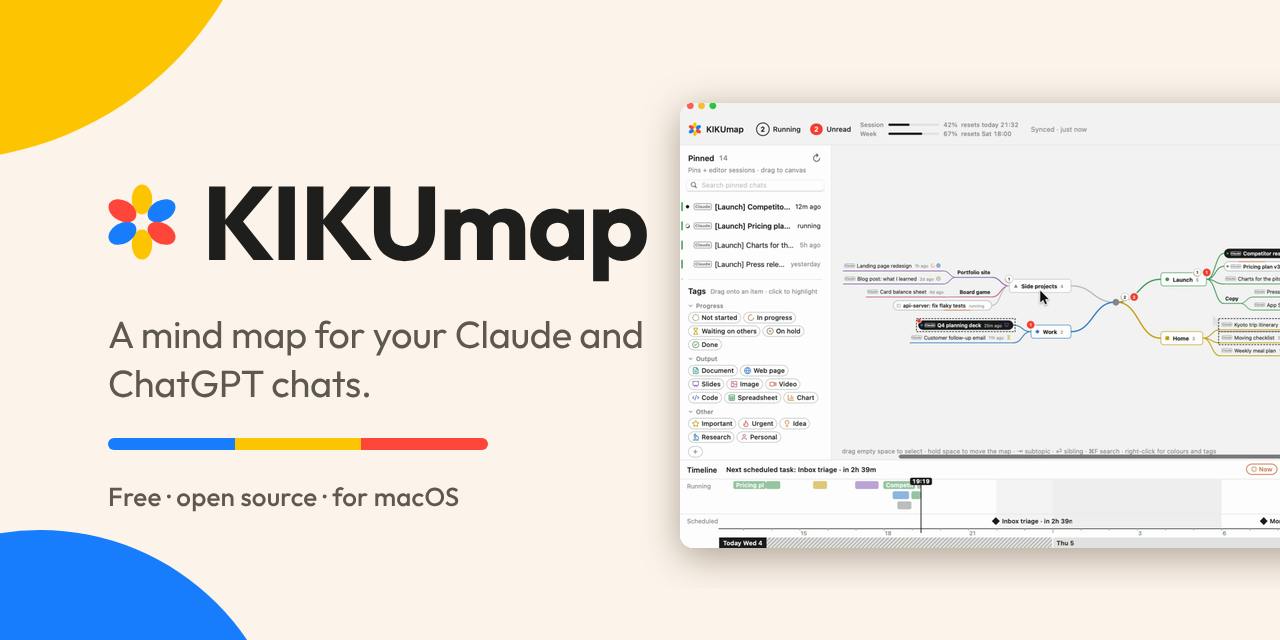
KIKUmap: Manage Your Claude and ChatGPT Conversations with Mind Maps
KIKUmap is a macOS menu bar app that visualizes Claude and ChatGPT conversations as mind maps with real-time status. Free and open source.

Hugging Face Executive Warns: Cyberattacks Are Eroding the Openness of Open-Source AI
Hugging Face executive Irene Solaiman warns that rising cyberattacks on open AI platforms may force stricter security limits, threatening the openness of the open-source community and affecting the developer ecosystem.