Indie Developer Comes Clean on AI Usage, Steam AI Disclosure Becomes a Player Boycott Flashpoint

An indie developer honestly disclosed AI use and was boycotted by players, reflecting the dilemma between transparency and survival.
A developer with 20 years of experience independently built the fly fishing game Mend using Claude and honestly disclosed AI usage on Steam—narration and character voiceovers use AI text-to-speech, some text was drafted with AI assistance, and menu music was created by AI, while explicitly stating that no AI image generation was used. However, the disclosure statement triggered boycotts in multiple communities, with some players directly abandoning the purchase and even mistakenly assuming that non-AI parts were also AI-generated. The developer calculated that replacing AI with human work would cost about $2,000, far exceeding the $13.99 price, and he himself lacks a recording environment. The incident highlights the common dilemma of indie developers between transparent disclosure and commercial survival, and the industry's lack of consensus on the reasonable boundaries of AI use.
A software developer with 20 years of experience independently built a fly fishing game called Mend using Claude, set against real rivers in Alberta and British Columbia. The game is set to launch on Steam next week, but what he didn't expect was that the focus of player discussion wasn't the fishing gameplay—it was the AI disclosure statement he honestly filled out on Steam.
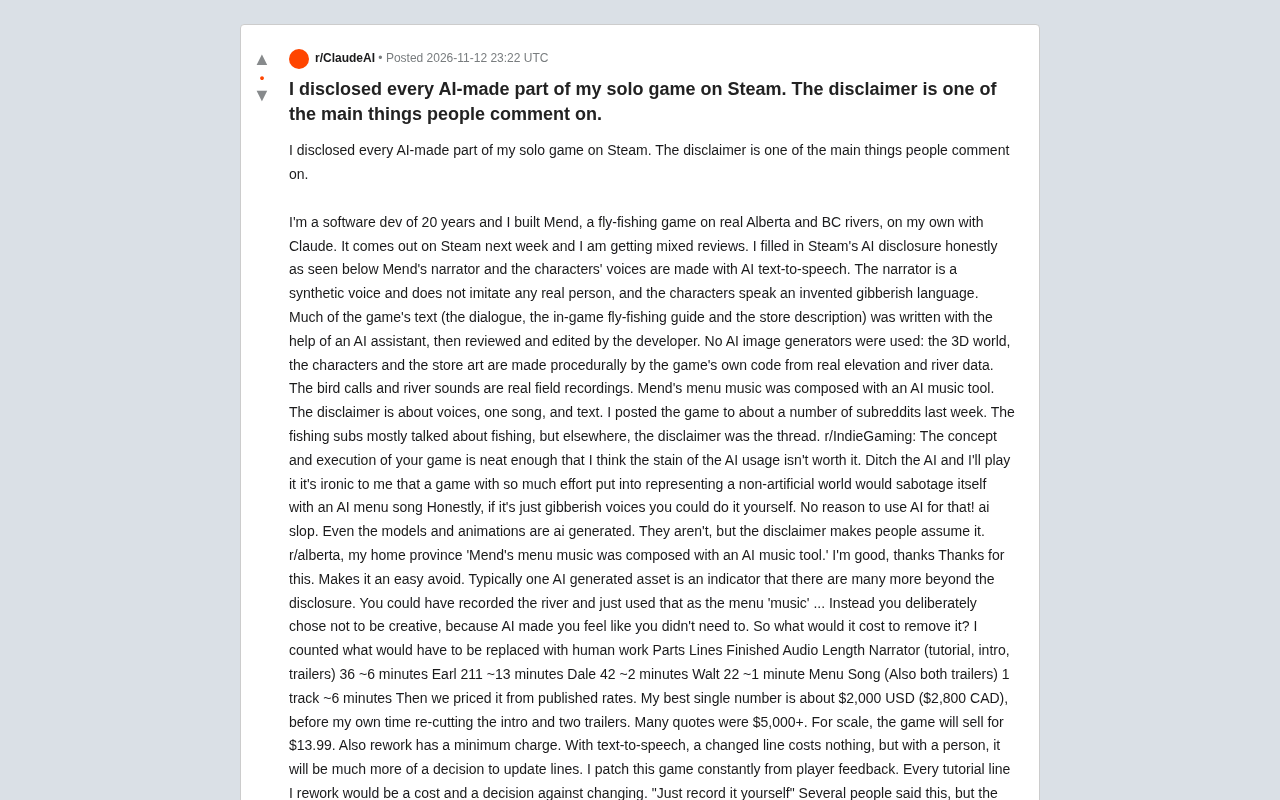
An "Honest" AI Disclosure List
The developer fully listed every part of the game where AI was involved: narration and character voiceovers use AI text-to-speech, with the narrator being a synthetic voice that doesn't imitate any real person, and characters using a fictional gibberish language; game text (dialogue, in-game fly fishing guide, store description) was drafted with the help of an AI assistant and then reviewed and edited by the developer; menu music was created with an AI music tool.
At the same time, he clearly drew the boundaries where AI was not used: no AI image generators were used—the 3D world, characters, and store art are all procedurally generated by the game's own code based on real elevation and river data; bird songs and river sounds are field recordings.
The intent of this disclosure was transparency, but in the eyes of some players, it became a "blacklist."
Since 2024, Steam has required developers to fill out an AI content disclosure questionnaire when submitting games, categorizing AI use into two types: one is "Live-generated" (content generated by AI in real time at runtime), and the other is "used during development" (assets such as art, audio, and code created with AI tools). Disclosure information is displayed prominently on the store page for players to review before purchase. Valve's original intent was to keep consumers informed, but it has not set prohibitive rules on AI use, nor does it review whether disclosure content is "sufficient," so the granularity and wording of disclosure are entirely up to the developer. In practice, this mechanism has created an informal "labeling effect": the more detailed the disclosure, the more likely it is to be scrutinized item by item by players.
Player Reaction: From Fishing Discussion to AI Trial
According to the developer, after the game was posted in multiple subreddits, fishing-related communities mostly discussed the fishing itself, but in other communities, the disclosure statement became the main thread of discussion.
In r/IndieGaming, one player said: "Your game concept and execution are polished enough that I think the taint of AI use isn't worth it. Drop the AI and I'll play." Another player pointed out the irony: "A game that puts so much effort into presenting a non-artificial world destroys itself with an AI menu track." Some players bluntly called it "AI slop," and even mistakenly assumed the models and animations were AI-generated—even though they were not.
In r/alberta, the subreddit for the developer's home province, the reaction was more direct. After seeing that the menu music was created by AI, one player said "I'm good, thanks," and noted "that makes it easy for me to avoid." Others believed that one AI-generated asset is usually just the tip of the iceberg, implying there was more undisclosed content.
These comments reflect a reality: in the current climate of public opinion, AI disclosure not only fails to dispel doubts but may actually reinforce bias. The developer helplessly pointed out that even though the models and animations were not AI-generated, the disclosure statement still makes people associate them that way.
The Cost Ledger of Replacing AI
Faced with the question "why not replace it with real people," the developer did a detailed cost calculation. He tallied up the parts that would need to be replaced with human work: narration 36 lines, about 6 minutes; character Earl 211 lines, about 13 minutes; Dale 42 lines, about 2 minutes; Walt 22 lines, about 1 minute; menu music 1 track, about 6 minutes.
Based on public quotes, he concluded that the best single cost would be about $2,000 (CAD 2,800), and that doesn't include his own time re-editing the opening and two trailers. Many quotes exceeded $5,000. By comparison, the game is priced at only $13.99.
In addition, redoing it incurs minimum charges. With text-to-speech, changing a line costs nothing; but with human voice acting, every line update becomes a cost decision. And the developer frequently patches the game based on player feedback, which means every change to a tutorial line comes with a cost consideration.
The cost structures of text-to-speech (TTS) tools and human voice acting are fundamentally different. TTS is billed by character or subscription, with near-zero marginal cost per generation—changing a line only requires re-synthesis, which takes seconds; human voice acting is a typical "hourly rate + minimum charge" model, which in addition to the recording itself involves studio rental, directing, post-editing, noise reduction, and mastering, and industry practice usually sets a minimum billing threshold per session (ranging from hundreds to over a thousand dollars), and re-recording often requires rebooking the actor's schedule. For indie games that need frequent iteration, this "every change is a purchase" model significantly raises long-term maintenance costs—which is the practical reason many small teams prioritize TTS in prototypes and early versions.
Why "Just Record It Yourself" Isn't Realistic
Many players suggested "just record it yourself," but the developer explained that the problem isn't the voice itself—it's the recording environment. He doesn't have a recording studio or audio equipment, nor does he think he has a good voice for games. He admitted that his own voice would be worse than what's in the game now, and that a room that isn't worse would cost more than an actor.
He isn't arguing about whether the criticism is fair—"People can buy what they like. I'd rather disclose and lose sales than hide it." What he really wants to ask is: for an indie developer with no budget, what is a reasonable expectation?
He listed several options: release with AI voice and music and disclose it, accepting the sales loss? Release silently, without narration, character voiceovers, or menu music, because "nothing is better than AI"? Spend $2,000 upfront without knowing whether the game will recoup its costs? Wait until the game reaches a certain level of success and then hire actors to replace it? Or is there some other approach he hasn't thought of?
Consensus and Divergence Across Multiple Perspectives
Looking at discussions across multiple subreddits on Reddit, a consensus gradually becomes clear: players' resistance to AI is real, and disclosure statements amplify that sentiment, even triggering excessive speculation about undisclosed AI content. At the same time, the economic constraints facing indie developers are also an objective fact—$2,000 is no small sum for a game priced at $13.99.
The divergence lies in defining "reasonable expectations." Some players believe that even with a limited budget, human creation should be prioritized, even if it means reducing content (such as releasing silently); others understand the developer's predicament and believe that transparent disclosure is already rare. The developer himself raised a more fundamental question: when AI tools enable indie developers to achieve things that were previously impossible at extremely low cost, should the industry resist across the board, or should it establish more nuanced criteria?
For developers who also use tools like Claude to build products, this fly fishing game author's confusion may be universal: where should the line be drawn, and is the cost of disclosure worth it?
"AI slop" is a derogatory label that has become popular in English-speaking communities since 2023, referring to large amounts of low-cost, homogenized, AI-generated content lacking human polish. It was initially used to describe AI-generated spam posts on social media, and later expanded to games, music, publishing, and other fields. Its problem lies in its blurred boundaries: players often apply the label based on "whether AI traces are detected" rather than "content quality," so even if AI is only used for marginal assets like menu music, the entire work may be categorized as slop. In contrast, the industry is also discussing more nuanced frameworks, such as distinguishing "AI-assisted human creation" from "AI-replacing human creation," and distinguishing core experience assets from peripheral assets—but there is currently no widely accepted unified standard.
Key Takeaways
- The developer independently developed the fly fishing game Mend using Claude and honestly disclosed AI usage on Steam, but it triggered a player boycott, with the disclosure statement becoming the focus of discussion.
- Player reactions are polarized: some directly abandon the purchase because of AI elements, and even mistakenly assume that the non-AI parts are also AI-generated; others understand the indie developer's budget constraints.
- The cost of replacing AI narration, character voiceovers, and menu music with human work starts at about $2,000, with many quotes exceeding $5,000, while the game is priced at only $13.99—a significant cost pressure.
- The developer points out that "recording it yourself" is unrealistic due to the lack of a recording environment and equipment, and the follow-up cost of changing lines is far higher than text-to-speech.
- The incident reflects the common dilemma of indie developers in the AI era: the tension between transparent disclosure and commercial survival, and the industry's lack of consensus on the reasonable boundaries of AI use.
One-line Summary
An indie developer honestly disclosed AI use, only to face a player boycott—highlighting the dilemma between transparency and survival.
Related articles

Programmers in the AI Era: How Deep Should You Learn Legacy Tech?
How should programmers transform under AI's impact? How deep should legacy tech be learned? Drawing on a Bilibili creator's share, this breaks down the levels of embracing AI, the shift from process-driven to project-driven learning, and how lower technical barriers affect junior and mid-level roles.

OpenAI Releases GPT-6.2 Dual Models Astra and Sol, API Price Cut by 20%
OpenAI releases GPT-6.2 Astra and Sol, with Astra's API price cut 20% to $8/$40 per million tokens and ranking second on the Artificial Analysis Intelligence Index. This article analyzes the dual-model strategy, price-cut impact, and developer selection advice.

Perplexity Computer Launches Multiagent: 16 AI Agents Cross-Validate Each Other
Perplexity launches Multiagent mode for Computer: a lead agent orchestrates up to 16 sub-agents on Claude, GPT, and Gemini, sharing findings and cross-validating work with effort above Ultra.