Instagram Founder's Advice: Solve Real Problems, Not Technology Looking for a Problem

Entrepreneurs should beware of "technology looking for a problem" and, like Instagram, focus on real user pain points rather than showing off.
Drawing on a talk by an Instagram co-founder, the article dissects the "technology looking for a problem" trap common among startups: assuming demand exists just because technical components are readily available (like mashing up Google Maps and Twitter). Instagram's success instead came from focusing on three "humble" but specific problems—making photos beautiful, making multi-platform sharing easy, and making uploads fast—rather than trying to upend photography. That restraint turned it from "yet another photo network" into an everyday product. The article further notes that "technology looking for a problem" is even more common in the AI era, and entrepreneurs should first find specific, perceptible, high-frequency friction points, then use technology to eliminate them; technology is the means, the problem is the starting point.
Too many entrepreneurs are obsessed with technology itself rather than the problems users actually face. A talk by an Instagram co-founder nails this widespread trap: countless startups are doing "technology looking for a problem" instead of "problem-driven technology."
The Trap of Technology Looking for a Problem
"There are too many people not focused on the problems people actually have. Too many startups are technology looking for a problem." He gave a vivid example: someone sees that both Google Maps and Twitter exist, and assumes they should mash the two together into a geolocated tweet product—simply because the technical components are readily available, they assume the demand exists.
The essence of this mindset is "assembly-style innovation": piecing together off-the-shelf technology modules and expecting users to flock to them. The problem is that users never pay for a combination of technologies—they pay for solutions to their own pain points. If a product can't answer "whose problem does this solve, and what is it," then no matter how flashy the technology, it's just a castle in the air.
"Technology looking for a problem" is a classic concept in entrepreneurship and innovation research, often contrasted with "problem-driven innovation." It describes a reverse R&D path: first you have an existing technical capability or component, then you try to find an application scenario and users for it. The phrase can be traced back to reflections on U.S. defense and aerospace R&D experience in the 1960s—a large amount of cutting-edge technology was developed but couldn't find a civilian market. In the Silicon Valley context, it's often used to criticize "solutionism": mistaking technical feasibility for user demand. A related concept is the "law of the instrument" (hammer syndrome): give someone a hammer and everything looks like a nail. The key to spotting this trap is to ask whether the product has a clear "problem statement" and a verifiable user pain point, rather than deriving demand solely from the availability of technical components.
The Three "Humble" Problems Instagram Got Right
Instagram's success didn't come from a grand vision to upend the world of photography. Instead, the team focused on three simple, specific, real problems: making photos beautiful, making it easy to share them across multiple social networks, and making uploads blazing fast.
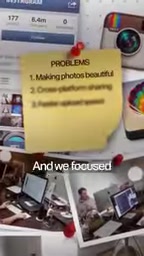
None of these three problems could be called "world-changing," but they precisely hit the core friction points users faced in mobile photography at the time. Poor photo quality? Add filters. Cross-platform sharing a hassle? One-tap multi-platform posting. Uploads too slow? Optimize compression and transmission. Every feature corresponded to a perceptible pain point, rather than existing just to show off technical prowess.

"We weren't trying to reinvent the world of photography—we just decided to focus on these three humble, simple problems." This restraint is precisely the key to the product's success. Most failed products do the opposite: they try to solve a problem that's too grand, too vague, and impossible for users to clearly perceive.
Instagram didn't start from scratch when it launched in October 2010. Its predecessor, Burbn, was a feature-heavy location-based check-in app inspired by Foursquare, with check-ins, points, photo sharing, and more. Co-founders Kevin Systrom and Mike Krieger discovered that what users used most was actually taking and sharing photos, so they decisively cut the other features, keeping only photos, filters, and social sharing, and renamed the product Instagram. The iPhone 4 had just been released, significantly improving camera quality, but mobile network upload speeds were limited, native camera filters were missing, and cross-platform sharing was cumbersome—these were exactly the real constraints that Instagram's three "humble problems" addressed. Within two months of launch, users surpassed 1 million, and in 2012 it was acquired by Facebook for about $1 billion. This history is often cited as a classic case of "subtraction" and "focusing on real friction points."
From "Yet Another Network" to a Product Users Actually Use
It was precisely this focus on real problems that turned Instagram from "yet another network trying to tackle photos" into a product people use every day.

The underlying logic of this transformation is worth pondering for every product person: users won't use you because you've adopted new technology; they'll stay only because you've made something they already wanted to do easier. Instagram didn't create the demand for "sharing photos"—it just made it faster, prettier, and simpler.
Lessons for Entrepreneurs in the AI Era
In today's AI startup boom, the "technology looking for a problem" pattern is more common than ever. Large models are powerful, so countless teams are repackaging old scenarios with AI without seriously answering "where are users actually stuck?" Instagram's experience reminds us: first find those three specific, perceptible, high-frequency friction points, then use technology to eliminate them.
Technology is the means; the problem is the starting point. Solving the problems people actually have matters far more than demonstrating technical capability.
In the AI era, "technology looking for a problem" has a more specific variant, often called the "AI wrapper": adding a simple interface on top of a general-purpose large model, packaging the model's capabilities into a product without solving a specific workflow problem for a specific user. Such products are easily overshadowed by the next capability upgrade from the underlying model vendor, and they lack the deep scenario embedding needed for user retention. The opposite is the "scenario-first" path: go deep into a vertical workflow, identify high-frequency, quantifiable friction points that existing tools can't satisfy, and then judge whether AI is the most appropriate means to eliminate that friction. A practical test is "problem interviews first"—before writing the first line of code, confirm whether target users are already enduring this pain point with clumsy workarounds (like Excel or manual processes); if no one is willing to pay a cost for the status quo, no matter how advanced the technology, it will be hard to convert into demand.
One-line Summary
Entrepreneurs should beware of "technology looking for a problem" and, like Instagram, focus on real user pain points rather than showing off.
Paragraph Summary
Drawing on a talk by an Instagram co-founder, the article analyzes the "technology looking for a problem" trap common among startups: assuming demand exists simply because technical components are readily available (such as mashing up Google Maps and Twitter). In contrast, Instagram's success came from focusing on three "humble" yet specific problems—making photos beautiful, making multi-platform sharing easy, and making uploads fast—rather than trying to upend the world of photography. This restraint turned it from "yet another photo network" into a product people use every day. The article further points out that "technology looking for a problem" is even more common in the AI era, and entrepreneurs should first find specific, perceptible, high-frequency friction points, then use technology to eliminate them; technology is the means, and the problem is the starting point.
Related articles

Last Week Tonight Exposé: The Dangerous Ties Between Politicians and White Supremacy
Last Week Tonight investigates Georgia Senate candidate Mike Collins and Florida candidate Marshall Rawson, exposing their multiple ties to white supremacists and the Republican Party's silent response.

AI Buzz Weekly: GPT-6.5 Leak, New Claude Model, and MiniMax's Cost-Effectiveness
This week's AI buzz roundup: suspected GPT-6.5 leak, Microsoft configs showing GPT-6.1 Tera, Anthropic's new model that can identify entire classes of bugs, disappointing early Gemini 4 Carbon results, and MiniMax M3.1 Flash beating Claude Opus 5 and GPT-5.6 Sol in benchmarks at extremely low cost.

AI Briefing: Gemini 4 Carbon Released, Ant Open-Sources Ling-3.1
AI Briefing: Google releases Gemini 4 Carbon qubit model, claiming to surpass Opus 5.5 with half-price tokens; Ant open-sources Ling-3.1-1019 for real-task Personal Agents; domestic AI drug discovery succeeds in 18 of 19 projects, hitting all 6 GPCR targets; zero-revenue company valued at $20B raises another $1B; Sichuan convenience store robot sales fail.