Instagram Head: Negative Sentiment Around AI Will Get Worse

Instagram head Mosseri predicts public negative sentiment toward AI will continue to worsen.
Instagram head Adam Mosseri said on a podcast that negative public sentiment around AI "is only going to get worse." Citing students booing tech executives at graduation ceremonies, he noted that antipathy toward AI is not limited to young people or creative workers and is broader than commonly perceived. Mosseri offered no specific data; his judgment is closer to an intuitive summary based on platform observation. The article argues this candor is both expectation management and a sign that platforms must confront user anxiety when advancing AI features, with booing showing the controversy has entered everyday scenarios.
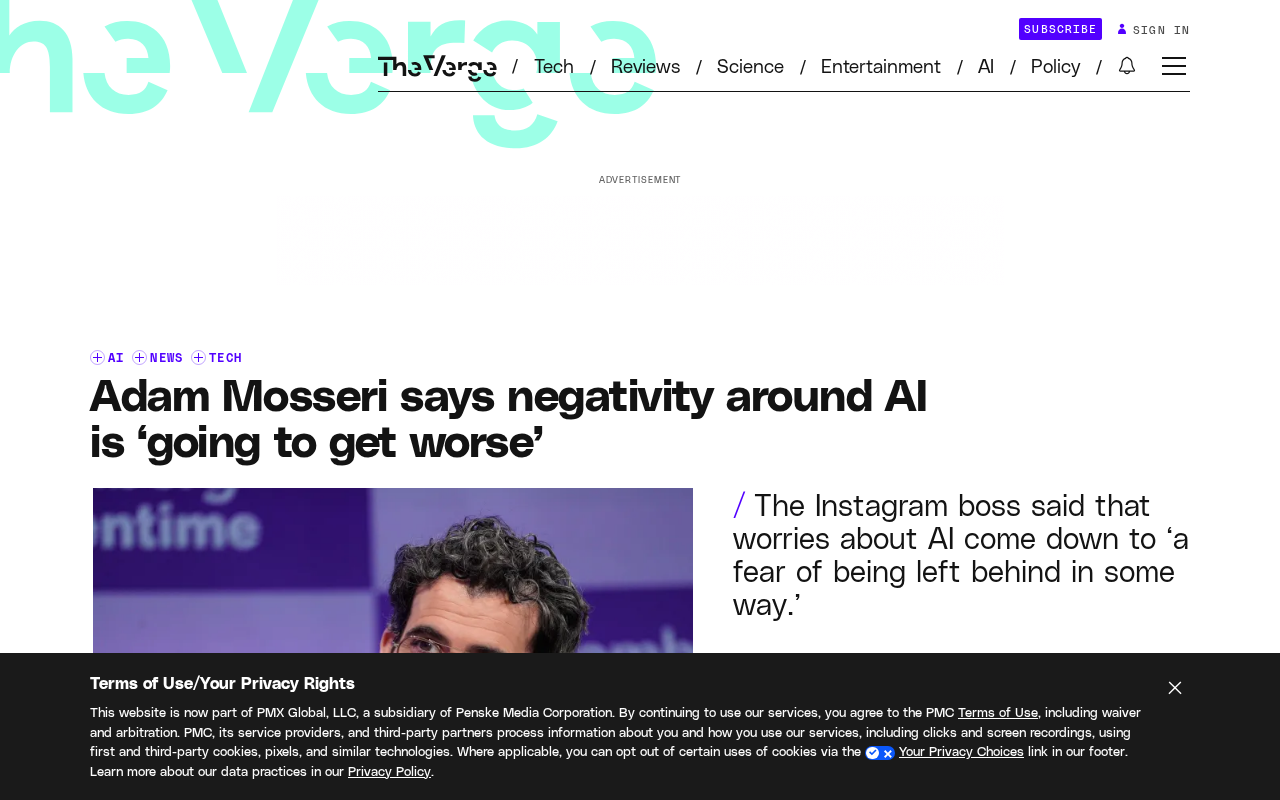
Instagram head Adam Mosseri, appearing on the Colin and Samir podcast, offered a rather pessimistic assessment of current public sentiment around AI: the negative voices are "only going to get worse." He was asked about AI during an interview discussing the launch of the widescreen feature, and the conversation was sparked by the recent phenomenon of college students booing tech company CEOs at graduation ceremonies.
Discontent Isn't Limited to Young People and Creative Workers
Mosseri's starting point is a highly symbolic scene: at university graduation ceremonies, students in the audience boo the tech executives who take the stage. After such footage spread on social media, many interpreted it as a shift in how the younger generation views the tech industry.
But Mosseri emphasized in the interview that antipathy toward AI is not confined to young people, nor is it solely the sentiment of creative industry professionals. He acknowledged that "a lot of people really don't like AI," and described the scope of this sentiment as broader than commonly assumed. This is worth noting: controversies around generative AI were previously often framed as a conflict over copyright and livelihoods between artists, writers, and tech companies, but Mosseri's remarks suggest that resistance has spread to more ordinary populations.
Mosseri himself did not provide specific survey data or user feedback figures in the interview; his judgment is more of an intuitive summary based on platform observation. This also means the value of his statement lies not in precise measurement, but in the fact that it comes from the top figure at a mainstream social platform, representing the platform's perception of the public opinion temperature.
Among the controversies sparked by generative AI, copyright and training data issues were among the first fronts to become institutionalized. Since ChatGPT's release in late 2022, a large number of writers, visual artists, and publishers have filed class-action lawsuits against AI companies, with the core allegation being that models scraped copyrighted works for training without authorization. The U.S. Copyright Office has since published multiple reports over the following years, clearly leaning toward the view that outputs generated solely by AI, lacking substantial human creative input, are not protected by copyright, while remaining cautious about the legality of training data. Such legal processes have pushed the controversy from moral condemnation to the level of enforceable rules, and have also given the creative industry's resistance an institutional language. Understanding this background helps clarify the reference point for Mosseri's judgment: as the copyright framework began to take shape, public sentiment did not subside but instead spread to more ordinary user groups.
Why a Platform Executive Would Voluntarily Discuss Negative Sentiment
A social platform head publicly acknowledging that the technology his own industry is pushing is unpopular is itself a signal. Typically, tech companies tend to emphasize AI's convenience and efficiency, attributing doubts to "transitional growing pains." Mosseri did not take this route, but directly acknowledged the existence of negative sentiment and predicted it will continue to worsen.
This candor may stem from two considerations. The first is expectation management: when public doubts about AI have already been expressed through booing at public occasions like graduation ceremonies, continuing to downplay the problem will only deepen distrust. The second is the platform's own positioning needs—Instagram's product updates (such as the widescreen feature mentioned in the interview) are closely tied to AI recommendation and AI creation tools, and the platform needs to understand user sentiment to determine the pace of feature rollout.
Recommendation algorithms and generative AI are two different but intertwined systems within social platforms. Recommendation algorithms determine what users see, have been running for years, and have accumulated considerable public scrutiny; generative AI is responsible for producing content—from image generation to automatic captions to providing material tools for advertisers. What both have in common is that they weaken the intuition of "users actively choosing": the former filters information for users, the latter creates content for users. Precisely because of this, when platforms announce updates that appear to be purely interface-level, such as the widescreen feature, they often simultaneously affect recommendation logic and how AI creation tools are integrated, and users' overall sentiment toward AI naturally attaches to specific features. That Mosseri was asked about AI while discussing widescreen is not a topic jump—the platform's product line itself has become difficult to separate from the AI narrative.
From Boos to Products: The AI Controversy Is Entering Everyday Scenarios
The booing at graduation ceremonies is a symbol worth unpacking. Over the past few years, public discussion around AI has mainly concentrated in two circles: capability and risk debates within the tech community, and the creative industry's dissatisfaction with training data and copyright. But students' direct resistance to tech executives shows that this sentiment has spilled beyond professional circles into broader public expression.
For platforms, this means rolling out AI features is no longer just an engineering problem but also a communication problem. Users' antipathy toward AI may not target any specific feature, but may stem from anxiety about broader issues such as employment, creative value, and information authenticity. Mosseri's judgment—"it's only going to get worse"—is in effect a warning to the industry: negative sentiment will not automatically dissipate as product experiences improve; it has its own inertia.
Tech company executives being booed at graduation ceremonies is not an isolated, occasional phenomenon. Around 2024, graduation speech events at multiple U.S. universities saw students turning their backs on the podium, raising signs, or collectively walking out, targeting the speakers' companies' positions on the Gaza conflict, labor policies, or their push for AI. The organization of such actions relies heavily on social media, and their spread is mainly through short video clips, allowing a few seconds of booing footage to quickly detach from its original context and become a public symbol. For observers, the significance lies not in the decibels of the booing itself, but in the fact that it transforms abstract discontent that previously stayed in comment sections and tech forums into face-to-face, physically present public expression. Once this form is replicated, it lowers the psychological threshold for others to express similar sentiments.
Editorial View
Mosseri's statement provides a rare insider perspective: the problem of AI's public acceptance may be harder to solve than the technology itself. For those building AI products, this is a reminder—no matter how good the features are, if users are resistant to the technology itself, adoption will still be limited. If the judgment that negative sentiment "will only get worse" holds true, then for some time to come, tech companies will need not just better models but also clearer communication strategies and direct responses to user concerns.
It is worth adding that this information comes from a single interview source, and Mosseri did not elaborate on specific arguments. Which groups his "worse" refers to and in what forms it will manifest currently lack further detail. This also makes the above judgment more suitable as a reference point for observing industry sentiment rather than a definitive conclusion.
One-line Summary
Instagram head Mosseri predicts public negative sentiment toward AI will continue to worsen.
Paragraph Summary
Instagram head Adam Mosseri said on a podcast interview that negative public sentiment around AI "is only going to get worse." Starting from the phenomenon of college students booing tech executives at graduation ceremonies, he noted that antipathy toward AI is not limited to young people or creative workers and is broader than commonly perceived. Mosseri provided no specific data; his judgment is closer to an intuitive summary based on platform observation. The article argues that this candid statement is both expectation management and a reflection that platforms need to face user anxiety when advancing AI-related features. The booing as a symbol shows that the AI controversy has spilled beyond professional circles into everyday scenarios; negative sentiment will not automatically dissipate as product experiences improve and may become a key obstacle to AI product adoption.
Related articles
Ponytail: Get AI to Write 10 Lines of Code Instead of 335
Ponytail, an open-source project with over 170,000 GitHub stars, makes AI coding assistants think like senior developers: implementing a date picker drops from 335 lines to 10 without sacrificing security checks or error handling. Works with Claude Code, Codex, Cursor, and more.

Claude Code Turned Into a Game Studio: 49 AI Agents Working Together
The open-source GitHub project Claude-Code-Game-Studios turns Claude Code into a game development studio with 49 AI agents and 72 skills, simulating a real studio hierarchy for multi-agent collaboration—nearly 29k stars.

ChatGPT Advice to Reduce Medication Led to Former Amazon Employee's Death? Behind the Reddit Controversy
Reddit controversy: A former Amazon employee allegedly died after following ChatGPT's advice to reduce medication dosage. The case involves U.S. employment-linked healthcare, work visa sponsorship, and cognitive side effects of epilepsy drugs, raising questions about AI medical advice responsibility.