Instagram Is Letting Celebrity AI Deepfakes Run Rampant?
AI-generated celebrity photos spread via blue-badge verification and search engine summaries, with platform governance facing absent labeling and delayed correction.
An AI-generated Mia Goth photo posted by a verified Instagram fan account spread across platforms, was covered by gossip sites, and was ultimately summarized by Google AI Overview as real—forming a complete false-information solidification chain. Similarly, AI videos of Taylor Swift and Lionel Messi have reached millions of views, mixed with real footage. Meta doesn't require labeling of AI-generated photos, and new accounts emerge daily after removals, making governance a game of whack-a-mole. Whether platforms should mandate labeling of AI-generated images of real people, and whether users have the right to post such content, form the core controversy. Under the current system, correction costs are extremely high, and institutional design needs to shift from passive reaction to proactive defense.
A photo of Mia Goth went viral across the internet—but it was AI-generated. Her representatives confirmed this to the media, and the Instagram account that posted it carried a blue verification badge, despite actually being run by a fan. The image was subsequently reposted across major social platforms, celebrity gossip sites piled on with coverage, and when users searched for Mia Goth on Google, AI Overview even summarized it as a real photo.
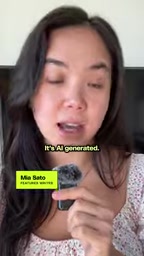
This is not an isolated case. According to analysis by a YouTube channel, Instagram is now flooded with AI-generated celebrity content: an AI video of Taylor Swift rapping a Drake song racked up 1.8 million views, and a similar clip of Lionel Messi hit 2.1 million. This fabricated content is mixed in with real footage, leaving ordinary users with virtually no way to tell the difference.
Why the Verification System Became an Accomplice
The blue badge was meant to signal account authenticity, but when it's granted to a fan-run account, it instead becomes an endorsement of credibility for false information. The spread of the Mia Goth photo clearly illustrates this vulnerability: verified account posts → cross-platform diffusion → media citation → search engine AI summary solidifies it. Each link in the chain assumes the credibility of the previous one, while the source is an unverified AI-generated image.
Meta currently does not require AI-generated photos to carry labels. Even when an account is removed, new ones emerge every day. This "whack-a-mole" approach to governance is clearly inadequate against mass-produced AI content.

The Verified Badge was originally introduced by Twitter in 2009 to prevent impersonation of celebrities, and gradually evolved into platforms' confirmation of "noteworthy accounts." Instagram's verification mechanism is managed centrally by Meta, with review criteria including authenticity, uniqueness, completeness, and notability—but after verification, platforms typically do not continuously fact-check the content accounts publish. This means verification only guarantees "who this account is," not "whether what it posts is true." Once a fan-run account obtains verification through some means, its posts automatically inherit the halo of credibility that verification confers, creating a trust mismatch.
The Governance Vacuum on Platforms
Google's AI Overview played the role of amplifier in this incident. When users searched for Mia Goth, the system automatically scraped and summarized that fake AI image, effectively stamping false information with algorithmic authority. The boundary of responsibility between search platforms and social platforms becomes blurred here—Instagram doesn't label, Google doesn't verify, and ultimately users bear the risk of misjudgment.
According to observations by the YouTube channel, view counts for this type of AI celebrity content have reached the millions. Taylor Swift's AI rap video and Lionel Messi's fabricated clip both achieved considerable reach, indicating that users have genuine demand for such content—or at least strong curiosity.

Google AI Overview is a generative search summary feature launched by Google Search in 2024. It uses large language models to synthesize search results, presenting answer-style summaries directly at the top of the page so users can get information without clicking through to links. The feature relies on crawling and trust evaluation of web content, but has not established specialized verification mechanisms for AI-generated images. Once an AI fake image is cited by enough web pages, AI Overview may treat it as a widely reported fact and present it in summaries. This "algorithmic authority endorsement" effect gives false information a second layer of solidification at the search level, further increasing the difficulty of correction.
The Boundary Between Real and Fabricated Is Disappearing
The thorny part of the problem is that not all AI celebrity content is malicious. Fan creations, parodies, and artistic experiments may all use AI-generated celebrity imagery, much of it entertainment-oriented rather than intended to deceive. But when this content is mixed with real footage in the same feed and carries no labels whatsoever, users are effectively deprived of their right to know.

Should platforms require mandatory labeling of AI-generated images of real people? Should users be allowed to post AI-generated images of real people? These two questions form the core of the current controversy. Those in favor of labeling argue it's a basic obligation of information transparency; opponents worry that labeling would inadvertently harm creative freedom, and that technical detection accuracy itself is imperfect.
Looking at the Mia Goth incident, once false information enters the dissemination chain under the current system, the cost of correction is extremely high. Representatives debunking, platforms removing accounts, search engines updating summaries—each step involves time lags, and during that window, the fake image has already completed its viral spread. Meta's "no mandatory labeling" policy is facing increasing pressure as the barrier to AI generation drops dramatically.
Whether Instagram has truly "given up" on governing celebrity AI deepfakes may be an exaggeration. But from the dimensions of verified accounts being misused, absent labeling mechanisms, and delayed cross-platform correction, the platform's current strategy is closer to passive reaction than proactive defense. When the production speed of AI-generated content far exceeds human review capacity, the institutional design itself needs rethinking—rather than expecting users to develop a sharp eye on their own.
Deepfake detection technology currently relies mainly on digital watermarks, metadata analysis, and generation-trace identification, but accuracy is limited by model iteration speed and image compression loss. Organizations such as C2PA (Coalition for Content Provenance and Authenticity) are pushing content credential standards that require AI-generated content to embed verifiable provenance information, but the standard needs broad adoption across platforms and toolchains to take effect. In the absence of mandatory labeling and unified detection standards, ordinary users can hardly distinguish high-quality AI-generated images from real photos with the naked eye alone—especially when images have been forwarded and compressed multiple times, further weakening detection signals.
One-line Summary
AI-generated celebrity photos spread via blue-badge verification and search engine summaries, with platform governance facing absent labeling and delayed correction.
Paragraph Summary
An AI-generated photo of Mia Goth, posted by a blue-badge-verified fan account on Instagram, was reposted across platforms, covered by celebrity gossip sites, and ultimately summarized by Google AI Overview as a real photo—forming a complete chain of false-information solidification. Similarly, AI videos of Taylor Swift and Lionel Messi have reached millions of views, mixed with real footage in feeds. Meta doesn't require labeling of AI-generated photos, and new accounts emerge daily after removals, making governance a game of whack-a-mole. Whether platforms should mandate labeling of AI-generated images of real people, and whether users have the right to post such content, form the core controversy. Under the current system, correction costs are extremely high, and institutional design needs to shift from passive reaction to proactive defense.
Related articles

AI Comic Drama with WorkBuddy from Scratch: A Step-by-Step Skill Pack Installation Guide
Learn how to create AI comic dramas with WorkBuddy from scratch. This guide covers installation, Skill pack import and invocation, plus a script generation demo with manual revision tips to get you through the first step from script to storyboard.

WorkBuddy Agent Runs the Entire GEO Database Mining Pipeline with a Single Prompt
WorkBuddy agent automates GEO database mining: from data search and curation to batch correction, differential analysis, co-expression networks, feature gene screening, and immune infiltration—a single prompt generates a complete bioinformatics report, greatly lowering the barrier to bioinformatics analysis.

PC Memory Wasted? Hacker News Debates Centralized Data Centers
Hacker News users argue that personal computer memory is wasted and should be centralized in data centers, sparking debate on centralized vs. distributed computing resource allocation. This article analyzes the logic behind the claim, the costs of centralization, and new tensions in memory resource allocation in the AI era.