Instant Search: Local AI File Search with 95% Hit Rate

Instant Search uses embedding models to enable semantic search of local Mac file content, claiming a 95% hit rate.
Instant Search is a Mac local AI file search tool that gained attention on Product Hunt and bills itself as the first accurate local AI file search. It uses embedding models to convert file content into vectors, supports semantic-level similarity matching, can pinpoint specific pages within files, and claims a 95% hit rate. The product emphasizes local processing to protect privacy, and its differentiation lies in deep indexing of file content rather than matching only file names. However, the official information does not disclose the specific embedding models, indexing speed, or resource usage, and the definitional boundaries of the 95% hit rate are unclear. It received 80 votes and ranked 12th on Product Hunt, with moderate attention and limited user feedback, and faces competition from tools such as Spotlight and Raycast.
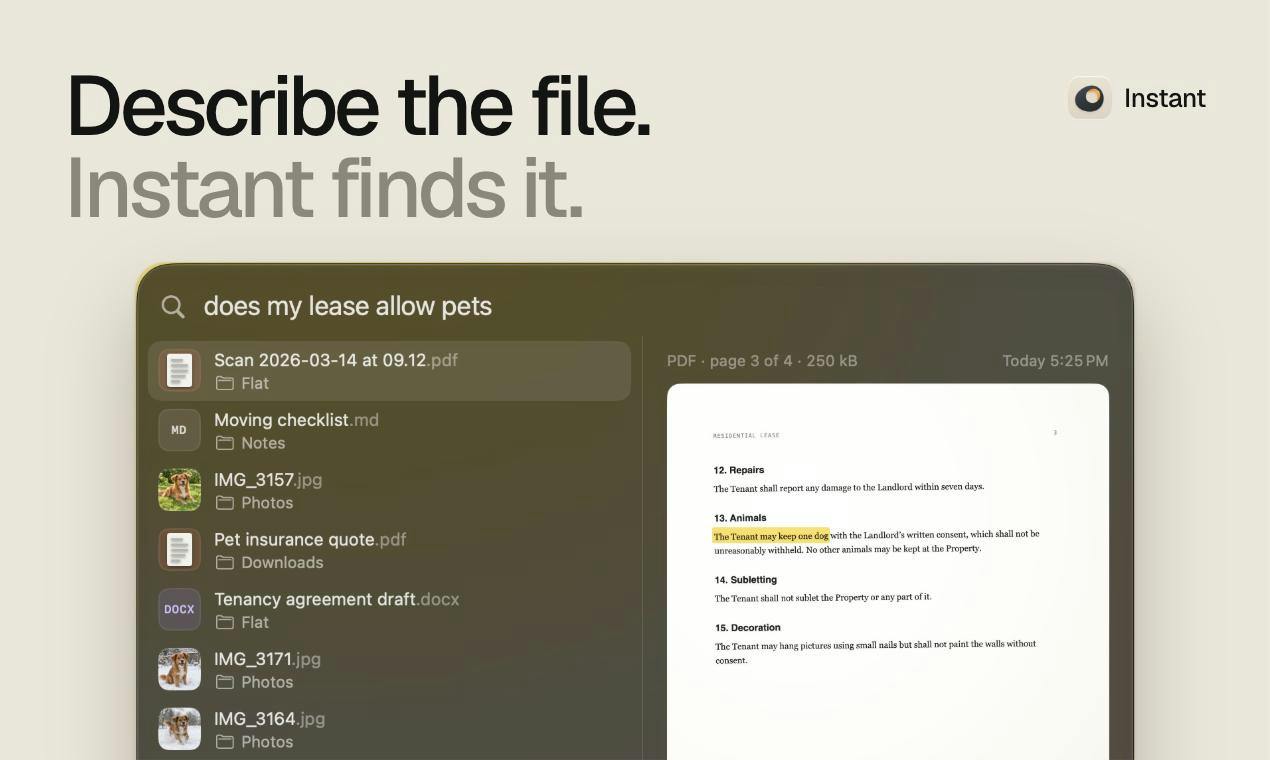
In an age of information overload, most of our important documents are scattered across local hard drives. Traditional file search tools rely on file names or basic keyword matching and often struggle when faced with massive document collections. Instant Search, which gained attention on Product Hunt today, aims to change this with AI—it bills itself as "the first accurate local AI file search," uses the latest embedding models to pinpoint the exact file—or even the specific page—you want, and claims a 95% hit rate.
The Pain Points of Local Search and AI's Solution
We've all been there: you remember that a report mentioned a concept, but you can't recall the file name; or you need to find the page in a stack of PDFs that contains a specific clause. Spotlight or Windows Search are fast, but they only match file names and metadata and have almost zero understanding of document content. Instant Search's approach is to bring embedding models into local search. These models convert text into vectors, enabling semantic-level similarity matching rather than literal keyword matching. That means you can describe what you're looking for in natural language, and even if the file name is completely unrelated, it may still be retrieved.
According to the official description, Instant can pinpoint "a specific page within a file," which is especially useful for long documents such as research materials, contracts, and ebooks. However, the publicly available information does not reveal which embedding models are used, nor does it explain indexing speed or resource usage—both of which will be key to the actual experience.
Embedding models are a class of neural network models that map data such as text and images into high-dimensional vectors. The core idea is that semantically similar content is also close together in vector space. For example, "how to apply for reimbursement" and "expense approval process" are different on the surface, but their embedding vectors will be very close. In search scenarios, the system pre-generates vectors for each file (or each page) and builds an index; at query time, the user's input is converted into a vector, and the best matches are found by computing metrics such as cosine similarity. Compared with traditional inverted indexes (keyword matching), embedding models can capture synonyms, context, and implicit semantics, and therefore support natural-language descriptive retrieval. Common embedding models include OpenAI's text-embedding series and open-source models such as BGE and E5. They can run locally, but different models vary significantly in accuracy, speed, and resource usage.
95% Hit Rate: Thoughts Behind a Striking Number
The most eye-catching claim about Instant is its 95% hit rate. In the search field, that is a very high number, but we need to understand its definitional boundaries: On what kind of test set was it obtained? Is it top-1 hit rate or top-5 hit rate? Is it consistent across different file types (plain text, scanned PDFs, images)? The original material does not provide details, so this number is better treated as a reference indicator than an absolute guarantee.
From a technical perspective, embedding-based semantic search can indeed achieve high recall when document content is clear and well structured, but for scans or handwritten content, performance drops sharply without OCR preprocessing. Instant is currently positioned as a Mac productivity tool and most likely prioritizes common text-based documents. If you mainly work with native digital documents, its performance is worth looking forward to.
In information retrieval evaluation, hit rate usually refers to the proportion of queries whose results include at least one relevant document, while top-1 hit rate requires the most relevant result to rank first, and top-5 hit rate allows relevant results to appear in the top five. The difficulty differs greatly: top-5 is often more than ten percentage points higher than top-1. In addition, the choice of test set (document types, how queries are constructed, relevance judgment criteria) greatly affects the numbers. If the 95% hit rate refers to top-5 and the test set consists mainly of well-structured native PDFs, it is not unusual; if it refers to top-1 and covers scans and handwritten content, it is quite astonishing. Therefore, when interpreting such metrics, one must ask about their definitions and test conditions and cannot directly equate them with accuracy in everyday use.
Product Positioning and Competitive Landscape
Instant Search positions itself in the Mac productivity tool segment, emphasizing speed and accuracy. Its direct competitors include built-in tools such as Spotlight and launchers such as Alfred, as well as emerging AI search tools such as Raycast's AI features. Compared with these tools, Instant's differentiation lies in deep indexing of file content and page-level pinpointing. However, whether it supports cross-application search and can integrate seamlessly with existing workflows is not yet clear from the Product Hunt page.
It is worth noting that Instant received 80 votes and 2 comments on Product Hunt, ranking 12th for the day. That level of attention is not a blockbuster, but it does show that a group of early users is willing to give it a try. Because there are very few comments, we cannot glean more real-world experience from user feedback.
Privacy and the Advantages of Local Processing
Instant emphasizes "local AI search," which means indexing and querying are likely done on the device without uploading files to the cloud. For privacy-conscious users, this is an important selling point. At a time when AI features generally rely on the cloud, local processing can both protect data security and reduce network latency, improving search speed. Of course, running embedding models locally places certain demands on hardware, especially when the file library is very large, since the initial indexing may consume considerable computing resources. Whether Instant has optimized for this remains to be tested.
OCR (Optical Character Recognition) is a technology that converts text in images or scanned PDFs into editable, searchable text. For embedding-based semantic search, OCR is a prerequisite step for handling non-native digital documents: only after text is extracted from images can meaningful embedding vectors be generated. If scans, photos, or handwritten notes have not undergone OCR, the embedding model can only "see" blank space or noise, and retrieval performance drops sharply. The quality of OCR (recognition accuracy, layout analysis capability) directly affects the recall of subsequent indexing. Many local search tools integrate OCR engines (such as Tesseract or Apple's Vision framework) as part of the indexing pipeline, but OCR is computationally intensive and poses a challenge to initial indexing speed for large batches of scanned documents.
Conclusion: A Local Search Option Worth Watching
Instant Search captures a real pain point in local file search—content-level retrieval—and offers its own answer with embedding models. If the 95% hit rate can be delivered in everyday use, it will become an efficient productivity tool. However, the currently available information is limited, lacking model details, performance data, and user reviews. Users who are interested are advised to follow updates on its official website or wait for more hands-on reports. For Mac users who frequently need to quickly locate information in large numbers of documents, Instant is worth adding to the candidate list.
One-line Summary
Instant Search uses embedding models to enable content-level semantic search of local files on Mac, claiming a 95% hit rate.
Paragraph Summary
Instant Search is a Mac local AI file search tool that has gained attention on Product Hunt and bills itself as the first accurate local AI file search. It uses embedding models to convert file content into vectors, supports semantic-level similarity matching, can pinpoint specific pages within files, and claims a 95% hit rate. The product emphasizes local processing to protect privacy, and its differentiation lies in deep indexing of file content rather than matching only file names. However, the official information does not disclose the specific embedding models, indexing speed, or resource usage, and the definitional boundaries of the 95% hit rate are also unclear. The product received 80 votes and ranked 12th on Product Hunt, indicating moderate attention, with little user feedback, and it faces competition from tools such as Spotlight and Raycast.
Related articles

LangChain Retry Middleware Configuration: Practices and Selection Guide
Based on Reddit community discussion, this article analyzes LangChain ModelRetryMiddleware retry parameter configuration practices, covering the selection logic and alternatives for key options like max_retries, backoff_factor, and jitter.

Texas Senate Race in Trouble: Why Are Republicans Nervous?
Texas Senate race stirs Republican anxiety. Based on street interviews, this article analyzes the Democratic offensive in funding, organization, and running everywhere, and how Republicans are defending "Texas, Texas" amid the political pendulum effect.

Gemini Chat Now Generates and Edits Google Docs Directly, a New Breakthrough in Office Productivity
Google Gemini's chat interface now generates and edits PDF, Google Docs, Sheets, Slides, Markdown, TXT, and code files. Available to all users; web supports all formats, mobile only PDF for now.