Is AI-Generated Content Trustworthy? Google Autocomplete Experiment Reveals Human Bias Blind Spots

Research shows AI attribution labels didn't increase Spanish speakers' vigilance toward gender-biased statements and may reduce scrutiny.
The study tested Spanish-speaking participants using gender-biased statements from Google Autocomplete and unbiased human-written facts. Participants were randomly assigned to an AI-attribution group or a no-source group. Results showed AI labels did not significantly affect reaction times or agreement judgments, indicating people don't automatically trigger heightened credibility vigilance toward AI content and may even scrutinize it less. Researchers note source disclosure alone has limited effectiveness against AI bias; the sample was limited to Spanish speakers and the gender domain, leaving cross-cultural and cross-bias generalizability unverified.
How Do Humans Evaluate AI-Generated Gender-Biased Content?
Large language models (LLMs) are rapidly permeating daily life, but how users perceive and evaluate the content these models produce remains an understudied area. A study with Spanish-speaking participants tested the influence of AI attribution information on human judgment using gender-biased statements generated through Google Autocomplete.
The study recruited Spanish-speaking participants via the Prolific platform and asked them to evaluate two types of materials: biased statements extracted from Google Autocomplete, and unbiased gender-related facts written by humans. Participants were randomly assigned to two groups: one was told that some of the materials were AI-generated, while the other received no source information.
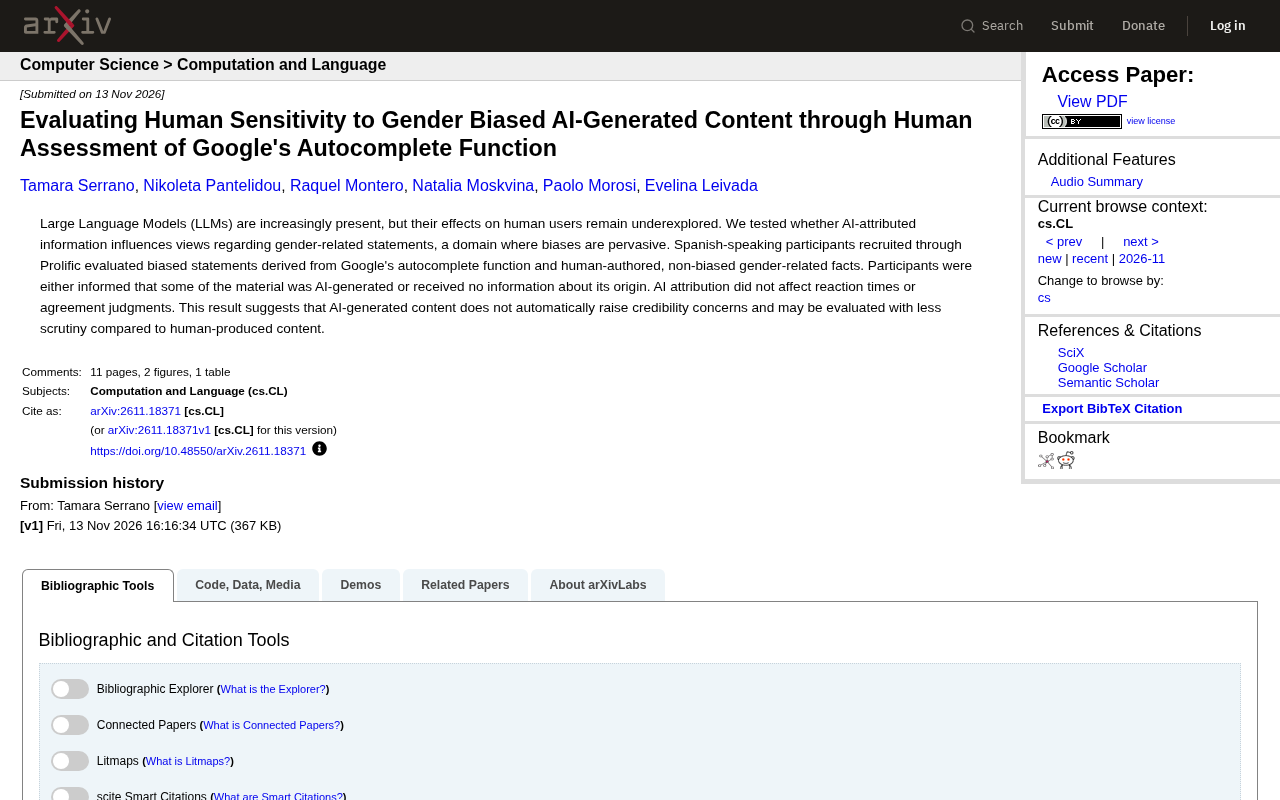
The experiment recorded participants' reaction times and agreement judgments. Results showed that AI attribution information did not significantly affect reaction times or agreement judgments. This means that when people face AI-generated content, they do not automatically trigger heightened credibility vigilance—and may even scrutinize it less than human-created content.
Key Finding: AI Labels Don't Change Judgments—They May Reduce Scrutiny
The study's most striking conclusion is that telling participants content was AI-generated did not make them more wary of gender-biased statements. Reaction time data showed that participants did not exhibit longer deliberation times when evaluating AI-attributed content; agreement judgments also showed no significant difference from the uninformed group.
This result challenges the common assumption that "AI-generated content triggers credibility concerns." Researchers note that AI-generated content may be evaluated with less scrutiny compared to human-produced content. In other words, rather than increasing critical thinking, AI labels may actually cause users to let down their guard.
This finding relates to the specific nature of the gender bias domain. Gender-related statements are inherently socially sensitive, but AI attribution information did not amplify this sensitivity. Participants appeared to treat AI-generated content as a "neutral" information source without maintaining heightened vigilance toward its potential biases.
Methodological Design: Google Autocomplete as a Source of Bias
The study chose Google Autocomplete as the source of biased statements for methodological reasons. The autocomplete feature generates suggestions based on large volumes of user query data, and these suggestions often reflect gender stereotypes prevalent in society. For example, when typing certain professions or adjectives, autocomplete may present gender-biased associations.
Participants were recruited through the Prolific platform and were all Spanish speakers. Experimental materials included biased statements extracted from autocomplete and unbiased gender facts written by humans. Participants were asked to rate their agreement with these statements, while reaction times were recorded as an indicator of cognitive processing depth.
The experiment set up two conditions: the AI-attribution group was told that some materials were AI-generated, while the control group received no source information. This design directly tested the impact of source labels on the judgment process, rather than the persuasiveness of the content itself.
The reaction time paradigm is a classic indicator in cognitive psychology for measuring processing depth. Its logic is based on the positive relationship between "cognitive load and reaction time": when individuals engage in more deliberate thinking, retrieval, or contradiction resolution regarding certain information, the required reaction time is typically longer. In this study, if the AI attribution label truly activated participants' critical scrutiny, their reaction times when evaluating biased statements should have been significantly longer than those of the unlabeled group. However, the results did not show this pattern, providing behavioral-level evidence that "AI labels did not trigger deep processing." It should be noted that reaction times may also be affected by factors such as statement length, reading speed, and fatigue, so they typically need to be triangulated with subjective indicators such as agreement ratings.
Google Autocomplete is a predictive text feature based on large-scale query logs: when users type a prefix, the system recommends the most likely subsequent words in real time based on signals such as historical search frequency, co-occurrence patterns, and regional popularity. Because its training data comes from real user behavior, autocomplete often faithfully maps societal stereotypes—for example, typing "nurses are" or "engineers are" may respectively yield highly gendered completion results. For this reason, autocomplete is regarded as a "natural specimen of social bias," capable of obtaining bias materials with ecological validity without artificially constructing statements. However, its limitation is that completion results change dynamically with algorithm updates and user behavior drift, and reproducibility is affected by time and geography.
Implications and Limitations: New Thinking on AI Content Governance
This study has practical significance for AI content governance. If users do not become more vigilant because of "AI-generated" labels, then relying solely on source disclosure to combat AI bias may have limited effectiveness. Policymakers and platform designers need to rethink: how can users' critical evaluation truly be activated?
The study also has limitations. The sample was limited to Spanish speakers, and cultural background may affect sensitivity to gender bias. Additionally, the experimental materials focused on the gender domain, and whether other types of bias (such as race and age) exhibit similar patterns remains unclear. The presentation of AI attribution information may also affect results—in the experiment, participants were told that "some materials" were AI-generated, not all of them.
Future research can explore differences across linguistic and cultural backgrounds, and whether more explicit AI disclosure methods can change judgment patterns. Regardless, this study reminds us that the credibility issue of AI-generated content is not only about technical accuracy but also about blind spots in human cognition.
AI disclosure is a common policy tool in current AI governance discussions, with the basic assumption that telling users content is machine-generated can prompt them to initiate more deliberate information evaluation. This assumption is rooted in "source monitoring" theory—people typically conduct metacognitive tracking of the credibility of information sources. However, the findings of this study suggest that the effectiveness of source disclosure may be highly dependent on the salience, specificity, and user motivation of the disclosure. When disclosure information is relatively general (such as "some materials are AI-generated"), users may treat it as a low-diagnosticity cue and ignore it. Moreover, labels may also trigger a reverse effect of "automation bias": some users tend to believe machine output is more objective and neutral, thereby reducing rather than increasing vigilance.
One-line Summary
Research shows that AI attribution labels did not increase Spanish-speaking users' vigilance toward gender-biased statements and may actually reduce scrutiny.
Paragraph Summary
This study, targeting Spanish-speaking users, examined the impact of AI attribution information on human judgment using gender-biased statements generated by Google Autocomplete and unbiased facts written by humans. Participants were randomly divided into two groups: one was told some materials were AI-generated, while the other received no source information. Results showed that AI attribution labels did not significantly affect reaction times or agreement judgments, indicating that people do not automatically trigger heightened credibility vigilance when facing AI-generated content and may even evaluate it with less scrutiny. Researchers note that relying solely on source disclosure to combat AI bias has limited effectiveness, and policymakers need to rethink how to truly activate users' critical evaluation; the sample was limited to Spanish speakers and the gender domain, and generalizability across cultures and bias types remains to be verified.
Related articles

GitHub Project 'GIF Factory' Nears 2K Stars: One Sentence Lets AI Batch-Create 12 Animated Stickers
A Chinese open-source GitHub project 'GIF Factory' with nearly 2,000 stars and an MIT license lets AI batch-generate animated stickers, transition cards, posters, and signatures from a single sentence.

DeepSeek Harness Plugin "Footprints": Turn Your Photo Album into a 3D Earth
DeepSeek Harness plugin "Footprints" projects album photos onto a 3D Earth by GPS location, auto-generates travel storylines, and supports natural language photo search, "that day in years past," and landmark recognition, with a local read-only index for privacy.

Quiver Launcher + Game List: One-Stop Management for PC Ported Games
Learn how the open-source Quiver launcher (localized) and game project list work together: the list discovers PC port and recompilation projects, while the launcher handles installation, version updates, and tag management, with full workflow and manual import options.