Is Jensen Huang's CEO Seat at Risk? Yale Scholar Puts His Odds of Staying at Roughly 50-50

NVIDIA's board investigates Jensen Huang over alleged spy ties; Yale professor says his odds of staying are about 50-50.
NVIDIA's board has launched an investigation into CEO Jensen Huang, focused on his dealings with a person suspected of being a Chinese spy. Yale School of Management professor Sonnenfeld offered a qualitative "50-50" judgment, saying Huang's fate depends on where the investigation leads, the board's internal balance of power, and external political pressure. The article notes that NVIDIA sits at the center of AI computing and at a key node of export controls against China, so any China-related governance controversy will be amplified at the industry and geopolitical levels. Founder-CEO status may turn from a talisman into a source of risk amid compliance and security controversies. The investigation's results and the board's handling will directly affect the company's strategic continuity and expectations across the AI supply chain, and the market needs to correct the perception that "NVIDIA is driven by one person."
NVIDIA's board of directors is investigating CEO Jensen Huang's relationship with a person suspected of being a Chinese spy, and Jeffrey Sonnenfeld, a management professor at Yale University, offered a blunt assessment: Huang's odds of staying on are "about 50-50."
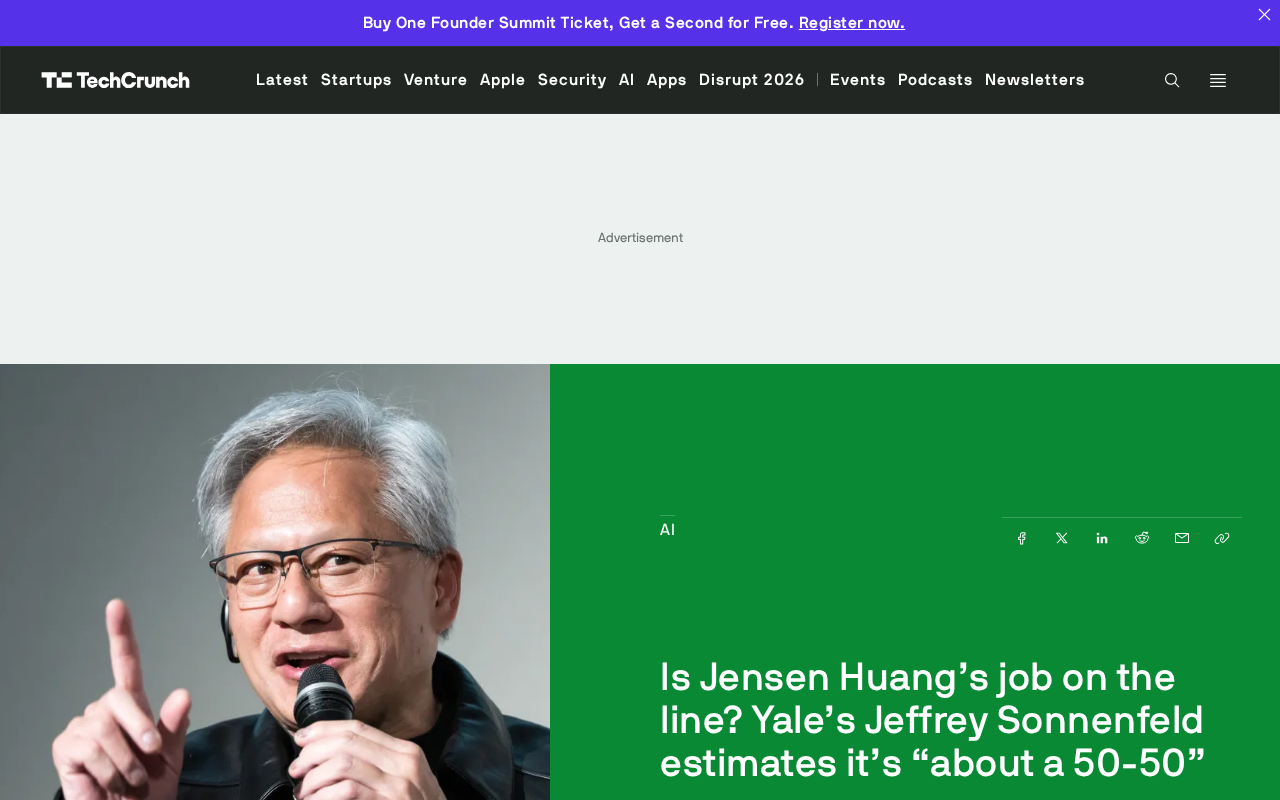
The Heart of the Investigation: A Relationship Under Renewed Scrutiny
According to publicly available information, NVIDIA's board has launched an investigation into Huang, focused on his dealings with a person suspected of being a Chinese spy. The investigation itself is not equivalent to a conviction, but for a company at the center of global AI computing power, having its CEO's personal network examined through a national security lens is already enough to constitute a major governance event.
NVIDIA's situation is unusual: it is both a key node in U.S. chip export controls against China and the most central supplier of global AI infrastructure. Any governance controversy involving a China factor will be amplified and interpreted at the level of industry and geopolitics.
Board investigation mechanisms in corporate governance: Under the U.S. listed-company governance framework, the board of directors (especially independent directors or the audit/compliance committee) has the authority to launch an internal investigation into a CEO's personal conduct and affiliations. Such investigations are usually assisted by outside law firms, with the goal of clarifying whether there is risk of violating company policy, securities regulations, or export control laws—not of conducting a criminal probe. Common triggers include whistleblower reports, regulatory inquiries, media disclosures, or anomalies found during due diligence. For the CEO, the board may adopt temporary measures during the investigation, such as information firewalls and restrictions on access to sensitive business. The investigation's conclusion can range from closure with no objections, to a warning, to a demand for remediation, or even a recommendation for dismissal. For a semiconductor company like NVIDIA that relies heavily on government licenses and export compliance, an investigation involving individuals linked to a foreign government could also draw the attention of the U.S. Department of Commerce's Bureau of Industry and Security (BIS) and intelligence agencies.
What Sonnenfeld's "50-50" Means
Sonnenfeld is a senior associate dean at the Yale School of Management who has long studied CEO leadership and corporate governance, and he frequently speaks publicly on whether senior executives at large companies should stay or go. His "50-50" is not a precise probability model but a qualitative judgment: Huang's fate depends on where the investigation leads, the balance of power within the board, and the magnitude of external political pressure.
The weight of this judgment lies in the fact that it opens a gap in the industry's long-held assumption that "Jensen Huang is irreplaceable." For years, the bond between Huang and NVIDIA has been regarded as a model of the founder-CEO approach, and the market has rarely seriously discussed what NVIDIA would look like without him.
The tension between founder-CEOs and corporate governance: The founder-CEO model refers to a company founder also serving as chief executive over the long term, and it is especially common in the tech industry. Its advantages lie in strategic continuity, long-termist decision-making, and strong cultural identity; its risks center on excessive concentration of power, insufficient board independence, and the absence of succession mechanisms. Academic research (such as analyses of S&P 1500 companies) shows that valuation premiums for founder-CEO firms often coexist with governance discounts, and once compliance or personal controversies arise, the market's pricing of "key-person risk" can rise quickly. Institutional investors and proxy advisors (such as ISS and Glass Lewis) typically require that boards demonstrate independent oversight when safety, legal, or reputational risks are involved. Therefore, the qualitative "50-50" judgment reflects this: between founder charisma and governance compliance, the board needs to reweigh the cost of removal against the risk of retention.
Founder Charisma Is No Longer a Talisman
Jensen Huang is NVIDIA's most distinctive symbol—from GPUs to the CUDA ecosystem, and to the pricing power in this round of the AI wave, his personal judgment has profoundly shaped the company's strategic path. But founder-CEO status is a double-edged sword in governance controversies: on one hand, boards are naturally cautious about removing a highly accomplished CEO; on the other hand, when controversies involve compliance and security issues, personal influence may instead become a source of risk that the board must cut off.
One detail: Sonnenfeld's statement addressed the specific question of "whether Huang stays on as CEO," not a characterization of Huang's personal conduct. That distinction matters: the investigation's results have not been released, and any discussion of whether he stays or goes rests on assumptions.
Potential Impact on NVIDIA and the AI Supply Chain
NVIDIA is currently the core beneficiary of the global AI investment cycle, and the stability of its management directly affects the expectations of customers, suppliers, and capital markets. If the investigation escalates and leads to management changes, the continuity of the company's strategy in the short term, the way it handles its China business, and the decision-making pace of its next-generation product roadmap could all be affected.
Conversely, the board's decision to launch an investigation itself sends a governance signal: even a founder-CEO regarded as irreplaceable must submit to board scrutiny. For investors accustomed to viewing NVIDIA as "a company driven by one person," this is a correction in perception.
Conclusion: The Suspense Lies in the Investigation, Not the Commentary
Sonnenfeld's "50-50" is a window for observation, not a conclusion. What truly determines Huang's fate is the factual findings and handling of the board's investigation. Before the results are clear, what is certain is this: NVIDIA's governance structure is undergoing a rare stress test, and the outcome of this test will affect more than just one company.
One-line Summary
NVIDIA's board is investigating Jensen Huang over an alleged spy relationship, with a Yale professor saying his odds of staying are about 50-50.
Paragraph Summary
NVIDIA's board has launched an investigation into CEO Jensen Huang, focused on his dealings with a person suspected of being a Chinese spy. Yale School of Management professor Sonnenfeld offered a qualitative "50-50" judgment, saying Huang's fate depends on where the investigation leads, the balance of power within the board, and external political pressure. The article notes that NVIDIA sits at the center of AI computing power and at a key node of export controls against China, so any China-related governance controversy will be amplified at the industry and geopolitical levels. Founder-CEO status may turn from a talisman into a source of risk amid compliance and security controversies. The investigation's results and the board's handling will directly affect the company's strategic continuity and expectations across the AI supply chain, and the market needs to correct the perception that "NVIDIA is driven by one person."
Related articles

Claude Fable 5.2 Hands-On: Top Intelligence but Absurdly Expensive
Anthropic releases Claude Fable 5.2 and Mythos 5.2, topping the Artificial Analysis intelligence leaderboard with big gains in scientific reasoning, strong game and hardware design, but max mode costs ~$26.54 per task. Hands-on game, circuit board design, and pricing advice.

1,000 AI Agents Formalize Fermat's Last Theorem in 30 Hours, Anthropic Releases New Claude Models
Anthropic releases Claude Fable 5.2 and Mythos 5.2: 1,000 agents formalize Fermat's Last Theorem in 30 hours, coding costs halved, plus hardware design and physics.

Claude Fable 5.2 Released: A Thousand AI Agents Build a Bootable OS in 8 Days
Anthropic releases Claude Fable 5.2 and Mythos 5.2—same model, two safety tiers. Demo shows 1,000 AI agents build a bootable OS in 8 days, formalize Fermat proof in 30 hours, score 64.6 beating Gemini 4 Carbon, price cut 20%.