Is the AI Coworker Space Already Crowded? Founders Ask Whether There's Still Room for a Simple, General-Purpose Agent

AI agent market is crowded, but there is still unmet demand for simple, reliable general-purpose AI coworkers.
Based on a Reddit discussion, this article analyzes whether there is still room in the crowded AI agent market for a simpler, easier-to-use general-purpose AI coworker. Existing products fall into three categories: general-purpose, workflow automation, and vertical specialized, and users report a gap between demos and real-world experience. Core pain points include insufficient reliability requiring full supervision, high complexity deterring ordinary users, pricing unfriendly to low-frequency users, and limited integration depth. Users are willing to pay for quantifiable time savings, with outcome-based pricing preferred. The conclusion is that the opportunity lies in lowering the barrier, improving reliability, focusing on high-frequency scenarios, and building trust through low-risk tasks.
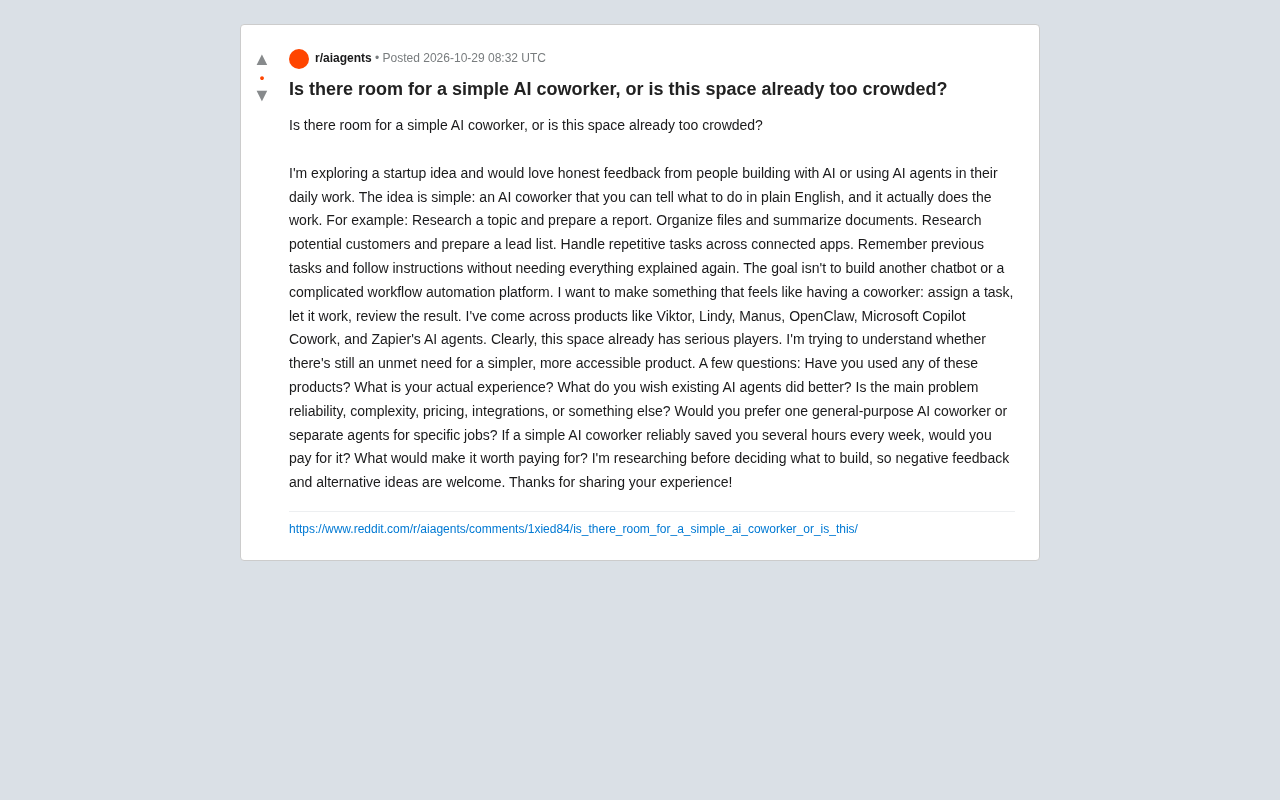
A founder posted on Reddit to explore a seemingly simple yet pointed question: with products like Viktor, Lindy, Manus, OpenClawAd, Microsoft Copilot Cowork, and Zapier AI agents crowding the market today, is there still room for a simpler, easier-to-use general-purpose AI coworker? The product form he envisioned: assign tasks in natural language, let the AI complete them autonomously, and the user only reviews the results—for example, researching and generating reports, organizing files and summarizing documents, researching potential customers and preparing lead lists, handling repetitive tasks across applications, and remembering previous tasks and instructions.
This post sparked discussion about the current state of the AI agent market, users' real pain points, and product opportunities. This article, based on that discussion and multi-source industry observations, analyzes the feasibility of a simple AI coworker.
Inventory of Existing AI Agent Products: Many Players, Uneven Experience
The products listed in the original post cover multiple layers, from general-purpose assistants to vertical automation. According to Reddit discussions and YouTube channel analyses, these products can be roughly divided into three categories:
- General-purpose AI coworkers: Such as Manus and Microsoft Copilot Cowork, which emphasize end-to-end task completion, but users report unstable reliability and that complex tasks easily deviate from expectations.
- Workflow automation platforms: Such as Zapier AI agents and Lindy, which excel at connecting applications to execute rule-based tasks, but have a high configuration threshold and are not friendly enough for non-technical users.
- Agents focused on specific scenarios: Such as Viktor (for finance/operations) and OpenClaw (an open-source agent framework), which perform better in niche areas but lack generality.
The consensus from evaluations by Bilibili creators and YouTube channels is that existing products are impressive in demos, but in actual use, issues such as integration depth, error handling, and contextual memory often force users to intervene repeatedly.
AI agents refer to software systems capable of autonomously perceiving their environment, making decisions, and executing actions to accomplish specific goals. Unlike traditional chatbots that can only answer single-turn questions, AI agents can decompose tasks, invoke tools (such as browsers, APIs, and file systems), maintain state across multiple steps, and adjust behavior based on feedback. Their core technologies include task planning, tool use, memory mechanisms, and reflection capabilities. Most AI agent products on the market today are built on large language models, achieving autonomy through prompt engineering or fine-tuning, but error accumulation in long task chains and context window limitations remain major technical bottlenecks.
OpenClaw is an open-source AI agent framework that allows developers to deploy and customize agent behavior themselves, emphasizing flexibility and data privacy. Unlike commercial closed-source products, OpenClaw provides basic modules for task orchestration, tool integration, and memory management, which users can extend as needed. Its advantage is auditability and modifiability, making it suitable for technically capable teams building vertical-scenario agents; its disadvantage is the lack of an out-of-the-box experience, making it difficult for ordinary users to use directly. The existence of open-source frameworks lowers the R&D threshold for AI agents but also exacerbates market fragmentation.
Users' Real Pain Points: Reliability, Complexity, and Pricing
The question raised in the original post—are the main issues reliability, complexity, pricing, or integration?—received responses from multiple angles in the discussion.
Multiple users stated that reliability is the primary obstacle. AI agents tend to accumulate errors in long task chains, forcing users to supervise throughout, which undermines the time-saving effect. Second, complexity deters ordinary users: many platforms require understanding concepts such as workflows, trigger conditions, and API connections, which goes against the intuition of "assigning tasks like to a coworker." Regarding pricing, models charging by task or by seat are unfriendly to low-frequency users, while integration depth determines whether an agent can truly work across applications—most products currently cover only mainstream SaaS, with limited support for long-tail applications.
According to feedback from one user in the Reddit discussion, after trying multiple agents, he ultimately kept only one for fixed report generation because "the debugging cost for other tasks is higher than doing them myself." This confirms the value of simplicity and reliability.
AI agent reliability issues often stem from "error accumulation": in long task chains, small deviations at each step (such as misinterpreting instructions, calling the wrong tool, or missing context) gradually amplify, ultimately causing results to deviate completely from expectations. In addition, hallucinations in large language models (generating plausible but incorrect content) and context window limitations (inability to remember overly long conversations or documents) also reduce reliability. The industry currently mitigates this through task decomposition, multi-step verification, human feedback loops, and restricted tool sets, but has not yet fully solved it. Reliability directly determines whether users dare to fully delegate tasks to agents.
Simple General-Purpose vs. Vertical Specialized: Demand Divergence Remains
Regarding "one general-purpose AI coworker or multiple specialized agents," the discussion showed divergence. One side argued that a general-purpose agent can reduce switching costs and is suitable for small teams and individuals with diverse tasks; the other side emphasized that specialized agents have higher accuracy in specific domains and are easier to build trust with.
Interestingly, one developer pointed out that the "simplicity" of a general-purpose agent often means hiding complexity in the background, but once a task exceeds the preset scope, users feel out of control. Therefore, product design needs to strike a balance between a simple interface and transparent control.
Willingness to Pay and Product Opportunities
The original post finally asked: if a simple AI coworker reliably saves several hours per week, would you be willing to pay? Under what circumstances is it worth paying?
In the discussion, most people said they would be willing to pay for quantifiable time savings, but only on the premise that the agent runs stably and requires no frequent intervention. Regarding payment models, charging by result or by time saved is preferred over fixed subscriptions. In addition, users hope the product can remember preferences and past tasks to reduce repeated explanations—exactly the selling point of "remembering previous tasks" in the original post's vision.
Overall, the opportunity for a simple AI coworker lies not in piling on features, but in lowering the barrier to use, improving reliability, and focusing on high-frequency scenarios. If it can achieve "assign and it's done" on specific task chains (such as research reports and lead organization) and gradually expand, it may still find a foothold in a crowded field.
Conclusion
The AI agent market is indeed crowded, but users still have unmet needs for a simple, reliable, and affordable general-purpose coworker. If founders can start with high-frequency, low-risk tasks, build trust in a transparent and controllable way, and design flexible payment models, they may find space between the giants and vertical players. As one Reddit user put it: "I don't need another tool that I have to teach how to work; I need a coworker that can just get the work done for me."
One-line Summary
AI agent market is crowded, but there is still unmet demand for simple, reliable general-purpose AI coworkers.
Paragraph Summary
Based on a Reddit discussion, this article analyzes whether there is still room in the crowded AI agent product market for a simpler, easier-to-use general-purpose AI coworker. The article divides existing products into three categories—general-purpose, workflow automation, and vertical specialized—and points out that users generally report a gap between demo performance and actual experience. Core pain points include insufficient reliability leading to full supervision, high complexity deterring ordinary users, pricing models unfriendly to low-frequency users, and limited integration depth. The discussion shows users are willing to pay for quantifiable time savings, with outcome-based pricing preferred. The conclusion is that the opportunity for a simple AI coworker lies in lowering the barrier, improving reliability, focusing on high-frequency scenarios, and starting with low-risk tasks to build trust.
Related articles
9Router Tutorial: A Free AI Token Solution for Claude Access
Complete 9Router tutorial: deploy an open-source AI routing proxy in two commands, aggregate free providers like KiRo AI, Gemini, and OpenCode, and use AI tokens free in the Claude client via Combo multi-model scheduling.

Cursor Agent SDK Released: Build Your Own AI Agents with Code
Cursor opens its Agent SDK: Agent-as-Code with Markdown instructions and TypeScript tools, one-command deploy, or self-host as a Node process. Pricing and independent testing still missing.
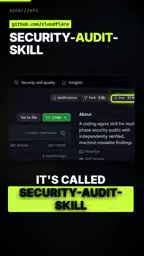
Cloudflare Open-Sources Security Audit Skill: Turning AI Agents into Code Auditors
Cloudflare open-sources Security Audit Skill, letting AI Agents run six-stage security audits with adversarial validation to cut false positives and output structured findings.json.