Java Engineers Transitioning to Agent Development: A Complete Four-Week Learning Roadmap

Breaking down the four-week Java engineer to AI Agent roadmap: timeline realism, strengths and gaps, and job-market realities.
The article breaks down a Bilibili "four-week crash course" tutorial on AI Agent development for Java engineers. The roadmap progresses as "theory → principles → collaboration → practice": week one covers core Agent components (LLM, planning, memory, toolset), week two covers classic paradigms like ReAct and their engineering implementation, week three goes deeper into multi-agent collaboration and Prompt tuning, and week four engages with business through small projects. The article notes that Java engineers' engineering capabilities in interface design, state management, and exception handling closely match the needs of productionizing Agents, which is their core strength; gaps lie in model capability understanding, Prompt engineering, vector retrieval memory mechanisms, and tool calling protocols, and the Java ecosystem has less accumulated experience in AI frameworks than Python. As for the "learn it and get a job" slogan, the article argues that four weeks can build a complete knowledge framework and produce presentable projects, helping to win interviews, but production-grade Agent capabilities still require honing in real projects; a more pragmatic positioning is completing the entry from 0 to 1.
Intensifying competition for traditional development roles, frequent pay cuts and layoffs are pushing many Java engineers to look for new technical directions. AI Agent development, with its broad applicability and salary premium, has become a popular choice for career changers. A tutorial series on Bilibili aimed at Java engineers proposes a "four-week crash course" learning roadmap, claiming that finishing it is enough to land a job. Is this timeline realistic? What gaps do career changers need to fill? Drawing on the tutorial's content and the realities of the industry, let's break it down.
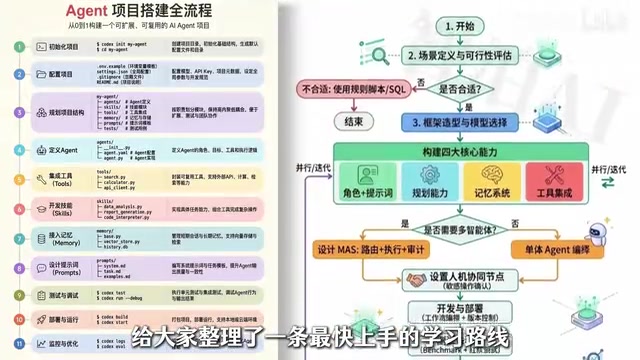
The Four-Week Roadmap: A Progressive Design from Theory to Practice
As designed in the tutorial, the four weeks are divided into four stages, each focusing on one theme, forming a progressive structure of "theory → principles → collaboration → practice."
Week 1: Mastering Core Agent Theory
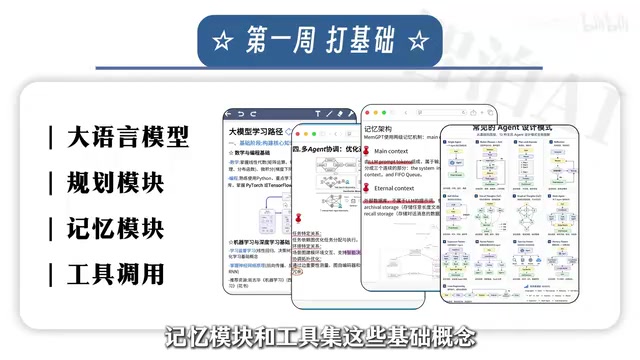
The goal of the first week is to build an overall understanding of AI Agents. The tutorial emphasizes grasping the core components of an Agent, including the large language model, the planning module, the memory module, and the toolset. These four parts form the basic skeleton of an Agent: the LLM handles understanding and generation, the planning module decomposes tasks, the memory module maintains context, and the toolset enables the Agent to invoke external capabilities. For engineers with Java development experience, the focus this week isn't programming but shifting from "procedural thinking" to "goal-driven thinking"—traditional development hardcodes logic, whereas an Agent is given a goal and then autonomously orchestrates the steps through the model.
Week 2: Focusing on Working Principles and Classic Paradigms
The second week moves into learning how Agents work and how to solve difficult problems, while also exploring classic Agent paradigms such as ReAct and Code. ReAct (Reasoning + Acting) is currently the mainstream Agent design pattern, having the model alternate between thinking and calling tools. For Java engineers, this week requires understanding not just concepts but the engineering implementation behind the paradigms—how to define tool interfaces, how to parse the model's action instructions, and how to handle exceptions in multi-turn loops. These happen to be Java engineers' strengths: experience in interface design, state management, and exception handling can be directly transferred.
The ReAct paradigm was proposed by Shunyu Yao et al. in the 2022 paper "ReAct: Synergizing Reasoning and Acting in Language Models." Its core idea is to have the LLM alternate between Reasoning and Acting: the model first outputs a thought (Thought) explaining what it is about to do; then outputs an action (Action), usually a call to some external tool; then receives the observation (Observation) returned by the tool and continues the next round of thinking based on that observation. This "Thought → Action → Observation" loop continues until the model considers the task complete.
From an engineering implementation perspective, the key to ReAct lies in defining a structured output format (such as Thought: ... Action: ...) so that the program can reliably parse the model output and dispatch tool calls. This is also why Java engineers' experience with interface design and state machines comes in handy—essentially, you are implementing a model-driven, looping state machine with external calls.
Week 3: Multi-Agent Collaboration and Prompt Tuning
The third week goes deeper into the logic of multi-agent collaboration while learning Prompt tuning techniques. Multi-agent collaboration addresses the limits of a single Agent's capabilities—through role division and message passing, multiple Agents work together to complete complex tasks. Prompt tuning directly determines the quality of an Agent's output, and the tutorial positions it as the key skill for making the Agent "more precisely understand the result you want." For Java developers accustomed to strong typing and explicit contracts, Prompt tuning is a "soft skill" that requires readjustment: the same intent, expressed differently, can produce significantly different results.
Multi-Agent Collaboration refers to breaking down complex tasks among multiple Agents, each playing a specific role, collaborating through message passing. Common collaboration patterns include: hierarchical (a dispatcher Agent assigns tasks to executor Agents), pipeline (each Agent processes and passes results in sequence), and debate (multiple Agents propose solutions to the same problem and review each other's work).
From an engineering standpoint, the complexity introduced by multi-agent systems lies mainly in: designing message protocols between Agents, how context is passed between Agents, retries and rollbacks when tasks fail, and the observability of the overall flow. These are classic problems in distributed system design, and the experience Java engineers accumulate in microservice architectures (service orchestration, message queues, idempotency, distributed tracing) is highly transferable here. Note, however, that "communication" between Agents is non-deterministic natural language, far looser than the contract of an RPC call.
Week 4: Hands-On Practice, Engaging with Business
The fourth week is the practical phase, requiring completion of several small projects that integrate what was learned in the first three weeks. The tutorial positions it as "after learning all this, you can truly bring AI technology into real business." This step carries the most weight—Agent development isn't dense in knowledge but is high in engineering complexity, involving model invocation, tool integration, state persistence, and error recovery. Whether a few small projects can cover production-grade scenarios is the key to judging the quality of this roadmap.

Java Engineers Transitioning to Agent Development: Strengths and Weaknesses
The reason this roadmap targets Java engineers is backed by clear job-market logic. The engineering capabilities Java engineers accumulate in backend development—service architecture, interface design, concurrency handling, system stability assurance—are exactly what is scarcest when bringing Agents into production. Many Agent demos run fine but can't go to production, and the problem often isn't model capability but engineering robustness.
The weaknesses are equally obvious. At its core, Agent development is about orchestration around large models, and the gaps to fill include: understanding the boundaries of model capabilities, Prompt engineering, vector retrieval and memory mechanisms, and protocol design for tool calling. The Java ecosystem has less accumulated experience in AI frameworks than Python, so career changers need to spend time getting familiar with mainstream Agent development frameworks and model APIs. The four-week roadmap compresses theory into the first week, which is a tight pace for learners starting from zero.
Vector retrieval and memory mechanisms are the knowledge foundation for an Agent to achieve long-term memory. The context window of a large model is limited, and each call is stateless, so to make an Agent "remember" historical information, you typically need to convert conversations or documents into vector embeddings stored in a vector database (such as Milvus, Qdrant, pgvector), retrieve relevant content via similarity search when needed, and then concatenate it into the Prompt.
This "embed → store → retrieve → inject" process is the core of RAG (Retrieval-Augmented Generation) and a typical implementation of an Agent's memory module. For Java engineers, solutions like pgvector that reuse existing PostgreSQL experience have a lower barrier to entry; what needs to be learned is mainly AI-side knowledge such as embedding model selection, chunking strategies, and retrieval quality evaluation.
The tool calling (Tool/Function Calling) protocol is another essential concept: mainstream model APIs support declaring available tools and their parameters with structured JSON Schema; the model returns the tool name and parameters when needed, and the application executes them and sends the results back. Understanding this protocol is a prerequisite for building an Agent's toolset.
A Reality Check on "Learn It and Get a Job"
The tutorial's title touts "learn it and get a job," which needs to be viewed rationally. Four weeks can establish a complete knowledge framework for Agent development and produce presentable small projects, which genuinely helps enrich a resume and win interview opportunities. But employers assess the ability to solve real problems: can you independently design a reliable Agent workflow, handle model hallucinations and tool-calling failures, and evaluate and optimize an Agent's output quality? These abilities are hard to fully establish through four weeks of check-in learning.
A more pragmatic positioning is: the four-week roadmap helps you get from 0 to 1, obtaining a ticket into this field; from 1 to independently owning production-grade Agents still requires continuous honing in real projects. The tutorial itself also mentions the prerequisite of "calming down and persisting without giving up halfway"—the value of a learning roadmap lies in providing a clear structure and avoiding pitfalls in self-study, but it doesn't replace practice volume.

A Few Suggestions for Career Transition Decisions
For Java engineers currently considering a career change, this roadmap can serve as a starting reference, but it's worth adding three points of awareness. First, Agent development doesn't replace traditional development; it layers on a new tech stack, and your existing engineering capabilities are an asset, not a burden. Second, after the four weeks of learning, get into real projects as soon as possible—even contributing to open-source projects or a small-scale pilot within your business; practical feedback is far more effective than tutorial explanations. Third, pay attention to the specific direction of job demand—how Agent development lands varies greatly across industries, and choosing a direction that matches your own business background increases the success rate of your transition.
There are no shortcuts in technical transformation, but there can be shorter paths. The four-week roadmap provides a structured starting point; the real watershed is whether you can continue investing in practice after finishing it.
One-line Summary
Breaking down the four-week Java engineer to AI Agent roadmap: how realistic the timeline is, strengths and weaknesses, and job-market realities.
Paragraph Summary
The article breaks down a Bilibili "four-week crash course" tutorial on AI Agent development for Java engineers. The learning roadmap progresses as "theory → principles → collaboration → practice": week one covers core Agent components (LLM, planning, memory, toolset), week two covers classic paradigms like ReAct and their engineering implementation, week three goes deeper into multi-agent collaboration and Prompt tuning, and week four engages with business through small projects. The article points out that Java engineers' engineering capabilities in interface design, state management, and exception handling closely match the needs of productionizing Agents, which is their core strength; weaknesses lie in understanding model capabilities, Prompt engineering, vector retrieval memory mechanisms, and tool calling protocols, and the Java ecosystem has less accumulated experience in AI frameworks than Python. Regarding the "learn it and get a job" slogan, the article holds that four weeks can build a complete knowledge framework and produce presentable projects, helping to win interview opportunities, but production-grade Agent capabilities still require honing in real projects; a more pragmatic positioning is completing the entry from 0 to 1.
Related articles

DeepSeek Open-Sources DeepInfer: The Cost-Saving Tricks Are There, the Scheduling Isn't
DeepSeek open-sources production inference engine DeepInfer, disclosing PD disaggregation, KV cache, and Dspark speculative decoding—but cluster scheduling stays closed. We break down the cost logic behind the 4x revenue-to-rent ratio and the open-source boundary.

Netizens Ship Them, the Companies Feud: The Sweet and Sour of DeepSeek and Claude
Netizens ship DeepSeek with Claude, but in reality Anthropic accuses DeepSeek of distillation, and the two battle over open-source and chip policy. This article unpacks the sweet and sour behind it all, and shares model-usage strategies for ordinary users.
Open-Source AI Art Livestreaming Tool: A Full Breakdown of Danmaku Orders and Virtual Avatars
Bilibili creator shares open-source AI art livestreaming tool IR-PIINTLIVE, integrating ComfyUI, danmaku orders, full-image moderation, and Live2D avatars. This article covers deployment prerequisites, API configuration pitfalls, OBS browser source setup, and Live2D green-screen keying.