Java to AI: A Full-Cycle, Production-Grade Agent Development Bootcamp

A production-grade AI Agent bootcamp for Java developers, covering two enterprise projects and a complete job-seeking loop.
The article introduces an AI Agent development bootcamp for Java developers. It highlights the rapid growth of the AI Agent market, projected to reach $120 billion in 2025, with a 30%-50% salary premium for Java developers transitioning into the field. Job market analysis shows that even traditional Java roles prioritize candidates with AI experience. The course targets six groups and emphasizes differentiation from demos to production-grade projects, including two live Agents: intelligent inventory transfer and intelligent BI reporting. It also covers enterprise-grade private LLM deployment, resume guidance, and mock interviews, forming a complete loop from development to job hunting.
Java to AI: A Full-Cycle, Production-Grade Agent Development Bootcamp
Why Should Java Developers Care About AI Agents?
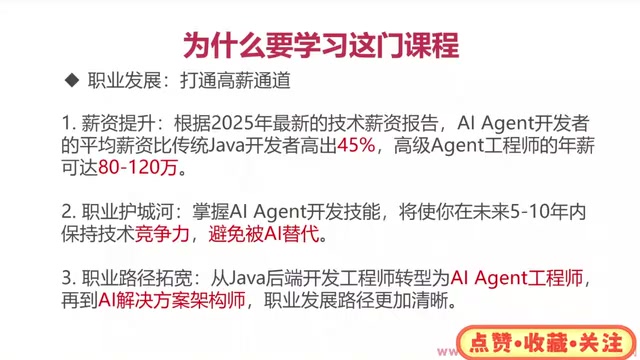
AI Agents are becoming the new frontier in tech. According to course instructor Carl, the AI Agent market is projected to reach $120 billion in 2025, with an annual growth rate exceeding 150%. Giants like OpenAI, Google, Meta, as well as domestic players Alibaba and ByteDance, are all investing heavily in Agent development. This year is also being called the "Year of AI Agents."
That said, competition for traditional Java backend roles is intensifying, while AI Agent development positions offer a salary premium of 30% to 50%. As the mainstream language for enterprise development, Java still holds an important place in Agent development. Frameworks like LangChain4j allow Java developers to transition seamlessly.
AI Agent refers to a computing system that can perceive its environment, make autonomous decisions, and take actions to achieve specific goals. Unlike traditional Q&A-style LLM applications, Agents possess capabilities such as planning, tool calling, memory, and reflection, enabling them to decompose complex tasks and execute them in multiple steps. Technically, an Agent typically uses a large language model (LLM) as its reasoning core, combined with components like Function Calling, Retrieval-Augmented Generation (RAG), and workflow orchestration. LangChain4j is the Java ecosystem's counterpart to Python's LangChain, providing Agent construction, memory management, tool integration, and more, so Java developers can connect to mainstream LLM services without switching languages.
Signals from the Job Market
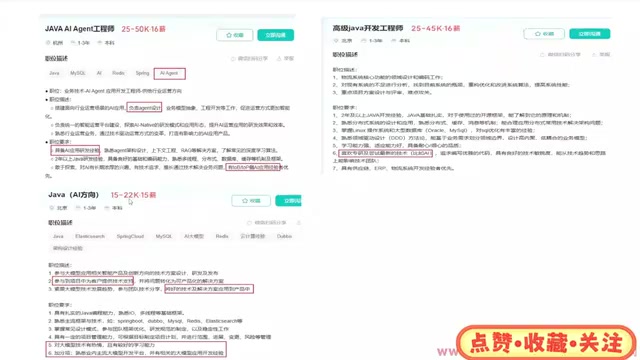
The instructor analyzed four job postings on Boss Zhipin: a Java AI Agent Engineer role paying 25-50K·16 months, requiring experience in Agent architecture design, context engineering, RAG, and more; a Senior Java Developer role paying 25-45K·16 months, listing "passion for exploring AI technologies" as a preferred qualification; and two other traditional Java roles that also list LLM application development experience as a plus.
According to the screenshots, the salary and star-rating information for these positions is clear. The instructor concludes: traditional Java roles now prioritize engineers with AI development experience, AI-oriented roles offer notably higher salaries, and the current AI requirements are not particularly high.
Context Engineering is a key practice in Agent development. It refers to providing appropriate and concise input to the LLM within a limited context window by carefully designing prompts, retrieving relevant documents, managing conversation history, and injecting tool return results, thereby improving output accuracy and stability. Unlike simple prompt engineering, it emphasizes the overall orchestration of multi-turn conversations, external knowledge sources, and tool call results. RAG (Retrieval-Augmented Generation) combines enterprise private knowledge bases with LLMs through vector retrieval and other methods, enabling the model to answer questions based on the latest or proprietary data. It is a common technique for enterprise-grade Agent deployment.
Who Is This Course For?
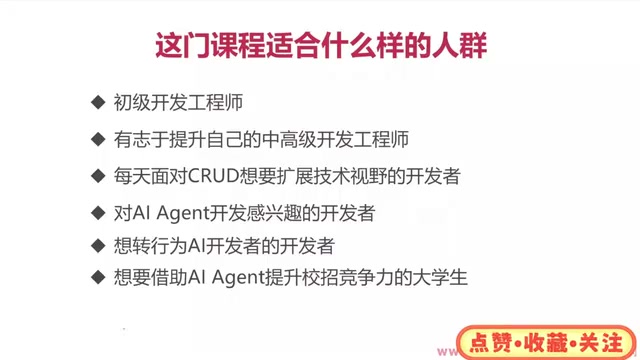
The course targets six groups: junior developers, mid-to-senior developers looking to level up, developers who face CRUD every day and want to broaden their technical horizons, developers interested in AI Agent development, developers looking to transition into AI, and university students who want to leverage AI Agents to boost their campus recruitment competitiveness. The instructor specifically notes that for developers working on B2B projects, the core work is often complex CRUD, and learning AI Agents can effectively broaden their technical horizons.
Add image:
Course Differentiation: From Demo to Production-Grade Projects
Unlike most courses on the market, this course emphasizes not simple demos but enterprise-grade, production-ready projects. Through two Agent projects, the course teaches students how to integrate traditional company projects with AI, designed entirely to enterprise-level requirements including high security, high concurrency, and high availability. The course also includes extensive project optimization design to increase project value, and provides hands-on implementation of multiple enterprise-grade private AI LLM deployment solutions—an area rarely covered by other courses.
Additionally, the course offers nanny-level tutorials that cover not only project development but also resume guidance and mock interviews, helping students translate project highlights into interview answers.
Private AI LLM Deployment refers to deploying open-source LLMs (such as Llama, Qwen, etc.) on an enterprise's own servers or private cloud environment, rather than calling public cloud APIs. This approach meets enterprise requirements such as data sovereignty, security compliance, and cost control. Common deployment solutions include inference frameworks like Ollama, vLLM, and Text Generation Inference, combined with containerization and GPU resource scheduling. For Java teams, it is also necessary to consider how to connect with private model services through frameworks like LangChain4j, and to ensure response performance and availability under high concurrency.
Two Live Agent Demos
The first Agent is an AI-powered inventory transfer order system. Once triggered, it automatically executes, analyzes product inventory data, sales data, and more, generates inventory transfer recommendations, and sends them to administrators via email. Administrators can accept or reject the recommendations; upon acceptance, the system automatically generates business documents and saves them to the database.
The second Agent is an intelligent BI reporting system. Users input natural language (e.g., "Check the sales of a certain product in a certain year"), and the Agent automatically executes and generates an Excel data report containing fields such as store, total sales amount, and quantity of products sold. Both Agents operate without human intervention, autonomously analyzing and executing.

Core Course Highlights
- Dual-Core Drive: Two high-value projects that can be written directly on your resume—not demos.
- Empowering Java Developers: No need to switch to Python; leverage the AI era with a familiar tech stack.
- Full-Cycle Closed-Loop Teaching: From data to decisions, from ideas to resumes, nanny-level guidance.
- Deep Enterprise Integration: Focus on high controllability and deep integration to build systems ready for production.
Instructor Carl emphasizes that mastering AI Agent development skills will maintain technical competitiveness for the next 5 to 10 years and help avoid being replaced by AI. For Java developers, this is not just a technical extension but a new channel for career development.
One-line Summary
A production-grade AI Agent bootcamp for Java developers, covering two enterprise projects and a complete job-seeking loop.
Paragraph Summary
The article introduces an AI Agent development bootcamp for Java developers. It first highlights the rapid growth of the AI Agent market, projected to reach $120 billion in 2025, with a 30%-50% salary premium for Java developers transitioning into the field. Job market analysis shows that even traditional Java roles prioritize candidates with AI experience. The course targets six groups and emphasizes differentiation from demos to production-grade projects, including two live Agents: intelligent inventory transfer and intelligent BI reporting. It also covers enterprise-grade private LLM deployment, resume guidance, and mock interviews, forming a complete loop from development to job hunting.
Related articles

GPT-6.1 Terra Launches at Rock-Bottom Price: Do Flagship Work for a Tenth of the Cost
OpenAI releases GPT-6.1 Terra at one-tenth the API price of flagship GPT-6 Astra, matching flagship Agent tasks at triple the speed. We break down its capability limits, hallucination improvements, coding performance, and practical advice for three types of users.

GPT-6.1 Terra Hands-On Test: Can a Low-Cost Model Be Your Daily Driver?
OpenAI's GPT-6.1 Terra targets low cost and speed. This article consolidates a Bilibili hands-on test, covering pricing tiers, quota consumption logic, availability, and computer use, development, and frontend performance, with practical task-based selection advice.

GPT-6.1 Terra vs Sol vs 6 Astra: Hands-On Comparison of Three Models and How to Choose
Hands-on comparison of GPT-6.1 Terra, GPT-6.1 Sol, and GPT-6 Astra across animation generation, image description and regeneration, and forest cottage web development—analyzing differences in motion logic, cross-modal consistency, and code implementation, with selection advice by task type.