Jensen Huang and Nvidia's Environmental Cost: The Environmental Bill Behind the AI Boom

Behind the Nvidia chip boom, fab water use, data center power draw, and e-waste form a hidden environmental bill.
The article outlines three environmental pressures from Nvidia's AI boom: water- and chemical-intensive wafer fabrication, heavy grid draw from large GPU data centers, and e-waste risks from rapid chip iteration. It points to Jensen Huang's leadership but notes that a demand-driven market structure also shapes leaders' choices, urging a full lifecycle view of AI's environmental costs.
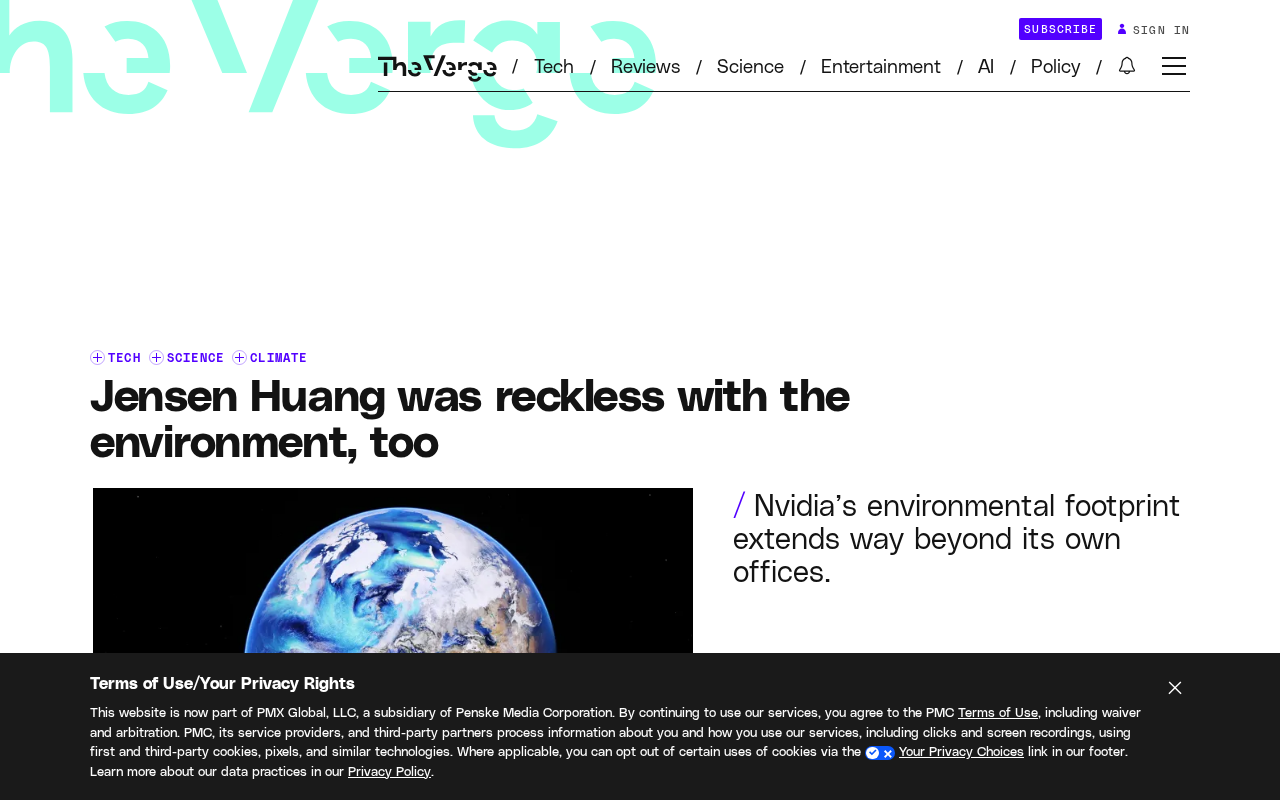
Under Jensen Huang's leadership, Nvidia has become the engine of the AI wave, but behind this growth curve lies an increasingly heavy environmental bill. According to an RSS-sourced report, Nvidia's highly sought-after chips are spawning a new wave of water- and chemical-intensive factories, draining massive amounts of power from inside large data centers, and setting the stage for a looming e-waste problem.
How the Chip Boom Translates into Environmental Pressure
AI chips don't appear out of thin air. Behind every high-performance GPU is a chain of resource-intensive processes—wafer fabrication, packaging and testing, and more. The report notes that demand for Nvidia chips has already driven the expansion of a batch of water- and chemical-intensive factories.
Such factories tend to be sited in regions already under pressure on power and water resources, meaning capacity expansion simultaneously raises the burden on local power grids and water systems. The more sought-after the chips, the higher the resource intensity upstream in manufacturing—a transmission chain that is easy to overlook.
Data Centers: The Concentration of Power Consumption
If manufacturing is the hidden cost, data centers are the visible one. The report uses "drained power grids from inside massive data centers" to describe the suction effect of Nvidia chips on power grids within data centers.
Training and inference workloads on large-scale GPU clusters keep pushing data center electricity curves upward. This is not an isolated problem for any single company but a common feature of AI infrastructure expansion as a whole—except that Nvidia, as the core compute supplier, sits at the very top of the chain.
Wafer fabrication is one of the most resource-intensive stages in the semiconductor supply chain. Producing an advanced-node chip typically requires hundreds of process steps, among which lithography, etching, and cleaning heavily use ultrapure water—used to rinse residual chemicals and particles from wafer surfaces. Industry estimates generally suggest that a single advanced logic fab's daily water consumption can rival that of a city with tens of thousands of residents, with extremely high water-quality requirements and costly wastewater recycling. Meanwhile, etching and cleaning involve chemicals such as hydrofluoric acid, sulfuric acid, and isopropyl alcohol, whose storage, transport, and waste-liquid treatment constitute another environmental burden. Advanced packaging (such as CoWoS), while not as water-intensive as front-end processes, still relies on precise temperature control and clean environments, indirectly driving up energy consumption. This is precisely the structural reason why resource pressure is amplified as AI chip demand propagates upstream.
Understanding data center power pressure requires distinguishing two often-conflated metrics: IT equipment power consumption and total facility power consumption. The former refers to the electricity used by GPU servers themselves; the latter also includes cooling, power distribution losses, and more. The ratio between them is power usage effectiveness (PUE). GPU clusters have far higher power density than traditional CPU racks, with per-rack power rising from 5–10 kW in the past to tens of kW, pushing air cooling toward its limits and accelerating the adoption of liquid cooling. High density brings not only higher totals but also bottlenecks in local grid interconnection—many data centers are concentrated in the same region, and stacked peak loads may trigger grid-connection queues or soaring demand charges. This also explains why "grid draining" has become one of the earliest hard constraints exposed in AI infrastructure expansion.
E-Waste: A Deferred Bill
The report also raises a temporal dimension: e-waste. High-performance chips iterate quickly and hardware refresh cycles are short; replaced accelerator cards, servers, and supporting equipment are laying hidden risks for future waste disposal.
This issue deserves separate discussion because its costs do not manifest immediately. The fiercer today's compute race, the greater the concentrated recycling and disposal pressure that will erupt in the future. The report's use of the word "looming" emphasizes precisely this lag.
The environmental risks of e-waste come mainly from two aspects: the economics of precious-metal recovery and the unregulated disposal of hazardous substances. Accelerator cards and server motherboards contain recoverable metals such as gold, palladium, and copper, but dismantling and refining are costly; informal channels often extract them through crude acid washing and burning, causing soil and water pollution. On the other hand, GPU refresh cycles are usually shorter than their physical lifespans—cloud providers, to maintain compute competitiveness, retire still-usable hardware early, creating "performance-driven obsolescence" rather than "functional obsolescence." Global formal recycling rates for e-waste have long remained low, and the concentrated volume surge of AI hardware may further widen the gap between generation and processing capacity—which is the real basis for the report's emphasis on lag with the word "looming."
Leadership Responsibility and the Tension of Industry Structure
The report's stance is clear: under Jensen Huang's stewardship, Nvidia is both the engine of the AI boom and one of the tech industry's largest environmental burdens. This judgment points the finger at the leader's personal decision-making responsibility.
But attributing it entirely to one person may oversimplify the issue. Nvidia operates in a demand-driven market structure—customers want compute, foundries want capacity, cloud providers want expansion. Leaders' room for choice is constrained by the incentives at every link in this chain. What is truly worth asking is: when compute becomes a strategic resource, who bears the environmental cost, and at which link is it measured?
Implications for the AI Industry
The value of this report lies not in convicting a particular company but in reminding the industry: environmental discussions about AI cannot stop at energy-consumption figures for model training. Water and chemicals in manufacturing, grid loads from data centers, and recycling pathways for retired hardware form a complete lifecycle ledger.
For practitioners focused on AI infrastructure, this means a more complete assessment perspective is needed beyond energy-efficiency metrics. For investors and policymakers, environmental externalities will sooner or later return to the cost sheet in some form. The story of Jensen Huang and Nvidia is merely the most visible facet of this discussion.
One-line Summary
Behind the Nvidia chip boom, manufacturing water use, data center power consumption, and e-waste form a hidden environmental bill.
Paragraph Summary
The article outlines the triple environmental pressure Nvidia brings amid the AI wave: upstream wafer fabrication and packaging's intensive consumption of water and chemicals, the significant draining effect of large GPU data centers on power grids, and the e-waste risks planted by rapid chip iteration. The report points environmental responsibility at Jensen Huang's leadership decisions, but the article also notes that the demand-driven market structure—customers wanting compute, foundries wanting capacity, cloud providers wanting expansion—equally shapes leaders' room for choice. The core takeaway is that AI environmental assessment cannot look only at model training energy consumption but should cover the complete lifecycle ledger from manufacturing to operation to recycling; environmental externalities will eventually return to the cost sheet in some form.
Related articles

Why Microsoft CEO Nadella Still Backs Nvidia After Jensen Huang's Departure
Microsoft CEO Nadella publicly expresses confidence in Nvidia interim CEO Colette Kress. This article analyzes Nvidia's power transition after Jensen Huang's departure, Microsoft's compute dependency, and the trust logic of the AI supply chain.

Nadella: Critical Infrastructure Is 'Unpatchable' as AI Cybersecurity Arms Race Escalates
Microsoft CEO Nadella addresses AI cyberattack fears, saying much critical infrastructure is unpatchable, downplaying the Outlook outage, and analyzing AI's dual role in cybersecurity.

Musk Backs Jensen Huang: Firing Him Is Like Cutting Jordan
Musk says Jensen Huang is loyal to the U.S. and likens firing him to cutting Michael Jordan—highlighting politicization anxieties in the AI chip industry and defending talent value.