Jio Surges 21% on Debut, Becomes India's Second Most Valuable Company

Jio surged 21% on debut, becoming India's second most valuable company, behind only parent Reliance Industries.
Indian telecom giant Jio completed a blockbuster IPO, with shares soaring 21% on the first trading day to become India's second most valuable listed company, behind only its parent Reliance Industries. This "second place on day one" structure means the two most valuable companies in India belong to the same business system. The high premium reflects the market's reassessment of Jio's platform attributes spanning mobile communications, broadband, and digital services. The successful debut sends a positive signal to India's primary market but also raises discussion about whether the offering was underpriced. Long-term market cap standing will depend on substantive progress in user growth, ARPU improvement, and digital service monetization.
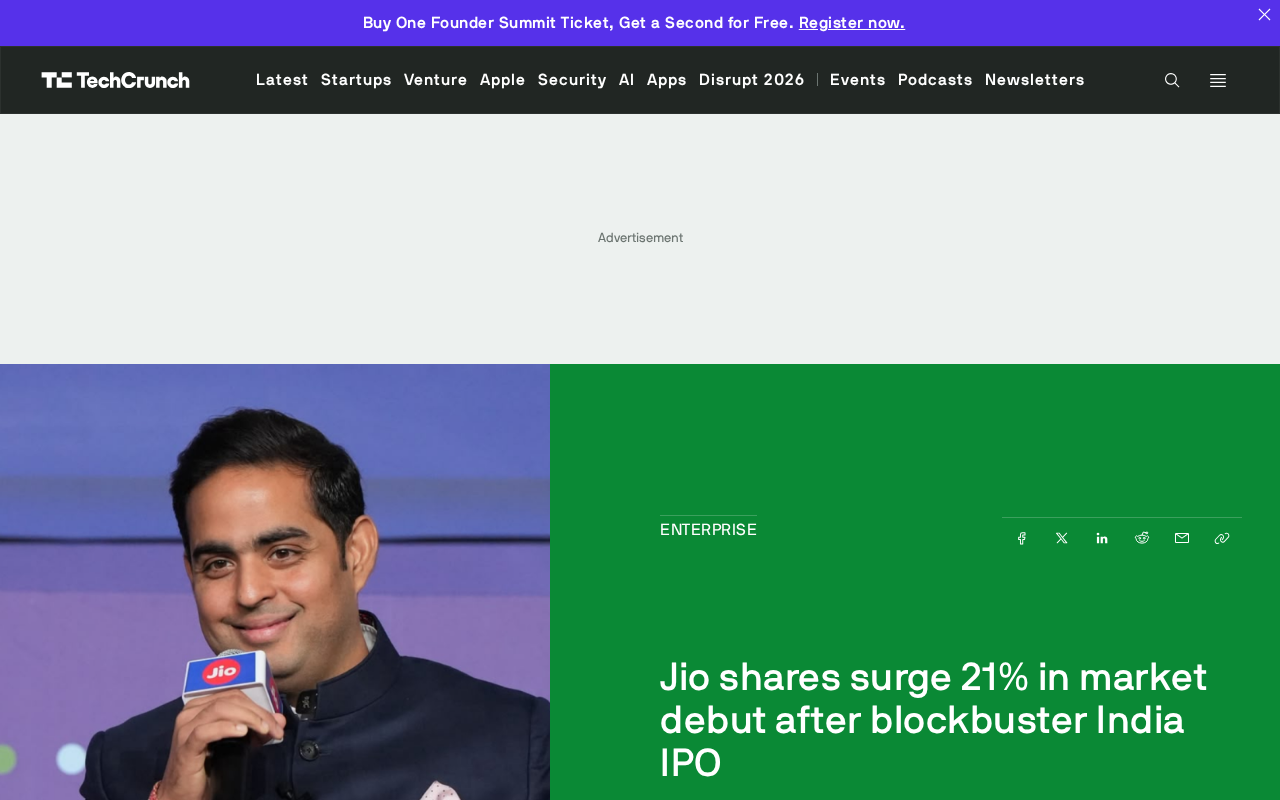
The listing of Indian telecom giant Jio has become one of the most closely watched events in Asian capital markets recently. According to RSS feed reports, Jio's shares soared 21% in its market debut following its IPO, making it India's second most valuable listed company, behind only its parent Reliance Industries.
An IPO Where "the Elephant Dances"
Jio's IPO has been dubbed a "blockbuster" by the market. Although the original report did not disclose the specific fundraising size, the phrase "blockbuster India IPO" itself speaks to its weight in India's primary market. A 21% gain on the first trading day, for an offering of such enormous scale, means the market has priced in a fairly positive view of its growth prospects.
In terms of valuation ranking, Jio leapfrogged numerous long-established listed companies to take the second-largest market cap spot in India. This "second place on day one" outcome is uncommon in the capital markets of major economies.
IPO (Initial Public Offering) refers to the process by which a private company first issues shares to the public and lists them for trading on a stock exchange. Companies raise capital through an IPO, existing shareholders gain liquidity, and the company takes on disclosure and compliance obligations. In India, IPOs are typically regulated by the Securities and Exchange Board of India (SEBI), and issuance involves prospectus disclosure, roadshow pricing, subscription and allotment, among other steps. A so-called "blockbuster IPO" generally refers to an offering with a huge fundraising size, extremely high market attention, and substantial subscription multiples. Such IPOs often test market liquidity, and their pricing and first-day performance are regarded as a bellwether for primary market sentiment.
The Parent Company Reliance Industries' "Twin Star" Structure
What's notable is the unusual structure of the market cap ranking: first place is the parent company Reliance Industries, and second place is its subsidiary Jio. This means the two most valuable listed companies in India belong to the same business system.
This structure has two implications for investors. On one hand, Jio's independent listing allows the market to price its telecom and digital businesses separately, unlocking value previously obscured by the conglomerate discount. On the other hand, the market caps of parent and subsidiary are highly correlated, and share price movements of Reliance Industries and Jio will transmit to each other.
Conglomerate discount refers to the phenomenon where a diversified group company's overall market capitalization is often lower than the sum of the separately valued business segments. The reason is that investors find it difficult to precisely price complex business structures, and internal capital allocation efficiency within the group may be lower. When a subsidiary lists independently, the market can price it separately; if that business has outstanding growth prospects, its valuation may exceed the level previously implied within the group as a whole, thereby unlocking value hidden by the discount. However, the market caps of parent and subsidiary still transmit to each other through the shareholding relationship: the value of the subsidiary's equity held by the parent is included in its market cap, and fluctuations in the subsidiary's share price also affect the parent's valuation.
Why the Market Is Willing to Pay a High Premium
Behind the 21% first-day gain is the market's reassessment of Jio's business nature. Jio is not a traditional telecom operator; its business spans mobile communications, broadband access, and digital services, with clear platform characteristics.
In India—a market with a massive user base and still-rising digital penetration—companies that combine infrastructure attributes with consumer-facing reach often command a growth premium. The strong demand on the first trading day reflects capital's endorsement of the "Indian digital infrastructure" narrative.
ARPU (Average Revenue Per User) is a core operating metric in the telecom and digital services industry, calculated as total business revenue over a period divided by the average number of users. Rising ARPU typically signals stronger willingness to pay, upgraded plan structures, or higher penetration of value-added services. For a company like Jio that combines telecom infrastructure with digital platform attributes, the market focuses not only on user growth but also on whether ARPU can continue to rise—which directly determines revenue quality and profitability. India's telecom market has experienced fierce price wars, and ARPU was once at low levels, so investors view ARPU recovery as an important signal of improving industry health and stronger monetization capability.
Signal Significance for India's IPO Market
Jio's successful debut is a positive signal for India's primary market. Large IPOs are often seen as a touchstone of market sentiment—if an offering of extraordinary size can be smoothly absorbed and post substantial gains, the pricing room for companies waiting in the pipeline will open up.
Conversely, the first-day surge may also spark discussion about whether the offering was underpriced. A 21% gain means there was a clear gap between the issue price and the price the market was willing to pay—value that went to IPO investors rather than the company itself.
What to Watch Going Forward
Short-term share price performance is only the starting point. For Jio, what truly determines its long-term market cap standing is whether it can sustain user growth, raise revenue per user, and make substantive progress in monetizing digital services after listing. The market cap linkage between parent and subsidiary also warrants continued tracking—how the valuation relationship evolves when the parent holds a large stake in the subsidiary is a case worth observing in India's capital markets.
According to the original report, Jio has secured the second-largest market cap position in India. Whether it can hold that ranking will depend on the performance in its first earnings report after listing.
One-line Summary
Jio surged 21% on its debut, becoming India's second most valuable company, behind only parent Reliance Industries.
Paragraph Summary
Indian telecom giant Jio completed a blockbuster IPO, with shares soaring 21% on the first trading day to become India's second most valuable listed company, behind only its parent Reliance Industries. This "second place on day one" structure means the two most valuable companies in India belong to the same business system. The high premium reflects the market's reassessment of Jio's platform attributes spanning mobile communications, broadband, and digital services, as well as recognition of the "Indian digital infrastructure" narrative. The successful debut sends a positive signal to India's primary market but also raises discussion about whether the offering was underpriced. Long-term market cap standing will depend on substantive progress in user growth, ARPU improvement, and digital service monetization.
Related articles

LangChain Retry Middleware Configuration: Practices and Selection Guide
Based on Reddit community discussion, this article analyzes LangChain ModelRetryMiddleware retry parameter configuration practices, covering the selection logic and alternatives for key options like max_retries, backoff_factor, and jitter.

Texas Senate Race in Trouble: Why Are Republicans Nervous?
Texas Senate race stirs Republican anxiety. Based on street interviews, this article analyzes the Democratic offensive in funding, organization, and running everywhere, and how Republicans are defending "Texas, Texas" amid the political pendulum effect.

Gemini Chat Now Generates and Edits Google Docs Directly, a New Breakthrough in Office Productivity
Google Gemini's chat interface now generates and edits PDF, Google Docs, Sheets, Slides, Markdown, TXT, and code files. Available to all users; web supports all formats, mobile only PDF for now.