JustWatch Enters Streaming: The Aggregator Steps In to Play Content Itself

JustWatch launches its own streaming service JustWatch TV, transforming from content navigation to a playback terminal.
JustWatch was originally an aggregator search tool helping users find which platform a film or TV show is available on. Now it has officially launched its own streaming service JustWatch TV, offering three models: ad-supported free tier, ad-free paid subscription, and movie rentals, with content from about 30 content providers. This transformation means the aggregator is attempting for the first time to capture the act of "watching" itself, converting search traffic directly into subscription revenue and rental transactions, and changing the business model from referral commissions to direct operation. The article analyzes that this reflects an industry trend of blurring boundaries between content discovery and content playback, but JustWatch faces challenges such as insufficient catalog depth, the need to build an ad sales system from scratch, and key details like pricing and launch regions not yet disclosed. Its success depends on content scale, acceptance of ad load, and brand trust transfer.
JustWatch was originally a "navigation hub" for users looking for film and TV content—type in a title, and it tells you whether you can watch it on Netflix, Disney+, or Prime Video. Now, this aggregator has decided to become a playback terminal itself. According to an RSS feed report, after teasing it last month, JustWatch has officially launched JustWatch TV, offering three models: ad-supported free subscription, ad-free paid subscription, and movie rentals, with content from about 30 content providers.
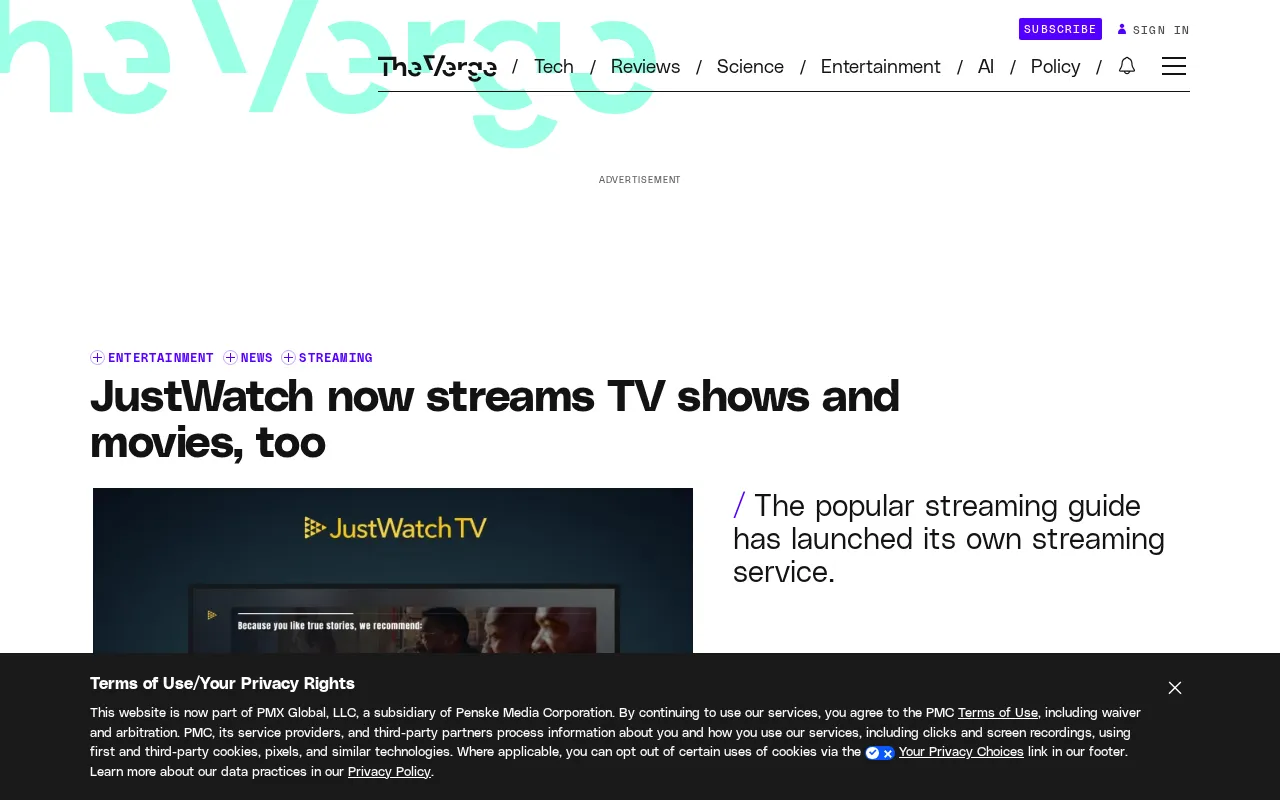
From "Telling You Where to Watch" to "Letting You Watch Directly"
JustWatch's core asset is its search and recommendation data: it has long tracked catalog changes across platforms, knowing when a show launches or leaves a platform and at what price. This data capability is now being used in reverse for its own service—users no longer need to jump to a third-party app, but complete the loop from discovery to viewing within JustWatch.
The significance of this shift is that, for the first time, the aggregation layer is trying to capture the act of "watching" itself. In the past, aggregators only influenced user decisions without participating in playback or monetization; JustWatch TV converts search traffic directly into subscription revenue and rental transactions, changing the business model from referral commissions to direct operation.
Content Aggregator refers to a platform that does not produce content directly but integrates information from multiple content sources for users to search, typically such as JustWatch, Reelgood, and TV Time. Its core value lies in solving the "don't know where to watch" problem caused by streaming fragmentation, influencing user decisions through metadata indexing and recommendation algorithms. Traditionally, such platforms monetize through affiliate marketing and referral commissions—when a user clicks through to Netflix and completes a subscription, the aggregator earns a commission. The limitation of this model is that once the user jumps away, they leave the aggregator's control, and the platform cannot participate in subsequent viewing or ongoing monetization. The essence of JustWatch TV is to break this limitation, upgrading the aggregation layer from a "decision entry point" to a "consumption entry point."
Betting on Three Monetization Models Simultaneously
JustWatch TV did not choose a single model but is walking on three legs:
- Ad-supported free tier: lowers the barrier to try, attracts price-sensitive users with free content, and monetizes through ads.
- Ad-free paid subscription: aimed at users willing to pay for experience.
- Movie rentals: pay-per-title, suitable for low-frequency viewing needs.
This combination is not new in the streaming industry, but operated simultaneously by an aggregator means it must build capabilities from scratch in content acquisition costs, ad sales systems, and subscription operations. A scale of about 30 content providers is not large, and initial catalog depth may be a weakness.
FAST (Free Ad-Supported Streaming TV) is the abbreviation for free ad-supported streaming television, with typical examples including Pluto TV, Tubi, and Roku Channel. Unlike SVOD (such as Netflix) which relies on subscription fees, and TVOD (such as Apple TV rentals) which charges per title, the FAST model uses linear channels or on-demand libraries as carriers, generating revenue through pre-roll ads, allowing users to watch without paying. Its commercial logic is to exchange free content for a larger user base, then sell attention to advertisers. For JustWatch, the challenge of the FAST layer lies in ad sales requiring an independent sales team and programmatic advertising technology stack, and excessive ad load harming the viewing experience while too little makes it difficult to cover content costs.
The Boundaries of Aggregators Are Disappearing
JustWatch's move reflects a larger trend: the line between content discovery and content playback is blurring. Smart TV manufacturers, operating system providers, and even search tools are all trying to keep users within their own interfaces to complete consumption. For JustWatch, doing playback is a natural extension; for platforms like Netflix, this means a new channel and possibly a new intermediary competitor.
A detail: JustWatch's relationship with content providers is cooperative rather than substitutive—it does not produce content but merely adds a new distribution outlet. This reduces the intensity of direct confrontation with mainstream platforms, but also means its bargaining power and content exclusivity are limited.
Questions to Watch
Whether JustWatch TV can succeed depends on several variables: whether the catalogs of 30 content providers are sufficient to support daily viewing needs; whether the ad load on the free tier is acceptable to users; and whether the aggregator's brand trust can transfer to the playback scenario. The original information has not yet disclosed pricing, launch regions, or the specific list of content providers, and these details will directly affect its competitiveness.
For users, an extra entry point is not necessarily a bad thing; for the industry, an aggregator stepping in personally shows that streaming competition has extended from "whose catalog is bigger" to "who is closer to the user."
One-line Summary
JustWatch launches its own streaming service JustWatch TV, transforming from content navigation to a playback terminal.
Paragraph Summary
JustWatch was originally an aggregator search tool helping users find which platform a film or TV show is available on. Now it has officially launched its own streaming service JustWatch TV, offering three models: ad-supported free tier, ad-free paid subscription, and movie rentals, with content from about 30 content providers. This transformation means the aggregator is attempting for the first time to capture the act of "watching" itself, converting search traffic directly into subscription revenue and rental transactions, and changing the business model from referral commissions to direct operation. The article analyzes that this reflects an industry trend of blurring boundaries between content discovery and content playback, but JustWatch faces challenges such as insufficient catalog depth, the need to build an ad sales system from scratch, and key details like pricing and launch regions not yet disclosed. Its success depends on content scale, acceptance of ad load, and brand trust transfer.
Related articles

RAG Interview Essentials: Breaking Down the Full Offline Indexing and Online Retrieval Pipeline
A complete breakdown of the RAG retrieval-augmented generation workflow: offline document loading, chunking, vectorization, and indexing; online query rewriting, vector retrieval, reranking, and generation, plus core interview points and system optimization directions.

AI Large Models for Absolute Beginners: Principles and API Calling in Practice
From AI's evolution to large model training principles and core concepts like Token, Temperature, and Top-P, this article explains system prompts, Function Call, RAG, and memory with hands-on examples and four API call scenarios—ideal for beginners.

Will GitHub Die? Open Source Maintainer Burnout and the Collaboration Crisis in the AI Era
Lex Fridman podcast discussion on open source maintainer burnout and GitHub's predicament: massive pull requests overwhelm core maintainers, and AI worsens code bloat. Using math journal peer review and Poincaré conjecture verification as analogies, the article analyzes why verification in knowledge production must be deliberately slow, and how open source communities can avoid the failure mode of maintainers exiting.