Kimi K3.1 Pro Lands on Token Pass: Moonshot's Strongest Coding Model
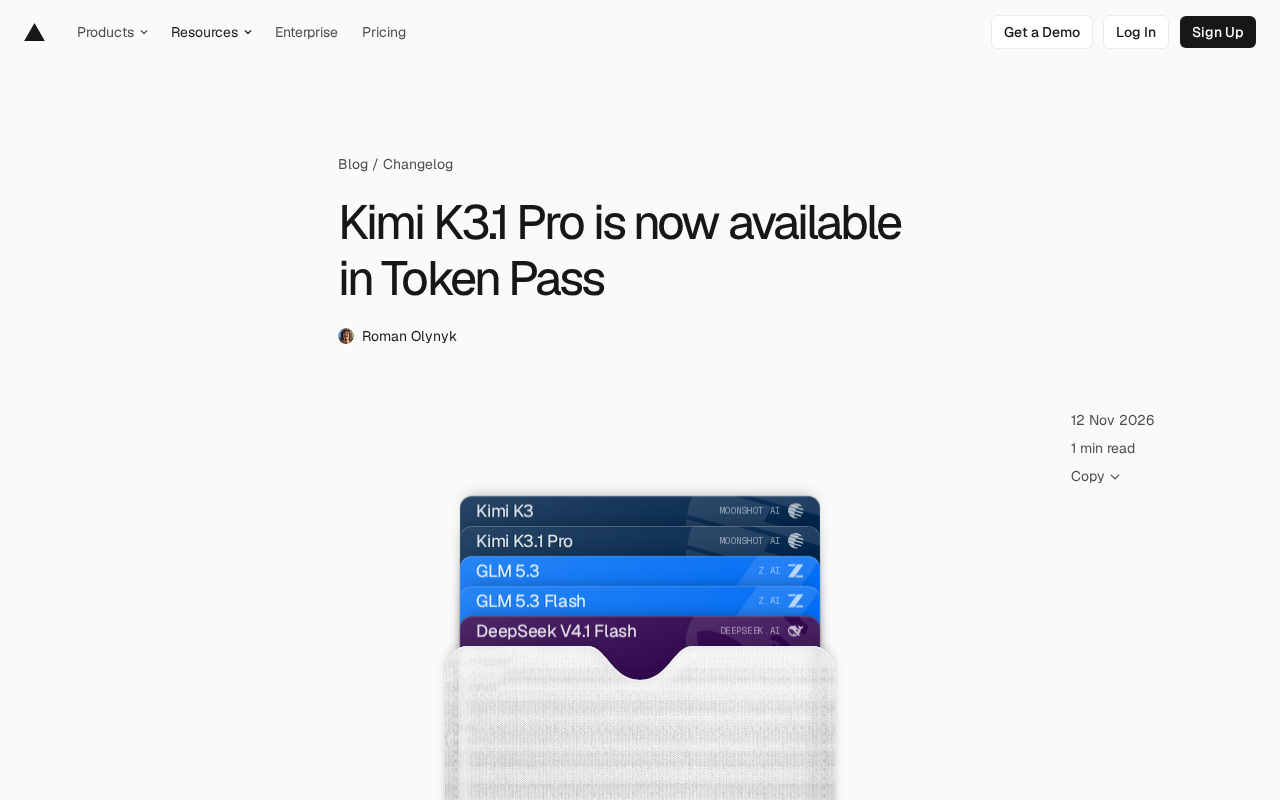
Kimi K3.1 Pro joins Token Pass, offering teams a new multi-model coding subscription option.
Moonshot AI's strongest coding and agentic model, Kimi K3.1 Pro, has officially joined the Token Pass early-access subscription service, featuring vision input, tool use, and a 1 million token context window for sustained task execution in real engineering environments. Token Pass bundles Kimi, GLM, DeepSeek, and other models at $30 per team per month with $80 in credit, usable with coding agents like fx, Pi, Cline, and Command Code connected to the AI Gateway as well as custom agents, under zero data retention. Teams subscribe in the console and specify the model identifier to make calls. The article also highlights factors to weigh, including credit consumption, the impact of zero retention on observability, and policy changes during the Early Access phase.
Token Pass's model lineup just got bigger. Kimi K3.1 Pro, Moonshot AI's most capable coding and agentic model, has officially joined this early-access subscription service. For teams building multi-model coding workflows, this means they can call yet another high-spec model within the same subscription—without opening separate accounts and separate billing for each vendor.
What Kind of Model: Long Context + Vision + Tool Use
According to official documentation, Kimi K3.1 Pro is positioned as Moonshot AI's most capable model to date, targeting two main scenarios: coding and agentic workflows. This positioning isn't surprising: for some time now, model vendors' competitive focus has clearly shifted from general conversation to engineering capabilities—"can write code, can call tools, can autonomously execute tasks over extended periods."
Kimi K3.1 Pro simultaneously offers three key features:
- Vision: It can directly process image inputs, which has practical value for tasks like reading design mockups, troubleshooting from screenshots, and parsing UI elements.
- Tool use: The model can proactively call external functions or interfaces, which is the foundation of agentic closed loops.
- 1 million token context window: Long context is especially critical for coding scenarios, meaning it can ingest larger codebases, long documents, or multi-turn complex conversation history in one go, reducing information loss from repeated chunking and retrieval.
Together, these three point to a model form capable of "sustained work in real engineering environments" rather than a single-turn Q&A tool.
Context window refers to the total number of tokens a model can hold in a single inference pass, covering both input prompts and generated content. 1 million tokens roughly equates to hundreds of thousands of lines of code or over a hundred long documents, allowing the model to maintain full awareness of an entire codebase or long conversation history within a single session. Related to this is the "attention decay" problem in long-context scenarios: even with a sufficiently large window, a model's recall of information in the middle section tends to be lower than at the beginning and end, so practical use still requires retrieval, segmented referencing, and other strategies rather than simply stuffing everything in at once.
Tool use (also called function calling) refers to the model outputting structured call requests during generation, which an external runtime executes and returns results to the model for continued reasoning. It is the core mechanism by which an agent forms a "perceive—decide—execute" loop, enabling the model to read and write files, run tests, and query interfaces rather than being limited to text output.
What Is Token Pass: $30 Team Subscription, $80 Credit
Token Pass itself is an Early Access subscription service for Pro teams. It bundles multiple third-party models, currently including Kimi K3 (as stated in the original text), GLM 5.3, GLM 5.3 Flash, and DeepSeekAd V4.1 Flash, with more models promised.
The pricing structure is relatively straightforward: $30 per team per month, with $80 in monthly usage credit. The credit can be used with coding agents connected to the AI Gateway, officially named as fx, Pi, Cline, and Command Code, and also covers custom agents users build on the AI SDK.
Another notable term is zero data retention: requests made through Token Pass are not retained. For enterprise teams, this is typically an unavoidable compliance consideration during selection, especially for sensitive assets like code.
AI Gateway is a unified proxy layer between applications and various model APIs, handling authentication, routing, billing, and usage tracking. Its value lies in abstracting "model vendors" into replaceable backends: teams only need to specify a model identifier in code (such as moonshotai/kimi-k3.1-pro) to switch the underlying vendor without changing authentication and billing logic. Token Pass credits are settled at this unified layer, which is the technical prerequisite for the same credit to be reused across multiple coding agents.
Zero data retention (ZDR) is a data handling model agreed upon both contractually and technically: request and response content is not persistently stored after inference completes, nor used for model training or human review. It typically requires vendors to make specific configurations at the logging pipeline level and may affect capabilities like abuse detection and failure reproduction, so enterprises should weigh it against their own compliance requirements and observability needs during selection.
How to Use It: Two-Step Onboarding
The onboarding process has few barriers. Teams first complete the subscription on the Token Pass page in the AI Gateway console, then specify moonshotai/kimi-k3.1-pro in the model selector of their connected agent to make calls. This "gateway + model identifier" approach lets teams reuse the same credit across multiple coding agents without configuring keys and billing separately for each tool.
From a product logic perspective, Token Pass aims to solve the subscription fragmentation problem of the multi-model era: there are more and more models, but teams don't want to manage a long list of accounts. Covering multiple flagship models with one subscription and directing the credit uniformly to coding agents is a quite pragmatic path.
Model identifiers follow the "vendor/model-name" convention, with the first segment used to route to a specific vendor and the second specifying the model version. This naming approach allows the gateway to distribute requests to different backends without changing caller code, and makes it easy to switch via configuration when model versions are upgraded or deprecated. When teams select a model in an agent, they are essentially choosing a routing target, while quota and rate-limiting policies are uniformly applied on the gateway side.
Points Worth Noting
Model lineup trade-offs. Token Pass currently pools models from Kimi, GLM, and DeepSeek together, covering different capability emphases and cost tiers. For teams, this is more like a "model shelf" where they can switch based on task difficulty rather than betting on a single vendor.
The balance of credit and pricing. $30 per month for $80 in credit is an obvious discount on paper, but whether it's actually worth it depends on the team's usage intensity and model unit prices. Teams heavily using coding agents may quickly hit the credit cap, while light users may not use it all—estimating real consumption before choosing is worthwhile.
What zero retention actually means. Zero data retention is a plus for compliance-sensitive teams, but it also means request data won't be used for subsequent analysis or debugging, so teams need to build their own logging and observability.
Early Access uncertainty. Token Pass is explicitly positioned as Early Access, and the model lineup, pricing, and features may all change. Before making it a core dependency in production, leave margin for vendor lock-in and policy changes.
With the addition of Kimi K3.1 Pro, Token Pass has become even more attractive for coding and agentic scenarios. For teams already using tools like Cline and Command Code, this is a cost-controllable model upgrade option; for teams still on the fence, it offers a low-barrier opportunity to try multi-model workflows.
One-line Summary
Kimi K3.1 Pro joins Token Pass, offering teams a new multi-model coding subscription option.
Paragraph Summary
Moonshot AI's most capable coding and agentic model, Kimi K3.1 Pro, has officially joined the Token Pass early-access subscription service, featuring vision input, tool use, and a 1 million token context window, targeting sustained task execution in real engineering environments. Token Pass bundles Kimi, GLM, DeepSeek, and other models at $30 per team per month with $80 in credit, usable with coding agents like fx, Pi, Cline, and Command Code connected to the AI Gateway as well as custom agents, under zero data retention. Teams subscribe in the console and specify the model identifier to make calls. The article also highlights factors to weigh, including credit consumption, the impact of zero retention on observability, and policy changes during the Early Access phase.
Related articles

Why Microsoft CEO Nadella Still Backs Nvidia After Jensen Huang's Departure
Microsoft CEO Nadella publicly expresses confidence in Nvidia interim CEO Colette Kress. This article analyzes Nvidia's power transition after Jensen Huang's departure, Microsoft's compute dependency, and the trust logic of the AI supply chain.

Nadella: Critical Infrastructure Is 'Unpatchable' as AI Cybersecurity Arms Race Escalates
Microsoft CEO Nadella addresses AI cyberattack fears, saying much critical infrastructure is unpatchable, downplaying the Outlook outage, and analyzing AI's dual role in cybersecurity.

Musk Backs Jensen Huang: Firing Him Is Like Cutting Jordan
Musk says Jensen Huang is loyal to the U.S. and likens firing him to cutting Michael Jordan—highlighting politicization anxieties in the AI chip industry and defending talent value.