LangChain Beginner's Guide: Building AI Agents from Scratch

LangChain connects LLMs to tools, data, and memory — the ideal starting point for AI Agent development.
LangChain is an open-source framework positioned as "Agent = Model + Wrapper Framework," playing a role similar to Spring in backend development. It solves three core LLM limitations: models only know information up to their training cutoff (LangChain adds web access to break this boundary); models can't access external databases or enterprise systems (LangChain provides a full RAG toolchain); and models are stateless with no multi-turn memory (LangChain's context management module addresses this). With a gentle learning curve and comprehensive official docs, it's the recommended entry point for LLM application development.
What Is LangChain: Model + Wrapper Framework
For developers just getting started with large language model (LLM) development, LangChain is often the first framework they reach for after picking up the basics of Python. The learning curve isn't steep, the official documentation is thorough, and there are plenty of starter demos and code examples — making it an ideal entry point for building LLM-powered applications.
Here's a one-line summary of where LangChain fits: Agent = Model + Wrapper Framework. The "model" here refers to familiar LLMs like DeepSeekAd, Claude, Gemini, and GPT; the "wrapper framework" is the LangChain ecosystem itself. To borrow the official framing: Agent = Model + Harness, and LangChain is one complete solution for that Harness layer.
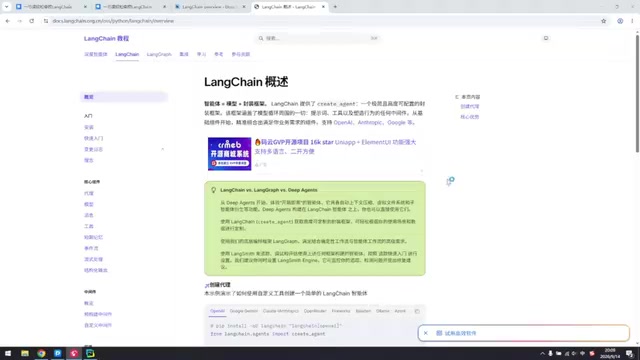
More precisely, LangChain is an open-source framework for building applications powered by large language models. Think of it the way Spring works in backend development — Spring helps you rapidly spin up web applications; LangChain helps you rapidly drive LLMs. But it goes far beyond simple API call wrappers. Tool calling, context management, and a range of other complex capabilities are all integrated within the ecosystem, so developers don't have to build that architecture from scratch.
Where the Name "LangChain" Comes From
The name is a combination of "Language" (as in large language models) and "Chain" (as in chaining things together). The core idea is that LLMs can be connected, in a chain-like fashion, to your local machine or external resources — ultimately forming a capable Agent that can solve real-world problems.
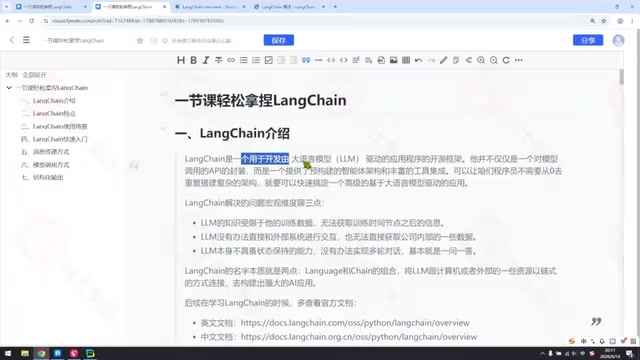
Understanding this naming logic is understanding LangChain's design philosophy: a model alone has limited capabilities; truly powerful applications come from connecting and orchestrating models with the outside world.
The Three Core Problems LangChain Solves
Large language models have a few natural limitations, and LangChain's value lies precisely in bridging those gaps. While it addresses far more than three problems, these three are the most fundamental.
1. Breaking Through the Model's Knowledge Cutoff
LLMs don't know everything. Their knowledge is bounded by the date their training data ends — they can only know what happened before that cutoff. If a model was trained through June, and you ask it about something that happened in August, it simply can't answer.
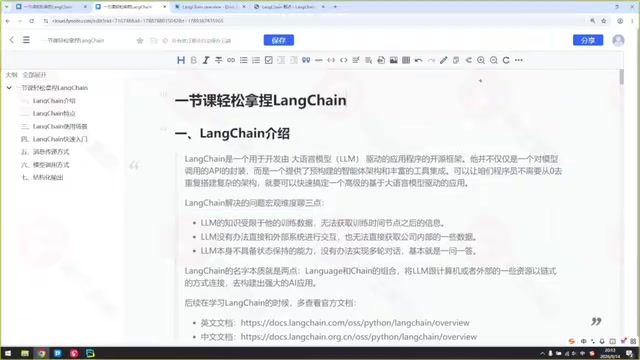
The model itself has no ability to call tools or browse the web — but it "knows that it doesn't know." This is where LangChain's built-in web-search tools come in, enabling the model to query external information on the fly.
There's a commonly overlooked nuance here: when you chat with a product like DeepSeek through its interface, you're not actually talking to a bare model. What you're interacting with is already a wrapped agent or knowledge system that has web access built in. A truly "raw" model, by itself, has no ability to reach out to the internet.
2. Connecting to External Data and Enterprise Systems
The second problem is accessing external data. Use cases like RAG (Retrieval-Augmented Generation) and knowledge base construction require connecting to vector databases, enabling source tracing, and sometimes querying internal enterprise databases. A base model can't do any of this on its own. LangChain bridges that gap, enabling developers to wire the model into enterprise systems and internal data pipelines.
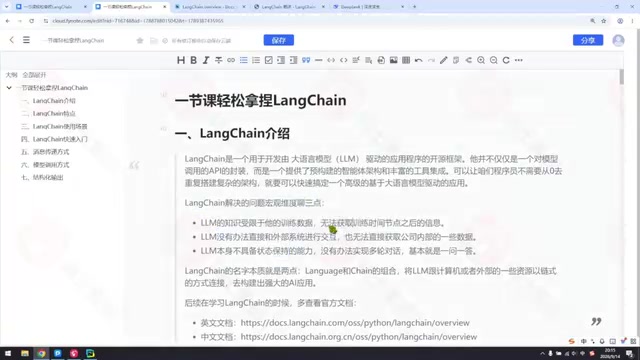
RAG (Retrieval-Augmented Generation) is one of the most widely adopted approaches for deploying LLMs in enterprise settings. The core idea: private documents or business data are pre-chunked, vectorized, and stored in a vector database (such as Chroma, Pinecone, or Milvus). When a user asks a question, the system first retrieves the most relevant text segments from the vector store, then passes both the segments and the question to the model — which generates a response grounded in real source material. This approach overcomes the model's training knowledge limitations while making answers traceable and verifiable. LangChain ships with a complete RAG toolchain, including document loaders, text splitters, vector store interfaces, and retrieval chains. Developers don't have to wire these pieces together manually, which dramatically lowers the barrier to building enterprise knowledge bases.
3. Memory and State Management for Multi-Turn Conversations
The third issue is statefulness — what's commonly called "memory." In a multi-turn conversation, a model that can reference what you said earlier provides a far more natural, coherent experience. But a raw model is stateless by default: it answers each message in isolation, with no awareness of what came before.
LangChain provides context management capabilities to address this. Developers could implement this themselves, but LangChain makes what would otherwise be tedious plumbing much more manageable.
At a technical level, large language models are inherently stateless — every API call is independent, and the model retains no memory of previous exchanges. The "memory" in multi-turn conversations is actually achieved by appending conversation history to the Prompt context window with each new request. LangChain's Memory module encapsulates multiple memory strategies: the simplest approach retains the full message history (ConversationBufferMemory), though this can exceed the model's context window in long conversations. More advanced options automatically summarize and compress history (ConversationSummaryMemory), or retain only the most recent N turns. Understanding this mechanism helps developers choose the right memory strategy based on conversation length and cost constraints in real projects.
Why LangChain Is a Good Starting Point
Beyond LangChain, OpenAI and DeepSeek have each released similar tooling. The general patterns are comparable, though the focus areas differ — some lean toward plugin ecosystems, others toward their own proprietary stacks. LangChain takes a more general-purpose route, and combined with its gentler learning curve and solid documentation, it makes sense as your first stop for LLM application development.
One learning tip worth emphasizing: always consult the official documentation. Whether you're working with LangChain or any other framework's Harness layer, the official docs are always the most accurate reference. Chinese-translated documentation may be convenient, but it's largely machine-translated and often incomplete. For example, "Agent" was at one point mistranslated as "代理" (proxy), leading some readers to think they needed to configure a VPN. Additionally, Chinese docs may be missing examples for Gemini, Claude, and other integrations — you'll still need to refer to the original English documentation for those.
For developers who aren't fully comfortable reading in English, a practical approach is to start with the Chinese docs to build a general mental model, then cross-reference the English docs to verify accuracy for key concepts.
Beyond LangChain, other notable frameworks in this space include Microsoft's AutoGen, CrewAI (developed by former OpenAI team members), and LlamaIndex, which emphasizes lower-level, controllable workflows. Each has its own focus: LlamaIndex specializes in data indexing and RAG pipelines; CrewAI is built around multi-agent collaboration; AutoGen excels at conversation-driven multi-agent interactions. LangChain's advantage is its maturity — the ecosystem is the most developed, the community is the most active, and it has the broadest integrations with models and tools. That makes it the natural first choice for rapid prototyping or building general-purpose agents. As your understanding of LLM development deepens, you can evaluate and switch to other frameworks based on specific use-case requirements.
Summary
At its core, LangChain upgrades a large language model from an "isolated Q&A machine" into an "agent capable of connecting to tools, data, and memory." The three fundamental problems it solves — breaking through the knowledge cutoff, connecting to external data sources, and managing multi-turn conversation state — are exactly the foundational capabilities needed to build practical AI agents. Once you understand the "Model + Wrapper Framework" paradigm, pair that with the official docs and start running code, and you'll have taken your first real step into Agent development.
Related articles

AI Weekly: Claude Code Backdoor Incident and AI Giants' Capital Game
AI security this week: Cursor marketplace seeded with a Claude Code backdoor affecting Mac and Windows developers. Meanwhile, Amazon AI capex hits $75.9B, Google AI search revenue lags traditional search, Anthropic launches Ultra subscription, and OpenAI commits to robots.txt training signals while publicly defending fair use.

Malicious Claude Code Extension Infiltrates Cursor: Version 2.1.313 Self-Check and Cleanup Guide
A malicious Claude Code build 2.1.313 appeared in the Cursor extension marketplace for about 11 hours, affecting up to 5,000 users. StepSecurity disclosed that it stole system information, git email, and environment variable names, and attempted to implant SSH keys and reverse tunnels. This article covers the incident, malicious behavior, and complete self-check and cleanup steps.

15 Essential Prompts for Vibe Coding: Keep AI from Wrecking Your Code
Vibe Coding often tempts AI to break your code. These 15 prompts—from PRD, architecture, and database to testing and debugging—chain each output as the source of truth, turning AI coding from casual chat into a controllable engineering process.