LangChain Beginner's Guide: The Core Framework for Agent and RAG Development
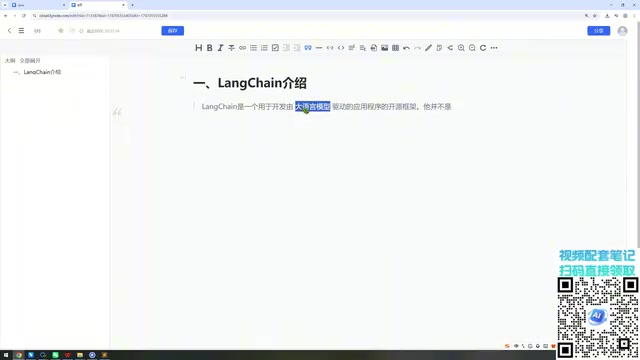
LangChain is the infrastructure for agent development, solving three major model limitations with a positioning similar to Spring in Java.
This article is aimed at beginners in AI application development and systematically breaks down LangChain's core positioning and key capabilities. It points out that LangChain is not just a model API wrapper but a pre-built agent framework and tool integration layer, similar to Spring in Java enterprise development and built on LangGraph. It explains the three major LLM limitations LangChain addresses—knowledge cutoff at training time, inability to interact with external systems, and lack of state persistence for multi-turn conversations—corresponding to function calling, tool integration, and the Memory component. It also unpacks the Language + Chain naming philosophy and recommends learning via the official English documentation, starting from the Overview and then diving into practical Agents and RAG.
In the field of AI application development, especially when building agents, LangChain is a framework that's almost impossible to avoid. But many beginners only have a vague understanding of it—they know it "can call models" but aren't clear on what problems it actually solves or what role it plays in the tech stack. Based on a comprehensive tutorial from a Bilibili creator and combined with the official documentation, this article breaks down LangChain's core positioning and key capabilities.
What Is LangChain: More Than Just an API Wrapper
LangChain is an open-source framework for developing applications powered by large language models (LLMs). In the Python ecosystem and even the mainstream agent development ecosystem, it's practically an essential component. But its value goes far beyond wrapping model-calling APIs—if you just want to call DeepSeekAd or Claude, native APIs can do that. LangChain's real role is as a pre-built agent framework and a rich tool integration layer.
Developers with a Java background can think of it this way: LangChain's position in agent development is similar to Spring's position in Java enterprise development. It's built on top of LangGraph and also integrates related components like DeepAgent, so developers can quickly build advanced LLM-powered applications without having to construct complex integration architectures from scratch.

The Three Major Model Limitations LangChain Addresses
Before learning any technology, you first need to understand what problem it solves. From a macro perspective, LangChain primarily addresses three core limitations of large language models.
1. Limited Knowledge Timeliness
A model's knowledge is cut off at the time its training data was collected. For example, a model that finished training on August 10th cannot answer questions about events that happened on August 11th or 12th. You might think "but when I ask Doubao, it clearly knows"—that's because the Doubao you're using is itself an application built on top of an LLM, not the underlying model directly. LangChain provides mechanisms like function calling that let developers invoke external tools to retrieve information from after the training cutoff, thereby breaking through the knowledge timeliness bottleneck.
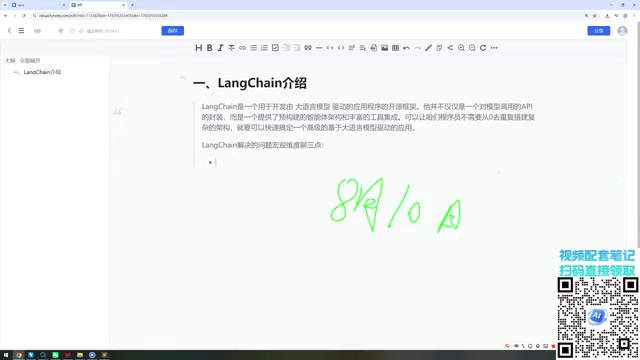
Function Call is a capability of large language models: developers describe available tools (function names, parameters, purposes) using structured schemas, and when the model determines during a conversation that it needs external information, it outputs a structured call request rather than fabricating an answer directly; the application layer parses that request, actually executes the function (such as searching, querying a database, or calling an API), and then passes the result back to the model, which integrates it into the final answer. It's the underlying foundation of LangChain's tool integration capabilities and the key mechanism for breaking through knowledge timeliness and external interaction limitations. Different model vendors have slightly different function call formats, and LangChain provides a unified abstraction over them.
2. Inability to Interact Directly with External Systems
The model itself has no ability to directly call third-party APIs, access databases, or perform precise calculations. Complex arithmetic operations are often inaccurate for models; data from a company's internal databases can't be accessed by the model via JDBC or similar means. LangChain's tool integration capabilities let developers wrap calculators, API clients, database connections, and more, enabling the model to "use" these external resources.
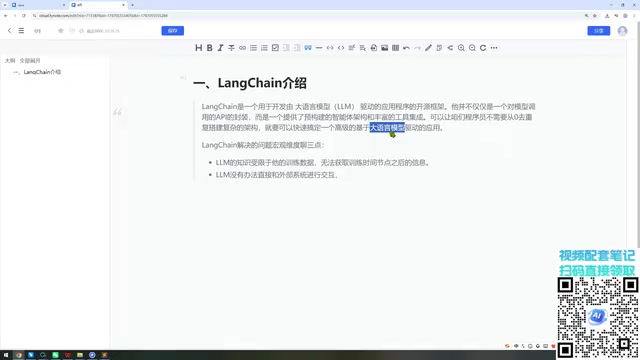
3. Lack of State Persistence
Large language models themselves don't have memory for multi-turn conversations—they're essentially one question, one answer. When you ask a second question, the model doesn't know what your first question was. LangChain uses components like Memory to maintain conversation state at the application layer, enabling coherent multi-turn interactions.
These three problems are just the most typical examples—LangChain can handle far more than these.
The Memory component doesn't change the model's inherently stateless nature; instead, it maintains a message history at the application layer: before each model call, previous multi-turn conversations (or summaries and key entities from them) are concatenated into the prompt and sent together, so the model "appears" to remember the context. Common strategies include keeping the full history, retaining only the most recent N turns, summarizing and compressing history, and storing long-term facts in external storage for on-demand retrieval. Note that context windows are limited—the longer the history, the higher the token cost and the more easily key information gets diluted. Therefore, Memory design is essentially a context management problem.
The Origin of the Name: Language + Chain
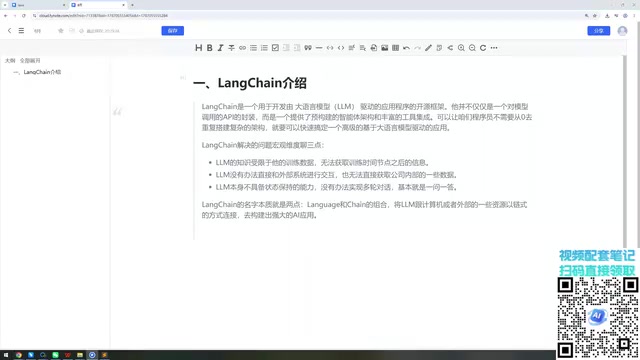
Breaking down the name LangChain gives you "Language" and "Chain"—connecting large language models with other computer resources in a chain-like manner, enabling interactions between them to build more powerful AI applications or agents. This chain-based thinking is key to understanding LangChain's design philosophy: the model is the core, but it only delivers real value when chained together with tools, data, memory, and other components.
Learning Path and Documentation Resources
LangChain iterates and updates frequently, so always rely on the official documentation when learning. The official English documentation covers introductions and relationship explanations for core components like LangChain, LangGraph, and LangSmith, and is the most authoritative information source. Developers with decent English skills are advised to read the English documentation directly; the Chinese documentation is also updated in sync, with code examples that are basically identical, but translations may contain deviations, making it suitable as a supplementary reference.
The Quick Start section provides installation guides and basic examples. It's recommended to start with the Overview to build an overall understanding of the model-wrapping framework, then gradually dive into practical modules like Agents and RAG. The official documentation explicitly states that LangChain provides configurable agent functionality and is an extremely simple yet highly configurable wrapping framework capable of interacting with various models.
LangGraph is the underlying orchestration framework released by the LangChain team. It models agent workflows as "graphs": nodes represent a model call or tool execution, edges represent transition conditions, and it has built-in state management and checkpoint mechanisms, thereby supporting complex control flows such as loops, branching, human intervention, and breakpoint recovery. Compared to earlier abstractions centered on linear Chains, LangGraph is better suited for building real agents that require multi-step reasoning and repeated tool calls. Upper-layer capabilities like DeepAgent mentioned in this article are also built on top of it, so understanding LangGraph is an important step toward mastering the LangChain ecosystem.
LangSmith is the companion observability and debugging platform, used to trace each model call, tool execution, and token consumption, view the complete call chain, evaluate output quality, and perform regression testing. Agent failures often hide in the intermediate steps of multi-step calls and are difficult to locate through log printing alone, so the chain tracing provided by LangSmith has become the primary means of debugging and optimizing agents. Together with LangChain and LangGraph, it forms the three pieces of the official ecosystem: development framework, orchestration engine, and observation platform.
Conclusion
LangChain is not a simple API wrapper but the infrastructure for agent development. Understanding the model limitations it addresses—knowledge timeliness, external interaction, and state persistence—is more important than memorizing APIs. The upcoming practical projects on agents and RAG are all built on a clear understanding of these core concepts. It's recommended to consult the official documentation as you learn, follow the quick start hands-on, and gradually build your own LLM applications.
One-line Summary
LangChain is the infrastructure for agent development, addressing three major model limitations with a positioning similar to Spring in Java.
Paragraph Summary
This article is aimed at beginners in AI application development and systematically breaks down LangChain's core positioning and key capabilities. It first points out that LangChain is not just a wrapper for model APIs but a pre-built agent framework and tool integration layer, occupying a position in agent development similar to Spring in Java enterprise development, built on top of LangGraph. It then explains from a macro perspective the three major limitations of large language models that LangChain addresses: knowledge being cut off at the training time point, inability to interact directly with external systems, and lack of state persistence for multi-turn conversations, corresponding respectively to function calling, tool integration, and the Memory component. The article also unpacks the meaning of Language and Chain in the LangChain name, emphasizing the design philosophy of chaining models with tools, data, and memory. Finally, it offers learning path recommendations: use the official English documentation as the authoritative information source, with Chinese documentation as a supplement, starting from the Overview and then diving into practical Agents and RAG.
Related articles

Gemini 4 Carbon Tops Global Rankings as AI Productivity and Open-Source Ecosystems Surge
Google DeepMind's Gemini 4 Carbon tops global benchmarks, built for complex agents and system security. ByteDance launches Doubao Work integrated with Feishu, Anthropic's AI autonomously breaches 5 system-level attack chains, and ModelBest and Fudan open-source on-device multimodal and image generation models.

Overseas Creator Breaks Down N8n AI Agent Business Playbook: From Tooling to Monetization
An overseas creator breaks down the N8n AI agent business playbook: comparing Zapier, Make, and N8n, detailing four monetizable automation categories—lead capture, WhatsApp follow-up, booking, and content pipelines—plus agency pricing and a sales playbook.

Empacer: The Voice-First AI Assistant for Small Business Owners That Topped Product Hunt
Empacer is a voice-first AI assistant for small business owners: three-question setup, voice requests turned into customer replies, social posts, and invoices—all owner-approved. It won #1 Product of the Day on Product Hunt with 231 upvotes and 47 comments.