LangChain-Fireworks 1.7.1 Released: Fix for Streaming Reasoning Preservation

LangChain-Fireworks 1.7.1 fixes lost reasoning content in streaming and tool call loops.
LangChain-Fireworks 1.7.1 is a maintenance-focused patch release. The core fix addresses reasoning content being lost or truncated during streaming output and multi-turn tool call loops — directly benefiting applications that rely on reasoning traces for debugging, auditing, or Agent decision logic. The release also refreshes model profile data for better recognition of new Fireworks models, and upgrades langgraph-sdk from 0.4.2 to 0.4.6 for LangGraph toolchain compatibility. No breaking changes are introduced, making this a low-risk upgrade.
The Fireworks integration package in the LangChain ecosystem has received a 1.7.1 update. This is a patch release focused primarily on bug fixes, with core changes addressing reasoning content preservation in streaming output and tool call pipelines, along with a dependency upgrade and model configuration data refresh.
Key Changes in This Release
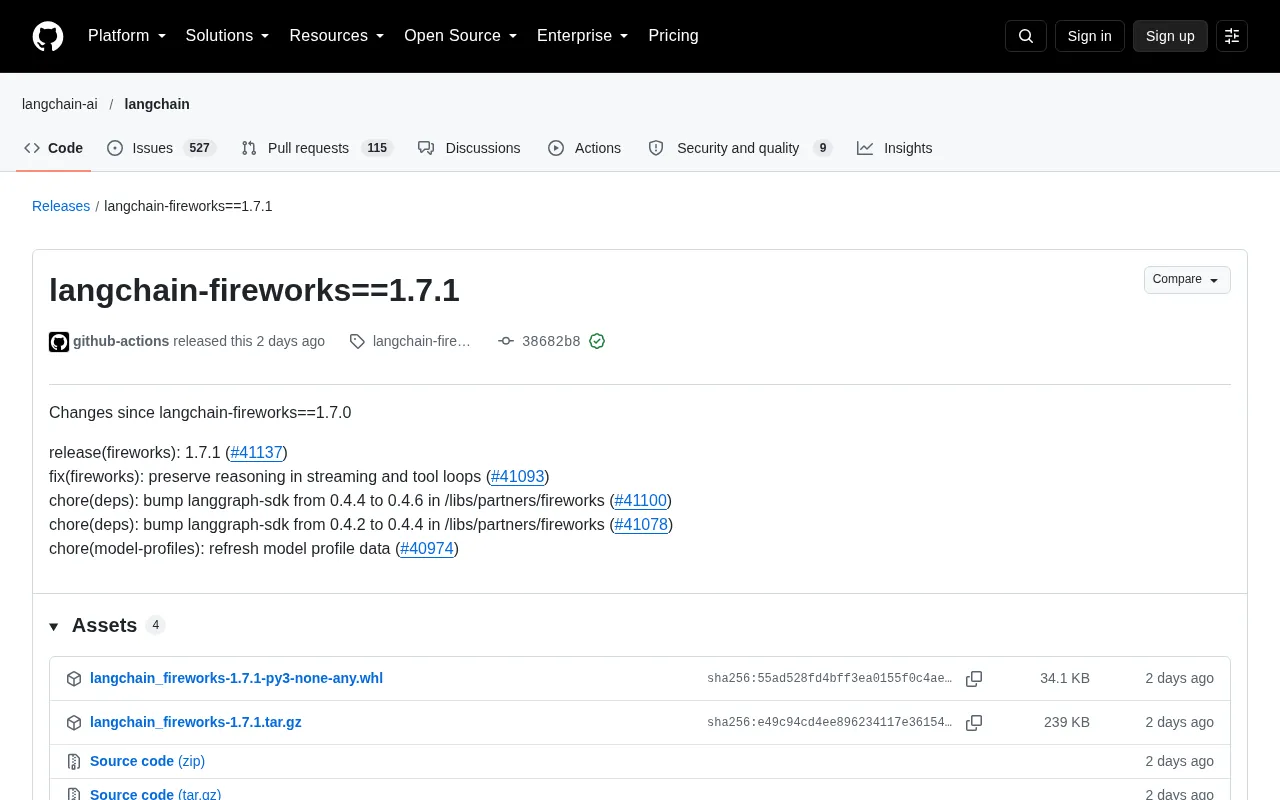
Looking at the changelog from 1.7.0 to 1.7.1, the most notable change is a fix targeting streaming scenarios (PR #41093): preserve reasoning in streaming and tool loops.
The significance of this fix lies in the fact that as more models support explicit reasoning processes, developers using streaming responses or building multi-turn tool call loops may have experienced lost or truncated reasoning information in previous versions. For applications that rely on reasoning traces for debugging, auditing, or building Agent decision logic, the completeness of this data is critical.
The release also includes a refresh of model configuration data (PR #40974), updating the model profile data. This type of data typically describes model metadata such as context window size and capability support (e.g., whether tool calling or vision input is supported). The refresh allows LangChain to more accurately identify and adapt to the latest models on the Fireworks platform.
"Reasoning content" refers to the internal thought process that some large language models output before delivering a final answer — a mechanism seen in OpenAI o1, DeepSeekAd-R1, and several reasoning-capable models hosted on the Fireworks platform. At the API level, this content is typically returned as a separate field (such as reasoning_content or text wrapped in <think> tags), transmitted independently from the final answer. In streaming mode, the model sends both the reasoning process and the final response as a token stream; in tool call loops, the model may output reasoning steps before deciding which tool to invoke, making each conversation turn more complex. In previous versions, this reasoning text could be accidentally discarded when concatenating streaming chunks or handling multi-turn tool call responses, leaving developers unable to read the complete decision process from the response object.
Dependency Upgrades and Maintenance Changes
The release also includes two dependency upgrades, both centered around langgraph-sdk:
- Upgraded
langgraph-sdkfrom 0.4.4 to 0.4.6 (PR #41100) - Upgraded
langgraph-sdkfrom 0.4.2 to 0.4.4 (PR #41078)
These chore(deps) type changes are typically initiated by automated dependency management tools (such as Dependabot), with the goal of maintaining compatibility with the LangGraph toolchain and ensuring that version mismatches don't cause issues when building Agent workflows based on LangGraph.
The release was completed automatically via GitHub Actions and verified with a GitHub GPG signature (key ID: B5690EEEBB952194), meaning the artifact is trustworthy and suitable for direct use in production environments.
LangGraph is a framework within the LangChain ecosystem specifically designed for building stateful, multi-step Agent workflows. langgraph-sdk is the client library for interacting with the LangGraph server (LangGraph Platform), handling task submission, status polling, and streaming event retrieval. Since LangGraph itself iterates quickly, if langchain-fireworks locks onto an older SDK version for too long, runtime issues such as incompatible serialization formats or missing event stream fields may occur. The two-step upgrade from 0.4.2 to 0.4.6 in this release indicates that multiple SDK minor versions landed during the 1.7.0 release cycle and were consolidated into a single release — a common pattern in monorepo multi-package management.
Practical Impact for Developers
LangChain-Fireworks is the official integration library connecting the LangChain framework with the Fireworks AI inference platform. Fireworks is known for its high-performance, low-latency open-source model hosting service, and developers can use this package to call various models deployed on the platform within LangChain applications.
For users already on 1.7.0, if your application involves any of the following scenarios, upgrading to 1.7.1 is recommended as soon as possible:
- Using streaming output and needing to retrieve the model's reasoning content
- Building Agents with multi-step tool calls that depend on complete reasoning traces
- Using new models on Fireworks that require accurate model capability metadata
Upgrading is straightforward:
pip install -U langchain-fireworks==1.7.1
Summary
Overall, 1.7.1 is a typical maintenance release with no breaking changes and low risk. The streaming reasoning preservation fix delivers real value for Agent and reasoning-focused applications, while the model configuration refresh ensures compatibility with new models on the Fireworks platform. For production environments that prioritize stable operation, this kind of incremental patch update is worth tracking promptly.
Related articles
Microsoft Fabric Database Agent in Action: From Reactive Firefighting to Intelligent Detective
A deep dive into the Microsoft Fabric Database Agent: how to enable it, supported monitoring scenarios, a blocking-issue demo, and the roadmap from reactive to autonomous operations.

Zendesk Uses ChatGPT Enterprise to Build a Sales Agent with 1,000 Daily Active Users
Zendesk opened ChatGPT Enterprise to all employees, who built about 600 apps themselves, including a sales expansion agent with about 1,000 daily active users. This article analyzes how it turns internal data into sales opportunities and its "don't wait" implementation strategy.

Google Releases Gemini 4 Carbon: Its Strongest Model Yet, Debuting with a Cybersecurity Focus
Google releases Gemini 4 Carbon, calling it its strongest model, with a cybersecurity focus. It tops the third-party composite ranking at 59 points but leads by only one or two. This article analyzes its security test results, staged rollout, token pricing, and the divergence between self-reported and third-party tests on hallucinations.