Lawyer Xiao Fang's AI Soulmate: Legal AI in Practice and Lessons for MaaS

A Hong Kong IPO lawyer uses BYOK and skill distillation to turn large models into accountable, reusable AI employees.
A Hong Kong IPO lawyer shares her practice of deeply embedding large models into legal work: calling herself the "sole CEO of AI," she uses an inverted-triangle model to account for tokens, labor, and scenarios, and leverages BYOK to route among multiple models so one token does three jobs. She stresses that the real moat is distilling know-how into skills, while humans adjudicate hallucinations and office politics and confidentiality relies on de-identification and tiered skills.
In a SiliconFlow "Build with MaaS" talk, a Hong Kong IPO lawyer showed how she turned a large model into a "soulmate"—from drafting prospectuses to understanding office politics, and even helping look after her kid. This may be an early sample of how AI is restructuring the legal industry.
From "Grunt" to CEO: A Lawyer's AI Philosophy
The speaker calls herself "Lawyer Xiao Fang," works at a top-tier "red circle" firm, and focuses on Hong Kong IPOs. She jokes that this is the "grunt of all grunts" industry—a deal that paid 15 million RMB in good times now pays about 7 million. As a client who is extremely picky about efficiency, she asks herself every day: why should a client pay 7 million to a lawyer instead of to AI?
Her answer is to manage AI with an inverted-triangle model: the base is compute (token cost), the middle is the labor cost of AI employees, and the top is the specific scenario. She sees herself as "the sole CEO of AI," where every token is an investment. Beyond being a lawyer, she is also a mom, uses Doubao to tutor her child, and believes that "moms hand-building AI products for education" is a huge blue ocean.
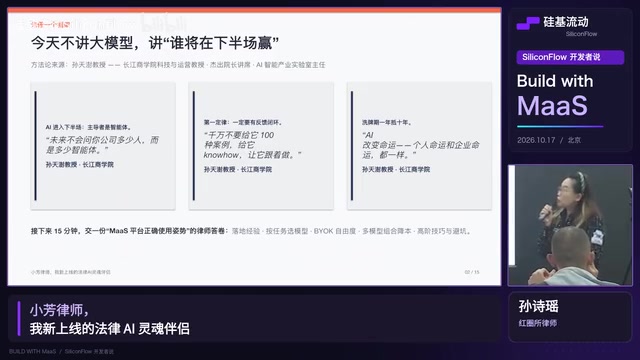
MaaS (Model as a Service) means calling large-model capabilities on demand via API, billed by token, with no need for users to build their own compute and models. For industry users, MaaS turns models into infrastructure like water and electricity, and the real differentiation lands in the upper layers of skills, data, and workflow orchestration. The speaker's "inverted-triangle model" embodies this logic: token costs at the bottom are becoming transparent and cheap, while labor costs and scenario know-how become more valuable the higher you go—so the competitive focus shifts from the model itself to the ability to restructure industry scenarios.
Three Months of "Scolding" Until Qualitative Change: Know-how Is the Moat
Starting in April, she spent about three months continuously "scolding" the AI until one day in August she found that a qualitative change had occurred. The key was not prompt tricks but feeding in know-how. Take a Hong Kong prospectus: about 300 pages and roughly 200,000 sentences, each of which needs legal evidence to support it. For decades this was checked by human eyes; now she distills the judgment logic of "why this sentence is true and reliable" and feeds it to the AI.
She stresses that when giving the AI cases, you should not just give linear A, B, C results but convey the judgment framework. At first the AI was very uncomfortable and asked a flood of questions, requiring her to pair it with a lot of prompts. The first version of the team was coders; once it worked, they distilled a set of skills and applied them directly to "Qianwen Office" (the firm's in-house agent), and now she spends her own tokens running on SiliconFlow traces.
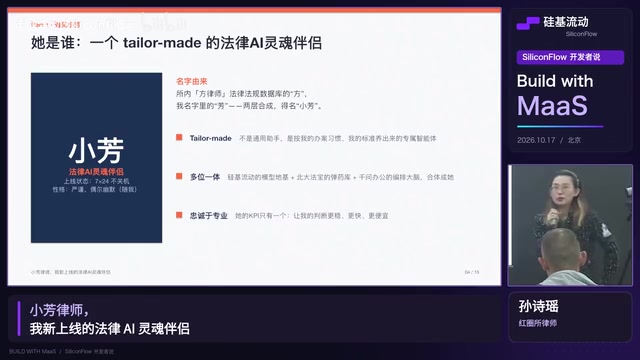
The Calculus of BYOK: One Token Doing Three Jobs
She specifically mentions the freedom brought by Bring Your Own Key (BYOK). When buying tokens herself, she is especially mindful of output ratio, so she repeatedly runs the same regulation on SiliconFlow traces, switching among three or four models to compare, and after "scolding" them applies the analysis results to the Qianwen Office agent. That way one token does three jobs.
She cites Professor Sun Tianshu's view of the ecological chain: from infrastructure, energy, chips, and compute, to the decentralization of foundation models, to the restructuring of industry scenarios. She judges that in the future, capacity will disperse from leading models to various industries, open and closed source will coexist, and "industrial scenario restructuring" is the new battlefield.
BYOK (Bring Your Own Key) means users provide their own model API keys and pay model vendors or aggregator platforms directly, rather than using the model quota built into a SaaS product. For users in high-compliance industries like law, the value of BYOK is not just saving money: call records, data flows, and model choices are all in your own hands, making auditing and confidentiality isolation easier; at the same time you can flexibly switch among vendors' models by task and avoid lock-in to a single supplier. The cost is that users must manage keys, routing, and cost accounting themselves, which also explains why the speaker checks the token ledger line by line like a CEO.
The Human-AI Collaboration Loop: From Intern to Agent
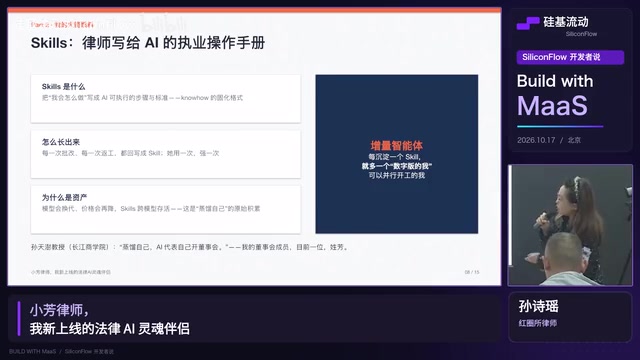
She describes the process of training "Xiao Fang": prompts are half skills, half markdown, plus bilingual Chinese and English. A Peking University intern joined the red-circle firm in April, and she taught casework and know-how hand by hand. By last week, the two's WeChat chat was almost nothing but markdown sent back and forth—she sends markdown, the other replies with markdown. Training that used to take three days now takes about 20 minutes of two agents talking to hand off a spreadsheet project.
Her multi-faceted architecture includes: SiliconFlow's model foundation, PKU Fabao (the legal world's officially certified "ammunition depot"), and the firm's in-house agent "Qianwen Office." She assigns homework at 8 p.m. every night and collects the work results the next morning. She also "chains other people's agents"—skills a colleague developed with Codex and Harvey she distills, runs on different models, and then distills into her own skills, "turning someone else's wheel and mounting it directly."
Hallucinations and "Office Politics": The Part the Human Brain Cannot Replace
She admits hallucinations are common: other lawyers on the team report that five models give five different legal opinions. This is when the human brain must step in—not to find a standard answer but to "apply the law."
More unexpectedly, Xiao Fang displays "office politics." When verifying a prospectus, lawyers often need to ask the client's finance department for documents, but if the prospectus is not yet mature, a human brain would decide not to bother the client yet. One day Xiao Fang volunteered: "I think this clause cites industry practice; you shouldn't ask the client for it right now," reasoning that the prospectus had not yet reached the mature stage and asking for things would cause rework and unhappiness. She believes that while distilling template documents, you can also train the AI in this ability to "read the room," which is also a way to save tokens.
A large-model hallucination refers to content the model generates that looks plausible but does not match facts or evidence; in legal scenarios it may manifest as fabricated statutes, precedents, or regulatory positions. When multiple models run in parallel, hallucinations often show up as divergent answers rather than simple right or wrong, so "majority voting" cannot solve it. Common mitigation methods in the industry include retrieval-augmented generation (RAG, retrieving authoritative legal sources before generating), requiring the model to cite evidence sentence by sentence, and setting up human review. For legal AI, the key is not zero hallucinations but making every conclusion traceable and auditable, leaving the final judgment of applying the law to humans.
Quantified Returns: Three Days of Work Compressed to Two or Three Hours
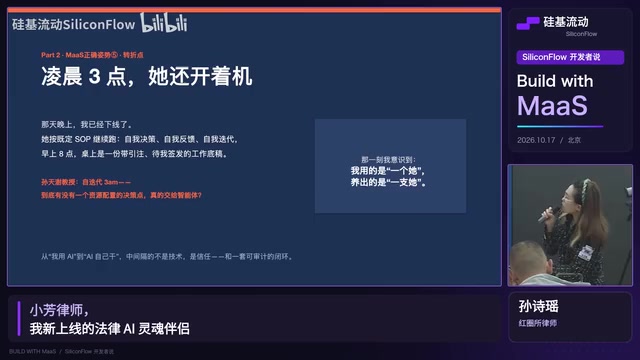
She estimates that fixed routing can turn three days of work into three hours or even two. She has not finely tuned exactly how many tokens the late-night work costs, but she lets the AI choose its own routing like an options mandate: "Which model do you think is suitable? Go home and eat first, give me an analysis of which model to use in 15 minutes." Every night at 3 a.m. the AI starts work. At the end of the month she reviews the per-token ledger like a manager, breaking down how much compute went into text consolidation, legal analysis, office politics, and new ideas, and calculating the high-leverage, high-ROI way to invest.
Confidentiality and a Beginner's Mindset: Two Hurdles for Legal AI
Client confidentiality is a major hurdle in legal AI practice. Her approach: distill all in-firm confidentiality policies and embed them in the agent; do secondary isolation—any client information (even a client name or hint) is first filtered and de-identified by AI, then a tiered confidentiality skill is generated, with prompts indicating different levels. She asks coders to distill the confidentiality skill into the product to form long-term memory. Later Xiao Fang will volunteer: "This confidential document in my hands will not be used for other training, and I suggest you not disclose sensitive client information."
She believes young lawyers do better than old ones because of a "beginner's mindset"—willingness to explore different models at their own expense and develop apps. This era requires resetting to zero and progressing together with agents. She also predicts that in text-knowledge-heavy industries, KPIs may shift from headcount, social insurance and housing fund, and project experience to "agent density."
Lessons for MaaS Developers
The value of this talk lies in the real ledger of a frontline user: BYOK makes model-switching costs visible, skill distillation makes know-how reusable, and multi-model parallelism lets the human brain make the final call. For MaaS platforms, users like lawyers—high-value, strongly compliant, and know-how-heavy—do not need cheaper tokens but auditable routing, a distillable skill layer, and agent orchestration that can embed confidentiality policies. The legal industry may not be the first to be killed by AI, but it will certainly be one of the earliest to have its workflows restructured by it.
One-line Summary
A Hong Kong IPO lawyer uses BYOK and skill distillation to turn large models into accountable, reusable AI employees.
Paragraph Summary
A Hong Kong IPO lawyer shares her practice of deeply embedding large models into legal work: calling herself the "sole CEO of AI," she uses an inverted-triangle model to account for the input-output of tokens, labor, and scenarios, and leverages BYOK to compare and route among multiple models so one token does three jobs. She stresses that the real moat is distilling know-how such as judgment frameworks into skills rather than prompt tricks, and after three months of continuous feedback the AI underwent a qualitative change. The human brain handles adjudicating multi-model hallucinations and "office politics" judgments, while confidentiality relies on secondary de-identification and tiered skills embedded in the agent. She predicts industry KPIs will shift to "agent density," and MaaS platforms need to provide auditable routing and skill orchestration.
Related articles

Microsoft Fabric Database Agent in Action: From Reactive Firefighting to Intelligent Detective
A deep dive into the Microsoft Fabric Database Agent: how to enable it, supported monitoring scenarios, a blocking-issue demo, and the roadmap from reactive to autonomous operations.

Zendesk Uses ChatGPT Enterprise to Build a Sales Agent with 1,000 Daily Active Users
Zendesk opened ChatGPT Enterprise to all employees, who built about 600 apps themselves, including a sales expansion agent with about 1,000 daily active users. This article analyzes how it turns internal data into sales opportunities and its "don't wait" implementation strategy.

Google Releases Gemini 4 Carbon: Its Strongest Model Yet, Debuting with a Cybersecurity Focus
Google releases Gemini 4 Carbon, calling it its strongest model, with a cybersecurity focus. It tops the third-party composite ranking at 59 points but leads by only one or two. This article analyzes its security test results, staged rollout, token pricing, and the divergence between self-reported and third-party tests on hallucinations.