Ling 3.1 Flash 1019 Launches Free on AI Gateway
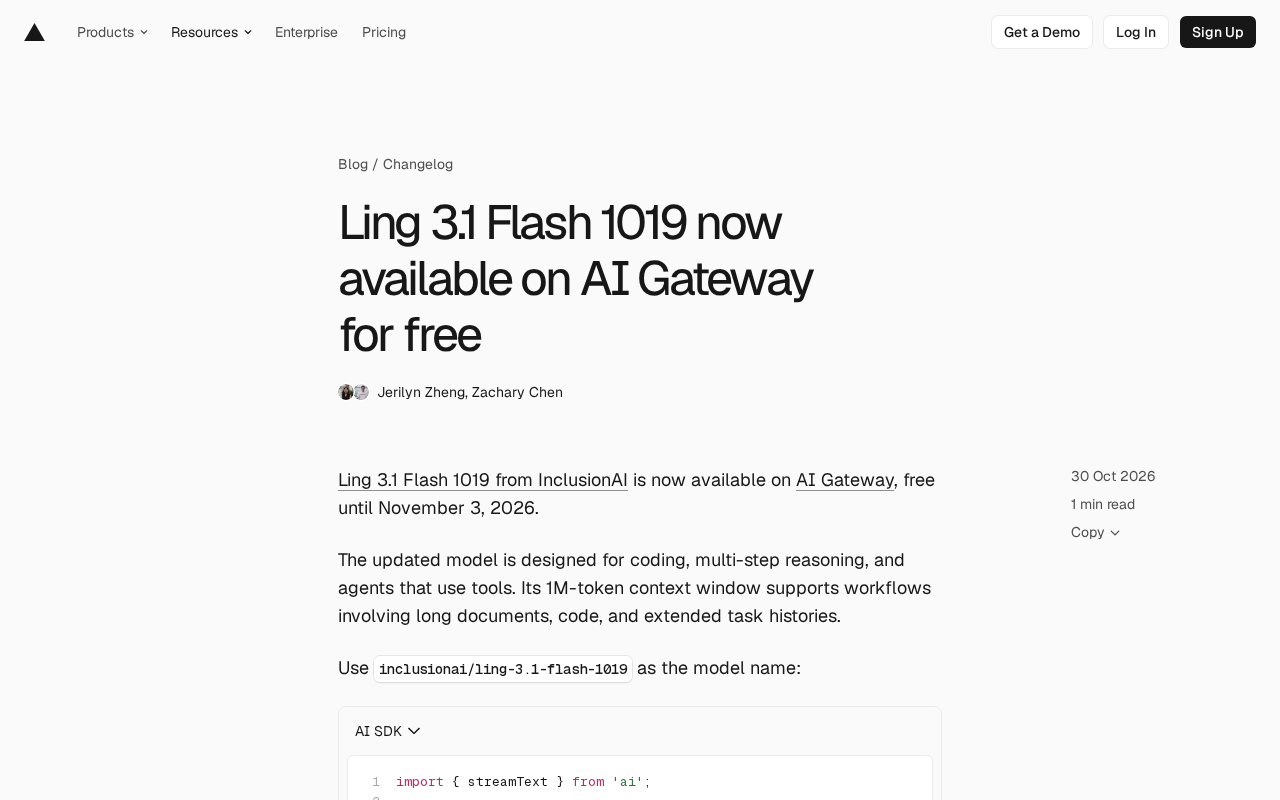
InclusionAI's Ling 3.1 Flash 1019 lands on AI Gateway with 1M token context, free until Nov 3, 2026.
InclusionAI's Ling 3.1 Flash 1019 is now available on Vercel's AI Gateway, free until November 3, 2026, after which published pricing applies. It targets coding, multi-step reasoning, and tool-calling agents, with a 1M token context window supporting long-document processing, code understanding, and multi-round tool-call history. The model name is inclusionai/ling-3.1-flash-1019, accessible via AI SDK's streamText, Chat Completions compatibility, and coding agents like Claude Code, Codex, and Cursor. Free requests still appear in the usage dashboard with full tracing but zero billing. AI Gateway passes through provider prices with no inference platform fee and offers retries, failover, budget management, and routing rules — ideal for comparative evaluation during the free window.
AI Gateway's model shelf has gained another contender built for coding and agentic use cases. InclusionAI's Ling 3.1 Flash 1019 is now officially available on AI Gateway, and it's free to call for a limited time — the free window runs through November 3, 2026, after which standard published pricing applies.
What This Version of Ling 3.1 Flash Is Built For
According to its positioning on the AI Gateway page, Ling 3.1 Flash 1019 targets three task categories: coding, multi-step reasoning, and tool-calling agents. These happen to be exactly where developers work most today, and where context capacity matters most.
A core selling point is its 1 million token context window. The official description says this capacity can support long-document processing, code understanding, and extended task history workflows. For agent applications that routinely stuff an entire codebase or multiple rounds of tool-call traces into a single session, long context means fewer truncations and more complete state retention.
Worth noting: AI Gateway is Vercel's unified model invocation layer. Calling Ling 3.1 Flash 1019 through it gives developers usage and cost tracking, retry and failover configuration, and performance optimizations beyond what providers natively offer.
Long context window refers to the maximum total tokens a model can "see" at once during a single inference. A token is the basic unit of text the model processes, roughly 0.75 English words or 1–2 Chinese characters. One million tokens is roughly equivalent to thousands of pages of text or a mid-sized codebase — far beyond the 4K–32K range of earlier models. The longer the context, the better the model can retain complete code files, multi-round tool-call records, and document details within a single session, reducing "forgetting" and contradictions caused by truncation. The trade-off is that VRAM usage and inference cost rise with length, and information in the middle of long contexts can still be diluted, so real-world results need task-level validation.
How to Connect
The model name is inclusionai/ling-3.1-flash-1019. In AI SDK you can call it directly with streamText, for example:
import { streamText } from 'ai';

const result = streamText({
  model: 'inclusionai/ling-3.1-flash-1019',
  prompt: 'Suggest three ways to make an AI agent more reliable.',
});

for await (const text of result.textStream) {
  process.stdout.write(text);
}
Beyond AI SDK, the page also lists compatible methods like Chat Completions. To use it in coding agents like Claude Code, Codex, or Cursor, install the latest Vercel CLI and run:
npx vercel ai-gateway setup
Then select inclusionai/ling-3.1-flash-1019 in your agent. AI Gateway also offers a model playground so you can test results before formally integrating.
AI SDK is an open-source TypeScript toolkit maintained by Vercel for calling multiple model providers through a unified interface. streamText is its streaming text generation function; the returned object contains a textStream async iterator that emits output as it's generated — ideal for chat interfaces and agent loops that need low-latency feedback. Beyond streaming text, AI SDK also provides generateText, generateObject (structured output), and tool calling APIs, so the same business code can switch underlying providers by changing only the model identifier — which is why the model name is passed as a string in the article's example.
Coding agents are AI tools that can autonomously read and write codebases, execute commands, and iterate over multiple rounds, such as Claude Code, Codex CLI, and Cursor. They typically connect to models via OpenAI Chat Completions compatibility or custom endpoints, so their demands on models center on long context, stable tool-calling formats, and instruction-following ability. The purpose of npx vercel ai-gateway setup is to write the gateway address and credentials config so these agents send requests to AI Gateway rather than directly to the provider — unifying billing, tracing, and failover.
A Few Details About the Free Period
Although free requests incur no charge, they still appear in your usage dashboard with full request tracing — meaning usage and call traces remain visible, only the bill is zero. After November 3, 2026, requests will be billed at published prices.
For teams that want to evaluate long-context coding models without immediately incurring costs, this window is a good time for comparative testing. Given that Ling 3.1 Flash is positioned for coding and tool calling, a natural validation approach is to run the same batch of multi-step reasoning tasks, long-document Q&A, and agent orchestration workflows on both the new model and your existing models, observing context retention and tool-calling stability.
AI Gateway Pricing Policy
AI Gateway emphasizes two pricing principles: passing through provider prices as-is with no markup, and charging no platform fee for inference — BYOK (bring your own key) requests included. For teams already routing across multiple models, this means integrating Ling 3.1 Flash 1019 adds no extra platform-layer cost; actual spend is still determined by provider pricing.
The platform also includes custom reporting, Zero Data Retention support, API key budget management, and routing rules — well suited to engineering teams that need unified management of multi-model calls.
Who Should Try It First
Ling 3.1 Flash 1019's positioning makes it a better fit for several scenarios: coding assistants handling large codebases, agent systems relying on multi-round tool calls, and analysis workflows requiring reasoning across long documents. The free period offers a low-cost validation entry point, but whether to adopt it long-term depends on its real-world task performance and whether pricing after November 3 matches expectations.
Related articles

PC Memory Wasted? Hacker News Debates Centralized Data Centers
Hacker News users argue that personal computer memory is wasted and should be centralized in data centers, sparking debate on centralized vs. distributed computing resource allocation. This article analyzes the logic behind the claim, the costs of centralization, and new tensions in memory resource allocation in the AI era.

Why Fair Use Benefits Everyone: OpenAI Publishes Multi-Party Case Brief Analysis
OpenAI publishes excerpts from multiple court briefs featuring creators, scholars, accessibility advocates, and legal experts, explaining how fair use supports AI training and innovation, and analyzing its practical impact on developers and content professionals.
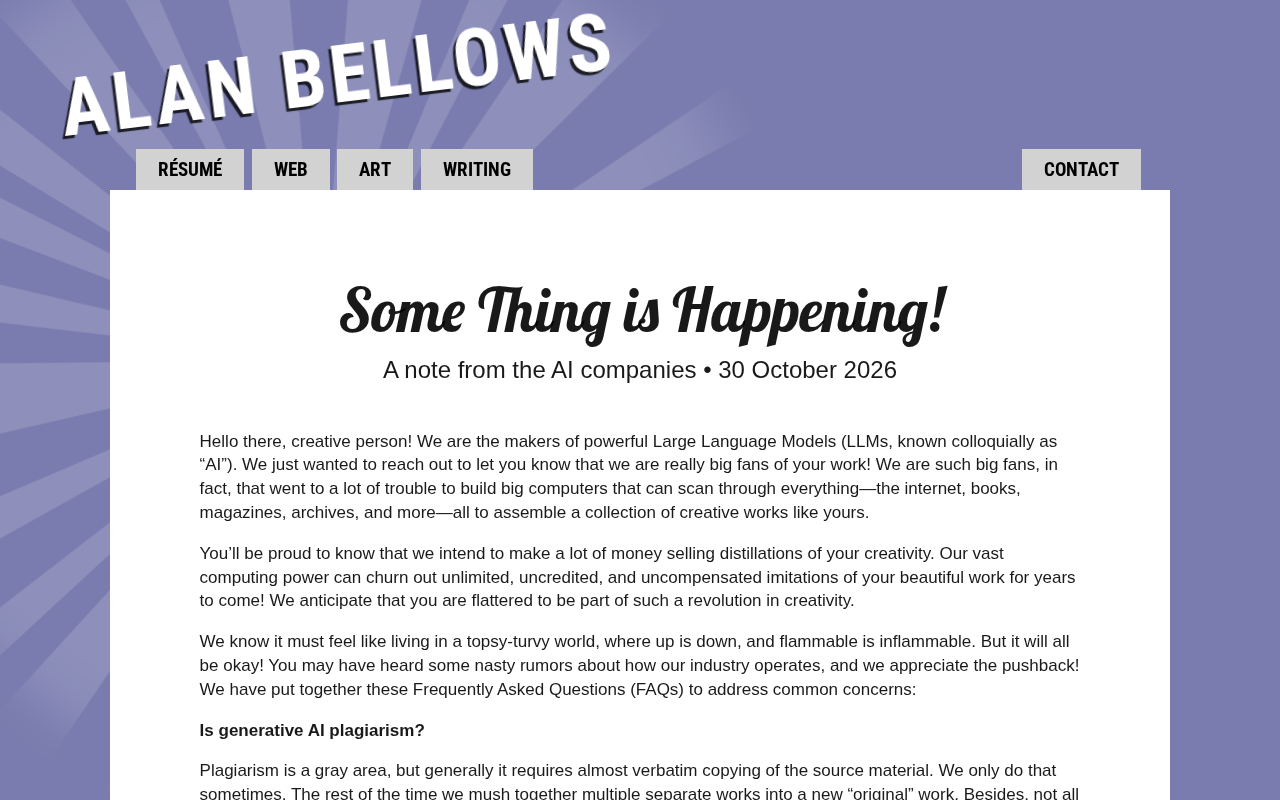
AI Companies' Joint Statement: 'Some Thing is Happening' Hints at Industry Shakeup
A Hacker News post 'Some Thing is Happening: A note from the AI companies' sparks speculation. This article analyzes the potential meaning of the joint AI company statement, industry context, and impact on developers.