LLM for Absolute Beginners: A Complete Learning Path from Principles to Practice

A learning map for an LLM introductory course: from five fundamentals to principles, training, and engineering implementation.
Based on a complete LLM hands-on course, the article outlines a learning path from prerequisites to engineering deployment. It stresses five fundamentals: Python, math, machine learning, PyTorch, and deep learning; reviews the BERT, GPT, and T5 technical routes and the post-2021 shift to GPT; explains that large models are probabilistic models involving Tokenizer, embedding, Transformer, and softmax; details the four training stages and decoding parameters; and introduces phase two LangChain, Agent, and interview practice, emphasizing fundamentals first before engineering.
Large model technology has a high barrier to entry and a vast, complex knowledge system. Many beginners feel lost when confronted with concepts like Transformer, RLHF, and LangChain. A systematic learning path can connect scattered knowledge points into practical, actionable skills. Based on the content of a complete LLM introductory hands-on course, this article outlines the core thread from preparatory knowledge and model principles to application deployment, helping readers build a clear learning map.
Pre-course Preparation: Five Fundamentals You Must Fill In
The course explicitly lists five foundational areas you need before learning large models. Python is the first requirement—large model R&D, most projects on GitHub, and Transformer components are all written in Python, so without the ability to read and write code, it's almost impossible to make progress. A math foundation is equally unavoidable; the course mentions it will cover the softmax function and mathematical content, since large models are essentially statistical models, and probability theory is the underlying language for understanding how they work.
Machine learning fundamentals help you understand classification models, generative models, and how evaluation metrics are calculated. PyTorch is a hard requirement at the practical level—although many models are well encapsulated, the moment you need to modify a structure or understand network details, you must be able to use PyTorch to build Tensors and networks. Finally, deep learning fundamentals complement machine learning basics, with a focus on neural networks. The course suggests learners fill these gaps according to their own situation, with Chapters 3 and 4 concentrating on the theoretical parts.
The Evolution of Large Models: Two Paths from BERT to GPT
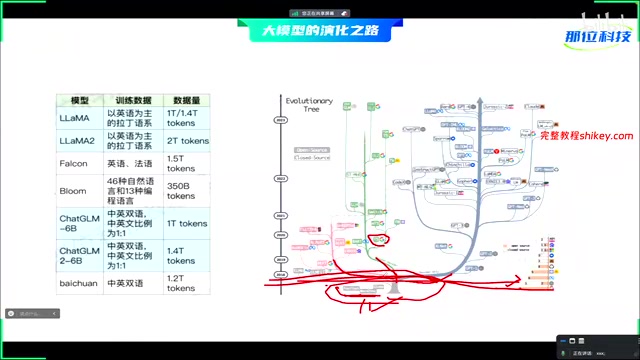
Understanding the development thread of large models is a foundation you can't avoid for both interviews and practice. The course divides the current landscape into two camps: commercial large models and open-source large models. On the commercial side there are ChatGPT, Claude, and domestic models such as Qwen, ERNIE Bot, iFlytek Spark, and MiniMax; on the open-source side, from early T5 and Bloom to the open-source wave triggered by Llama and subsequent models like Baichuan.
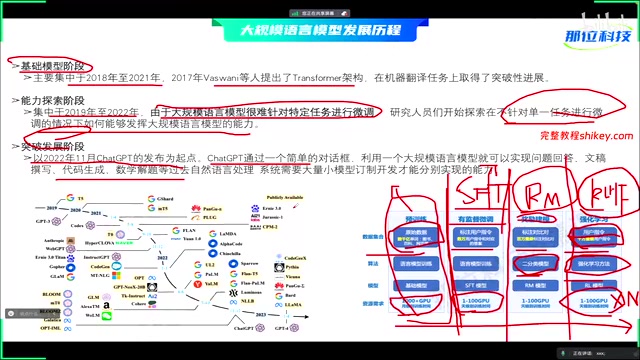
More insightful is the breakdown of technical routes. After Transformer appeared in 2018, the industry split into three lines: the BERT route using only the encoder, the GPT route using only the decoder, and the T5 route using encoder and decoder together. BERT excels at natural language understanding (NLU), can see context bidirectionally, and performs well on tasks like semantic encoding and search recommendation, but each task requires a specific downstream network design, making transfer costly. GPT follows the decoder route and was early on inferior to BERT at the same parameter count, until GPT-3 dramatically increased parameters and scaling law began to show its power, highlighting the unifying advantage of the generative approach—any task can be solved with a generative paradigm.
The course summarizes this turning point with a single image: before 2021 the industry generally chose BERT, and after 2021 it rapidly shifted to the GPT route. When asked why the two different routes emerged, you can answer from the application context: with small parameter counts BERT was more favored; once compute scaled up, GPT's decoder approach suited autoregressive generation scenarios and had a richer ecosystem.
Differences Between Encoder and Decoder Architectures
The original Transformer structure consists of an encoder and a decoder. The encoder uses self-attention to let each position simultaneously see all other positions in the sequence (bidirectional context), excelling at compressing input into semantically rich representations, making it suitable for understanding-type tasks such as classification, extraction, and semantic matching. The decoder uses masked self-attention, where each position can only see itself and previous tokens, naturally suited to generating word by word from left to right—exactly how autoregressive language models operate. BERT retains only the encoder and learns representations through masked language modeling (randomly masking some words for the model to guess); GPT retains only the decoder and learns generation by predicting the next word. T5 uses both encoder and decoder, unifying various tasks into a "text-to-text" form. Understanding this structural difference explains why BERT is strong at NLU, GPT is strong at generation, and why downstream tasks require a separately designed classification head for BERT.
The Essence of Large Models: A Probabilistic Model
The course repeatedly emphasizes a core understanding: large models are essentially probabilistic models. Given a word sequence, the model computes the probability of that text appearing. High probability means it conforms to language patterns; low probability means poor generation quality. This objective function can be written as a product of conditional probabilities, optimized by maximizing likelihood estimation of model parameters.
To make this probability computable, large models use an embedding layer to map tokens into vectors, add positional encoding, feed them into Transformer blocks, pass through multiple hidden layer transformations, and finally output a probability distribution over the vocabulary via a softmax layer. During training, gradient descent updates the weights so that the model's output probability distribution approaches the distribution of real language.
The course also explains the concept of tokens: they are subword units after tokenization. Different models use different Tokenizers (such as BPE, SentencePiece), with different splitting methods, and vocabulary sizes ranging from tens of thousands to over a hundred thousand. Therefore, when comparing models, the fair angle is to look at the Tokenizer they use rather than simply comparing vocabulary size. There is also a practical formula for the relationship between parameter count and VRAM: at full precision, multiply parameter count by 4; at FP16, multiply by 2. For example, a 6B model needs about 24GB of VRAM at full precision, and about 12GB at FP16.
Maximum Likelihood Estimation and Cross-Entropy Loss
The "maximizing likelihood estimation" mentioned in the article is the core objective of training language models. Given a word sequence in the real corpus, the model outputs a probability distribution over the vocabulary at each position, and the probability of the entire text is the product of the conditional probabilities at each position. Maximum likelihood estimation means adjusting parameters so that the probability of sequences actually appearing in the training corpus is as high as possible. Since products easily underflow numerically, in practice you take the logarithm to turn it into a sum of log-likelihoods, then negate it to get the cross-entropy loss—which is exactly what CrossEntropyLoss in PyTorch computes directly. Therefore, in language model training, "minimizing cross-entropy" and "maximizing likelihood" are two ways of saying the same thing. With this understood, you can see that SFT computing loss only on the output part essentially means computing log-likelihood only on answer tokens.
The Four Training Stages: Pretraining, SFT, Reward Model, and Reinforcement Learning
The R&D process for modern large models has evolved from the early "pretraining + fine-tuning" into four stages. The pretraining stage trains a base model on massive data; the course mentions GPT-3 used 45TB of data (about 700+GB after cleaning), 175 billion parameters, and required large-scale GPU clusters and months of training.
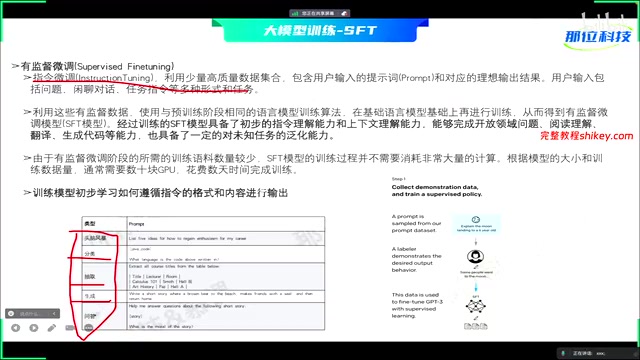
The SFT (supervised fine-tuning) stage teaches the model to follow instructions. The course gives a key interview point: during SFT training, loss is computed only on the output part, not the input part, with the goal of making answers conform to specifications as much as possible. Common types of SFT data include brainstorming, classification, extraction, generation, and question answering. Another high-frequency question is catastrophic forgetting—fine-tuning overwrites knowledge learned during pretraining. Mitigation methods include mixing pretraining data into training, and weighting and adding pretraining loss with downstream loss.
The reward model (RM) stage solves the question of "whether what is generated is good." For the same question, generate multiple answers, have humans rank them, and train a reward model to learn human preferences. The course points out that RM data construction methods include scoring and pairwise ranking; their quality directly affects the effectiveness of subsequent reinforcement learning, but overly strong ranking preferences can also weaken the model's creativity.
The RLHF/PPO stage integrates the SFT model with the reward model, using the reward model's scores to optimize SFT parameters via PPO, while adding a KL divergence constraint to prevent the model from drifting too far. The course admits that reinforcement learning training is difficult, but tools like PPO and TRL are well encapsulated and can be picked up quickly.
The Role of the KL Divergence Constraint
The KL divergence mentioned in the RLHF stage is a metric measuring the difference between two probability distributions, ranging from 0 (when they are completely identical). In PPO training, the optimization objective is for the model to obtain higher rewards, but the reward model is only an approximation of human preferences; the model may find shortcuts to "game the score," generating text with high rewards that is bizarre, repetitive, or deviates from normal language—this is reward hacking. Adding a KL penalty term constrains the output distribution of the current policy model from deviating too far from the SFT reference model, essentially adding a "don't drift off" leash to optimization. A larger KL coefficient is more conservative and closer to the SFT model; a smaller one is more aggressive and more likely to cater to the reward model. Understanding this term explains why RLHF-tuned models can improve helpfulness without losing their original language abilities.
Decoding Strategies: Top-k, Top-p, and Temperature
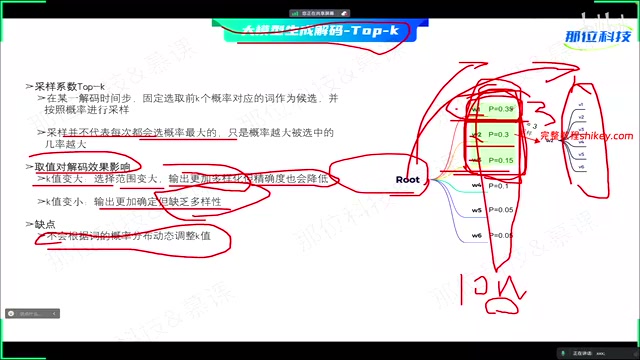
After the model outputs a probability distribution, how to choose the next word is a high-frequency topic in deployment and interviews. Top-k limits candidates to the k words with the highest probability; a smaller k makes output more deterministic but less diverse, a larger k is more diverse but may introduce low-probability words; the drawback is that k is fixed and cannot be dynamically adjusted according to the probability distribution. Top-p (nucleus sampling) defines the candidate range by cumulative probability, dynamically selecting at each step, solving Top-k's fixed-value problem. In actual code, Top-k is usually applied first, then Top-p.
Temperature changes the scaling of the probability distribution: when temperature approaches 0, the model tends to choose the highest-probability word, producing conservative but repetitive output; when temperature rises, the distribution becomes flatter, increasing diversity but potentially sacrificing coherence. The course's rule of thumb is that application scenarios generally use values around 0.2 to 1, and can be raised appropriately when diversity is needed.
Greedy Search and Beam Search
Top-k, Top-p, and Temperature are all stochastic sampling strategies, contrasted with deterministic search methods. Greedy search directly selects the highest-probability word at each step; it is simple to implement and fast, but easily falls into local optima, generating repetitive, monotonous text. Beam search keeps several candidate sequences simultaneously, expanding at each step and retaining the top beam by cumulative probability, which can find outputs with higher overall probability to some extent, and is often used in tasks requiring high accuracy such as machine translation. However, beam search tends to generate safe, mediocre text, which in open-ended dialogue appears stiff. Therefore, chat applications mostly use sampling with temperature and Top-p, while tasks like summarization and translation more often use beam search. Understanding the trade-offs of these methods explains why the same model with a different decoding method produces strikingly different output styles.
Phase Two Upgrade: LangChain, Agents, and Interview Practice
The course mentions that the phase two content is "more for the same price," and phase one students can learn it for free. Phase two focuses on supplementing PyTorch operator fundamentals, practical applications of LangChain in Agents and industry Q&A, and sharing of large model interview experience. The hands-on part covers data collection and cleaning, chunking and vectorized retrieval, Prompt assembly, project deployment and launch, and log monitoring, using tools like Flask to complete model launch and operations. For students changing careers or job hunting, this chain from theory to projects is the most direct path into the large model industry.
Overall, the value of this course lies in organizing fragmented knowledge points into an executable learning route: first fill in the fundamentals, then understand the principles, and finally land in engineering practice. For absolute beginners, patiently working through the foundational reserves of the first two chapters will make the subsequent code practice truly fall into place.
One-line Summary
A learning map for an LLM introductory course: from five fundamentals to principles, training, and engineering implementation.
Paragraph Summary
Based on a complete LLM introductory hands-on course, the article outlines a learning path from preparatory knowledge to engineering deployment. It first emphasizes the five fundamentals needed before learning: Python, math, machine learning, PyTorch, and deep learning; then reviews the evolution of large models, breaking down the three technical routes of BERT encoder, GPT decoder, and T5 encoder-decoder, explaining why the industry shifted to GPT after 2021 due to scaling law and the unifying generative paradigm; next, it points out that large models are essentially probabilistic models, involving Tokenizer, embedding layers, Transformer, and softmax; it then details the four training stages of pretraining, SFT, reward model, and RLHF, and analyzes decoding parameters such as Top-k, Top-p, and Temperature; finally, it introduces phase two content on LangChain, Agents, and interview practice, emphasizing the execution route of filling fundamentals first before engineering implementation.
Related articles

64 Releases in 40 Days: How Strata Uses Release Velocity to Define Its AI Local Inference Roadmap
Strata shipped 64 releases in 40 days with 460k+ characters of notes. From 0.1.0 to 0.2.10, a three-step path: make it run, make it fast, make it trustworthy.

Ripple-65B Open-Source Model Tops Community Charts
Ripple-65B open-source LLM debuts atop community charts, using a self-recursive architecture to slash long-context KV cache for low-latency hundred-billion-scale inference on ordinary GPUs, with preview weights, quantized files, and one-click Olema & VLM deployment.

Deploy Open-Source Video Model MiniMax H3 Locally in 5 Minutes and Skip Cloud Generation Fees
Bilibili creator tests local deployment of open-source video model MiniMax H3: three-step ComfyUI install, 5-minute setup, no coding. Same prompt generates in 2 minutes locally vs 4 minutes online with queuing, saving about 30 RMB per 15-second 720P video. Includes VRAM requirements and RTX 5080 test results.