LLM Takes On Zachtronics' Brain-Bending Masterpiece TIS-100
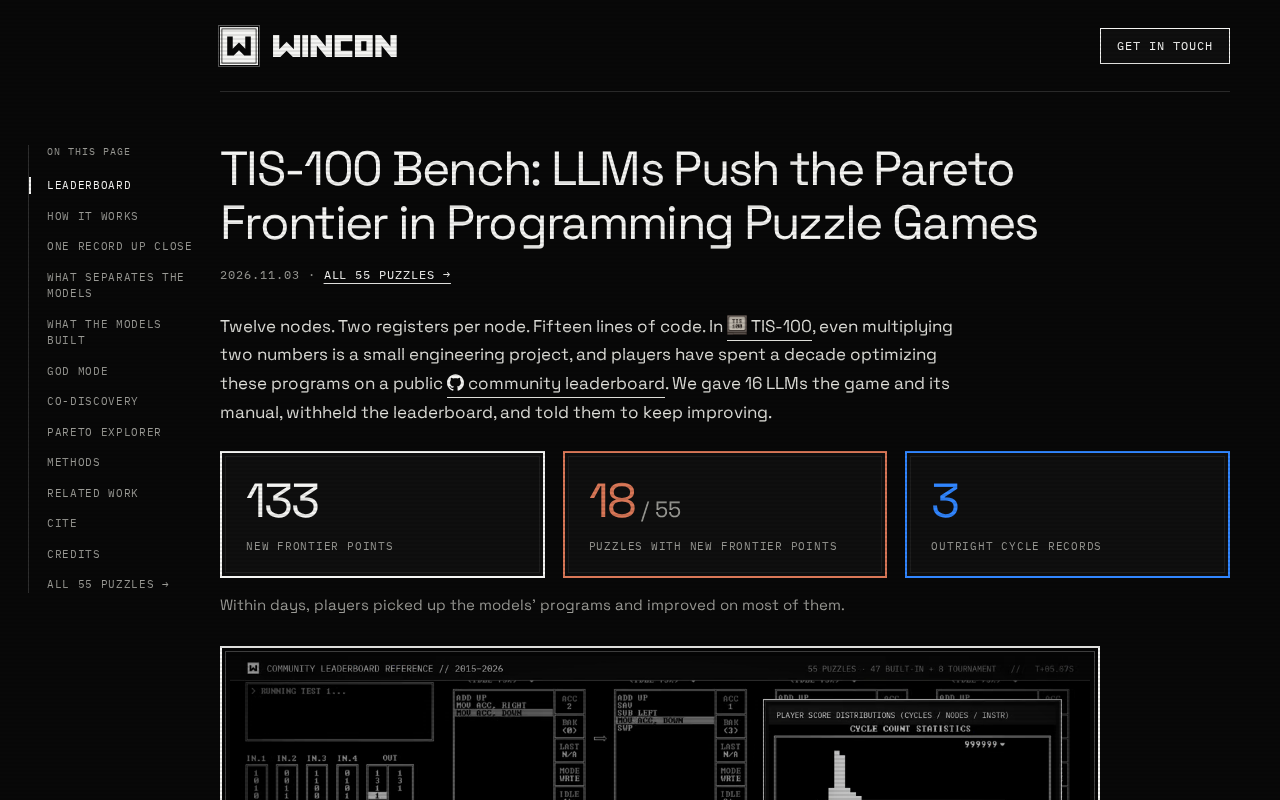
LLM takes on Zachtronics' hardcore assembly puzzle TIS-100, testing program synthesis and concurrent coordination under strict instructions.
A Hacker News project lets LLMs play Zachtronics' programming puzzle TIS-100, which requires writing parallel programs with minimal assembly instructions across nodes. The article analyzes why TIS-100 is a litmus test for LLMs—no frameworks to rely on, shifting difficulty from syntax to computational thinking. The project is early-stage with only 5 points and no comments. The article infers capability boundaries can be observed via instruction semantics understanding, multi-node data consistency, and iterative correction after failure, and notes such controlled environments can benchmark LLM program synthesis, offering insights for AI coding tools in constrained scenarios like embedded systems and low-level protocols.
When Language Models Meet Assembly Puzzles
A noteworthy project has appeared on Hacker News: letting large language models (LLMs) attempt to play Zachtronics' hardcore programming puzzle game TIS-100. The original game requires players to write parallel programs across individual nodes using an assembly-like instruction set to transform data streams—a dual test of logic and patience. Putting an LLM into this environment is more than a casual experiment; it's a stress test of the model's program synthesis and spatial reasoning capabilities.
Why TIS-100 Is a Litmus Test for LLMs
The core mechanics of TIS-100 revolve around a fictional TIS-100 computer. Players must understand the instruction semantics from the manual, plan communication between limited registers and ports, and write miniature programs that satisfy input/output specifications. Unlike typical code generation tasks, there are no large frameworks or libraries to call upon—every solution must precisely control the flow of data between nodes.
This setup shifts the difficulty from "syntax memorization" to "computational thinking." LLMs excel at mimicking code patterns, but here they must perform state tracking and concurrent coordination within an extremely small instruction space. The game also features a built-in scoring system based on cycle count and node count, forcing solutions to pursue efficiency beyond mere correctness, further amplifying the challenge.
TIS-100 Instruction Set and Parallel Computing Model
The TIS-100 instruction set is extremely minimal. Typical instructions include MOV (move data between registers/ports), ADD/SUB (arithmetic operations), JMP/JEZ/JNZ (conditional jumps), SAV/SWP (save and swap), etc.—all in single-operand or dual-operand formats, with no function calls, stacks, or dynamic memory. Each node has only ACC (accumulator), BAK (backup register), NIL, and four ports (up, down, left, right) available. Programs must communicate with adjacent nodes through port reads and writes. This design forces solutions to be built as "data flowing through a network of nodes": upstream nodes generate or filter data, downstream nodes aggregate or output it, and multiple nodes are pipelined when necessary. For LLMs, the difficulty lies in simultaneously maintaining each node's local state and inter-node timing synchronization—port reads and writes are blocking; reading an empty port waits, and writing to a full port waits. Any timing misalignment leads to deadlock or out-of-order output.
Zachtronics Style and Program Synthesis Evaluation
Zachtronics is known for titles like SpaceChem, Infinifactory, and Opus Magnum, all sharing a common characteristic: open-ended engineering puzzles with "multiple correct solutions, ranked by efficiency." TIS-100 compresses this philosophy down to the pure assembly level, making each level a formal specification: given an input sequence, produce an output sequence satisfying transformation rules, with the program halting within a finite number of cycles. This is highly isomorphic to benchmark tasks in the field of program synthesis—given input-output examples, search for a program satisfying the specification. The difference is that TIS-100's specifications are implicitly given by game levels, and the scoring function (cycle count, node count) provides a multi-objective optimization signal. Thus, it is naturally suited as a sandbox for evaluating LLMs' "specification-to-code" capabilities: small task scale, deterministic feedback, automatically scorable, while retaining the real difficulty brought by concurrency and resource constraints.
Capability Boundaries Revealed by the Project
From the Hacker News discussion page, the project currently has only 5 points and no comments, indicating it's still in an early demonstration stage. Public information does not disclose the specific number of levels cleared or success rate data.
However, from the nature of the task, several observation dimensions can be inferred: whether the model correctly understands the semantic constraints of the TIS-100 instruction set; whether it maintains data consistency when multi-node collaboration is required; and whether it can iteratively correct programs in response to failure feedback rather than repeating the same mistakes. These dimensions correspond precisely to common weaknesses of LLMs in strict rule systems.
Implications for AI Programming Tool Development
The value of such experiments lies not in the game itself but in providing a controlled, automatically judgeable programming environment. Compared to open-ended code completion, each TIS-100 level has clear pass criteria, making it naturally suitable as a benchmark for LLM program synthesis capabilities.
If models can demonstrate stable iterative capability on such tasks, it means future AI programming assistants may better handle strongly constrained scenarios like embedded systems and low-level protocol parsing. Conversely, if models frequently get lost on simple instruction sets, it reminds developers that rule comprehension within context remains an area needing reinforcement.
Community Perspective and Follow-up
The low discussion volume on Hacker News suggests the project has not yet attracted widespread attention, though it may also mean it's just a personal exploration by the author. For readers interested in AI programming capability evaluation, it's worth tracking whether the project later releases code, test cases, and details of model performance.
Putting LLMs into retro hardcore puzzle games may seem quirky, but it's actually using a minimized rule system to probe the limits of model reasoning. This experimental approach reveals more about models' behavior patterns under real constraints than simple benchmark scores.
One-line Summary
LLM takes on Zachtronics' hardcore assembly puzzle game TIS-100, testing its program synthesis and concurrent coordination capabilities under a strict instruction set.
Paragraph Summary
A project on Hacker News lets large language models play Zachtronics' programming puzzle game TIS-100. The game requires players to write parallel programs across multiple nodes using a minimal assembly instruction set to perform data transformations, demanding high levels of state tracking and concurrent coordination. The article analyzes why TIS-100 serves as a litmus test for LLMs: with no frameworks or libraries to rely on, it shifts difficulty from syntax memorization to computational thinking. The project is currently in an early demonstration stage, with only 5 points and no comments, and no public clearance data. The article infers that model capability boundaries can be observed across three dimensions: instruction semantic understanding, multi-node data consistency, and iterative correction after failure. It notes that such controlled environments can serve as benchmarks for LLM program synthesis, offering insights for developing AI programming tools that handle strongly constrained scenarios like embedded systems and low-level protocols.
Related articles

Starlink Mini 2 Launches: Portable Satellite Internet Evolves Again
Starlink Mini 2 sparks heated debate on Hacker News with 285 points and 291 comments. This article reviews the portable satellite terminal's iteration direction, community discussion focus, and real-world use cases.

PewDiePie Googles Himself: Retirement, His Custom AI Model Ajax, and Linux Life
PewDiePie's self-search video addresses retirement rumors, reveals his custom AI model Ajax hits 60 tokens/s and is still in BF16 training, and shares his Arch Linux routine, OpenAI ban experience, and fatigue with the YouTube ecosystem.

PewDiePie Admits Failure: Why Did His Two-Year Crow Friendship Plan Fall Apart?
PewDiePie shares a two-year failure: trying to befriend Japanese crows, from feeding peanuts to rescuing a hanging crow, only to have the glory 'stolen' by a Japanese dad. The video reveals the real challenges of interacting with wildlife and a creator's honest take on failure.