Matiks Raises $10M to Lower the Barrier to Creating AI-Powered Math Games
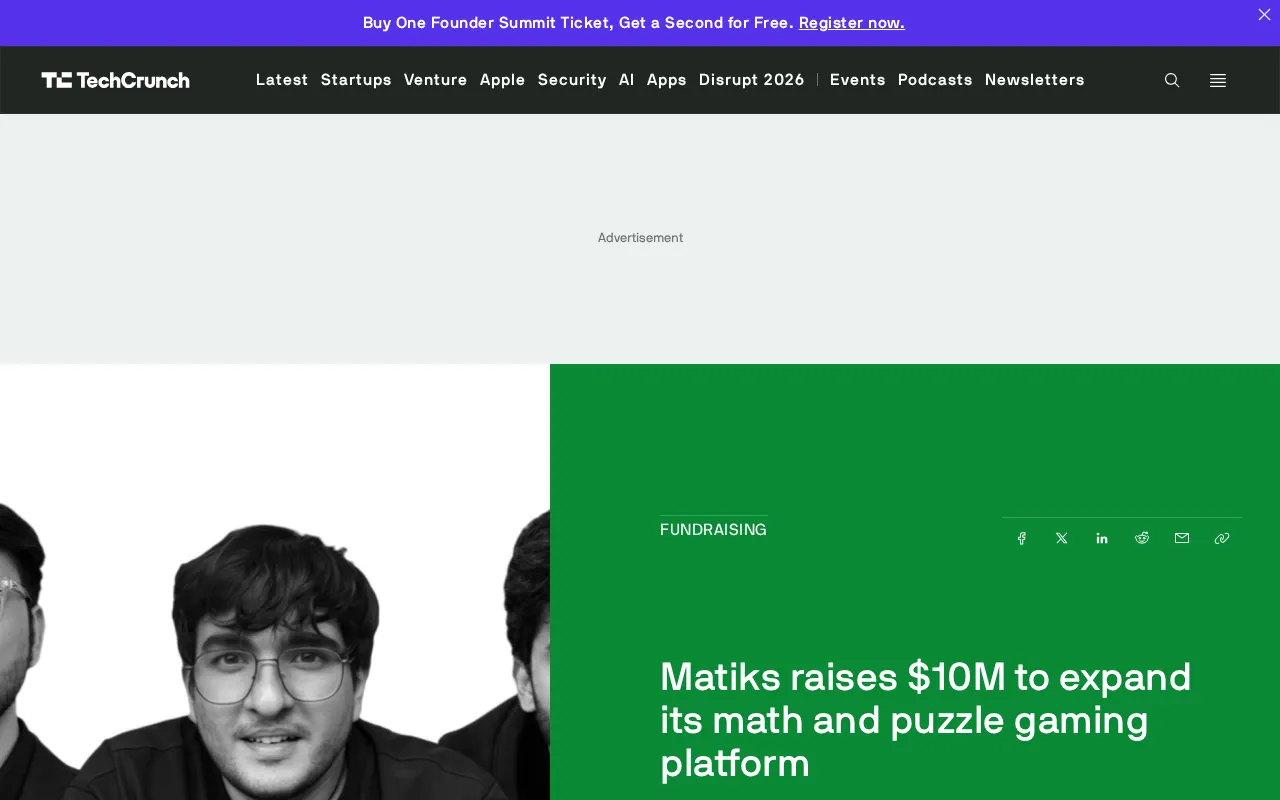
Matiks raises $10M to let users create their own math games with AI.
Matiks, a platform focused on math and puzzle games, has completed a $10 million funding round to expand its platform capabilities, with the core focus being to let users create their own games with AI. The article notes that math games have long faced a structural contradiction: high-quality level design is costly, while players consume content quickly. Introducing AI and the UGC model could shift content production from professional design by a small team to large-scale user generation. This approach differentiates itself through the transformation of the player's role and changes in the platform's marginal cost structure, but it also faces challenges such as logical rigor, quality screening, and UGC cold start. The original material does not disclose key details such as investors, user scale, or the degree of feature implementation.
From Solving to Creating: Matiks Wants to Be the 'Creation Tool' for Math Games
While most edtech products are still figuring out how to package problems more attractively, Matiks has chosen a more upstream path—letting users build games themselves with AI. According to an RSS source, the company behind this math and puzzle game platform has completed a $10 million funding round to expand its platform capabilities, with the core focus being to let users create their own games with the help of AI.
This positioning is worth pondering. The value anchor of traditional math products lies in "question bank quality" and "difficulty gradients," while Matiks places its focus on the creation side: users are not just players but also designers. The size of the funding round itself shows capital's interest in this "platformization + AI generation" approach, but what's more noteworthy is how it redefines the boundaries of the math game category.
AI Game Creation Solves the Content Supply Problem
Math games have long faced a structural contradiction: high-quality levels are expensive to design, while players consume content extremely quickly. A carefully designed puzzle may require designers to repeatedly refine the logic chain and difficulty curve, yet skilled players can clear it in minutes.
Matiks' introduction of AI game creation is essentially an attempt to shift content production from "professional design by a small team" to "large-scale user generation." This follows the same logic as UGC (user-generated content) platforms in the gaming industry—the platform provides tools and rules, and the community continuously produces content. For math games, this approach is especially appealing because math itself has a clear rule system, making it well suited for AI-assisted generation and verification.
Of course, tooling also brings new problems: do AI-generated levels have sufficient logical rigor and fun? How does the platform screen for quality? These are questions Matiks needs to answer at the product level, and they are also key to whether this model can hold up.
UGC (User-Generated Content) refers to platforms that do not directly produce content but instead provide creation tools and rules, with users producing and sharing content. Typical examples include Roblox, Minecraft, and Super Mario Maker. The core economic logic of UGC platforms is that content supply is no longer limited by team size, and marginal production costs are diluted as users grow. But this brings with it uneven content quality, rising moderation costs, and concentration among top creators. For educational products, UGC also has to face the additional challenge of verifying whether content is correct, which means the platform cannot simply offer free creation—it also needs built-in rule constraints and review mechanisms.
Use of Funds and Sector Signals
According to the source report, the $10 million round will be used to expand the platform. Against a broader backdrop, the math and puzzle game sector has continued to attract attention in recent years: such products naturally span education and entertainment, their user retention and willingness to pay are often better than those of pure tool-based education products, and the addition of AI generation capabilities gives them room for "platformization."
That said, the original material provides limited detail on key information such as investors, specific product form, and user scale, so it is currently difficult to make a more specific judgment about Matiks' actual product maturity and commercialization progress. The material does not clearly state how far the AI game creation feature has actually been implemented—whether it is already open to users or still in planning.
Observation: Differentiation Points for Math Game Platforms
If the AI creation tool can work, Matiks' differentiation will show at two levels: one is for players—shifting from passively solving problems to actively designing, which will significantly change engagement and community stickiness; the other is for the platform itself—content supply shifts from being labor-driven to tool-driven, and the marginal cost structure will change.
Conversely, the challenges of this path are also clear. For platforms with user-generated content, the hardest part of the cold-start phase is the chicken-and-egg problem between "the tool is good enough to use" and "the content is good enough." Math games also demand higher logical correctness than ordinary casual games; if AI-generated results contain errors or ambiguity, it will directly damage the platform's foundation of trust.
Matiks has secured the funding needed to expand. What it really needs to prove next is whether its AI creation tool can make it easy for ordinary users to build "worth playing" math games. This problem tests design skill more than any puzzle on its platform.
Cold start is a classic challenge for platform products: without enough high-quality content, users cannot be retained; without enough users, content production cannot be incentivized. UGC platforms usually break through by providing official preset content, invite-only creator programs, or subsidies for early creators. For a math game platform like Matiks, cold start also adds the barrier of "tool usability"—if the learning curve for the AI creation tool is too steep and ordinary users cannot produce playable content, community supply cannot get off the ground. Therefore, the tool's onboarding cost and the quality of the first batch of content often together determine whether the platform can cross the cold-start threshold.
One-line Summary
Matiks raises $10M to let users create their own math games with AI.
Paragraph Summary
Matiks is a platform focused on math and puzzle games. It has recently completed a $10 million funding round, which will be used to expand its platform capabilities, with the core focus being to let users create their own games with the help of AI. The article points out that math games have long faced a structural contradiction: high-quality level design is costly, while players consume content quickly. Introducing AI and the UGC model could shift content production from professional design by a small team to large-scale user generation. The differentiation of this approach is reflected at two levels: the transformation of the player's role and the change in the platform's marginal cost structure. At the same time, however, it faces challenges such as the logical rigor of AI-generated levels, quality screening, and the cold start of UGC platforms. The original material does not disclose key details such as investors, user scale, or the degree to which the feature has been implemented.
Related articles

Cursor AI in Practice: Weighing Efficiency Gains Against Costs in an AI IDE
An in-depth look at Cursor AI IDE's interface layout, four modes (Agent/Plan/Debug/Ask), model selection, and Git context integration, with hands-on demos weighing subscription costs against going direct to Claude.

Free Landing Page Design Rules Library: A Practical Guide for Claude Code and Cursor
A free landing page design skill for Claude Code and Cursor: MIT licensed, nearly 9,000 stars, asks about offer/audience/action before planning 12 sections with hard font and spacing constraints.

Cursor Keeps Writing Wrong Code? The Problem May Be Context, Not Prompts
Cursor keeps writing wrong code? The problem may be context, not prompts. Learn how to supply relevant files, full error messages, and expected results, plus a plan-first, small-step, test-driven workflow to reduce AI coding errors—while remembering code review remains the developer's job.