MCP Protocol: How Do AI Assistants Connect to Enterprise Systems?
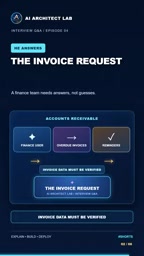
MCP uses a client-server architecture to standardize how AI applications call external tools—a connectivity standard, not a business replacement.
The article focuses on the Model Context Protocol (MCP), noting that duplicated integration when AI applications call external tools is a key pain point in enterprise AI adoption. Using a finance manager querying overdue invoices as an example, the lack of a unified interface forces every AI application to write separate integration code for each business system. MCP solves this with a client-server architecture: servers expose tools and enforce access control and audit logging, while AI applications act as clients to retrieve data, draft content, and request human approval before sending—decoupling business logic from security control. The article clarifies that MCP only standardizes tool discovery and invocation and does not replace business APIs, permission systems, or workflow approvals; enterprises must still maintain their own business systems.
In the process of bringing AI assistants into enterprise scenarios, a core challenge is enabling AI applications to securely and efficiently call external tools and business systems. The Model Context Protocol (MCP) is an open protocol born precisely to solve this problem. Based on technical interview content, this article explains how MCP standardizes the interaction between AI applications and external tools, as well as the boundaries of its value in real-world business.
Why Is MCP Needed?
Imagine a finance manager asking an AI assistant: "Which invoices are overdue? Can you prepare reminders for these customers?" Behind this seemingly simple request lie multiple business modules such as the invoicing system, customer records, and notification services.
In the absence of a unified interface, every AI application needs to write integration code separately for invoices, customer records, and notifications. This point-to-point integration approach not only has high development costs but is also difficult to maintain and scale. As enterprises introduce more AI applications, the problem of duplicated development will become increasingly serious.
According to the analysis in the interview, the core value of MCP lies in standardizing the way AI applications discover and call external tools, thereby eliminating duplicated integration work.
MCP was proposed and open-sourced by Anthropic at the end of 2024, positioned to establish a unified bidirectional connection between AI models and external data sources and tools. Before MCP, the industry already had mechanisms such as Function Calling and Plugins, but most of them were tied to specific model vendors or application platforms, with limited cross-vendor and cross-application reusability. What sets MCP apart is that it abstracts "how tools are described, discovered, and invoked" into a model-agnostic protocol layer, similar to the relationship between the Language Server Protocol (LSP) and editors and programming language tools. This analogy is often used to explain MCP's design philosophy: LSP lets different editors share the same set of language tools, while MCP lets different AI applications share the same set of tool interfaces, thereby reducing M×N point-to-point integrations to M+N standardized connections.
How MCP Works: The Division of Labor Between Client and Server
MCP adopts a client-server architecture, clearly separating AI applications from tool providers.
MCP Server: Exposing Tools and Enforcing Control
The MCP server is responsible for exposing a set of tools to AI applications. In the above financial scenario, the server might provide tools such as "list overdue invoices," "get customer details," and "draft reminders."
More importantly, the server also bears security responsibilities: it enforces access control to ensure the AI assistant can only access authorized data, and it logs all operations for auditing and traceability.
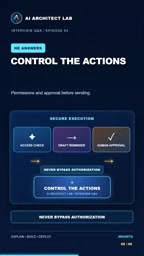
In the MCP protocol, the capabilities exposed by the server are typically summarized into three types of primitives: Tools, Resources, and Prompts. Tools are function-like operations that the model can actively invoke, such as "list overdue invoices"; resources are context data that can be read, such as customer records; and prompt templates are preset reusable instructions. The server describes each tool's name, parameters, and purpose through declarative JSON Schema, based on which the client lets the model decide when to invoke and how to fill in parameters. In addition, MCP supports multiple transport methods: local scenarios commonly use standard input/output (stdio), while remote scenarios can be implemented over transport layers such as HTTP, enabling the same protocol to serve both desktop AI applications and enterprise-grade distributed deployments.
MCP Client: The Role of the AI Application
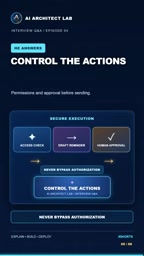
As an MCP client, the AI application interacts with the server through the standard protocol. The client can retrieve authorized invoice data, draft reminder content, and request human approval before sending.
This design decouples business logic from security control: the AI application focuses on understanding and executing user intent, while the server handles permission management and operational compliance.

The Boundaries of MCP: What It Does Not Do
The interview particularly emphasized a key clarification: MCP standardizes the way AI applications discover and call external tools, but it does not replace business APIs, permission systems, or workflow approvals.
This means MCP is a specification for the connection layer, not a replacement for business logic. Enterprises still need to maintain their own business APIs and permission systems; MCP simply enables AI applications to connect to these existing systems in a unified way. Business processes such as workflow approvals also remain the responsibility of the enterprise's existing systems.
Implications for Enterprise AI Adoption
The emergence of MCP lowers the barrier to integrating enterprise systems with AI applications. For enterprises looking to deploy AI assistants, adopting MCP means they no longer need to repeatedly develop integration code for each AI application, while server-side access control and logging can help meet compliance requirements.
From a broader perspective, MCP represents a trend toward the standardization of AI infrastructure: by defining clear protocol boundaries, it makes the interaction between AI applications and the outside world more predictable and manageable. For developers, understanding MCP's positioning—it is a connectivity standard, not a business replacement—is a prerequisite for applying this protocol correctly.
One-line Summary
MCP uses a client-server architecture to standardize how AI applications call external tools; it is a connectivity standard, not a business replacement.
Paragraph Summary
The article centers on the Model Context Protocol (MCP), pointing out that a major pain point in enterprise AI adoption is duplicated integration work when AI applications call external tools. Using a finance manager querying overdue invoices as an example, the lack of a unified interface means every AI application must write separate integration code for each business system. MCP solves this through a client-server architecture: the server exposes tools and enforces access control and log auditing, while the AI application acts as a client to retrieve data, draft content, and request human approval before sending, thereby decoupling business logic from security control. The article specifically clarifies that MCP only standardizes tool discovery and invocation and does not replace business APIs, permission systems, or workflow approvals; enterprises still need to maintain their own business systems.
Related articles

Microsoft Fabric Database Agent in Action: From Reactive Firefighting to Intelligent Detective
A deep dive into the Microsoft Fabric Database Agent: how to enable it, supported monitoring scenarios, a blocking-issue demo, and the roadmap from reactive to autonomous operations.

Zendesk Uses ChatGPT Enterprise to Build a Sales Agent with 1,000 Daily Active Users
Zendesk opened ChatGPT Enterprise to all employees, who built about 600 apps themselves, including a sales expansion agent with about 1,000 daily active users. This article analyzes how it turns internal data into sales opportunities and its "don't wait" implementation strategy.

Google Releases Gemini 4 Carbon: Its Strongest Model Yet, Debuting with a Cybersecurity Focus
Google releases Gemini 4 Carbon, calling it its strongest model, with a cybersecurity focus. It tops the third-party composite ranking at 59 points but leads by only one or two. This article analyzes its security test results, staged rollout, token pricing, and the divergence between self-reported and third-party tests on hallucinations.