MCP vs A2A: The Fundamental Difference Between AI Tool Invocation and Agent Collaboration

MCP connects AI systems with tool capabilities; A2A coordinates independent agents; the two are layered and can be combined.
Using a customer service scenario, the article clarifies the division of labor between MCP and A2A: when a customer queries an order, the support agent acts as an MCP client connecting to an MCP server, discovering and invoking the order query tool—this is the "AI system to capability" connection; when a package delay requires a logistics agent to step in, the support agent delegates the task to a remote logistics agent via A2A, which executes autonomously and returns the result—this is "agent-to-agent" coordination. The article emphasizes that the two are not mutually exclusive: an A2A agent can absolutely use MCP tools internally, and both share the same engineering requirements around authentication, authorization, timeouts, and audit trails. Confusing the two leads to simple integrations being over-engineered into multi-agent systems, or tasks that should be autonomous being crammed into a single application.
When enterprises start pushing AI from the chat window into real business workflows, an unavoidable architectural question arises: how exactly do AI systems connect to each other? MCP (Model Context Protocol) and A2A (Agent-to-Agent Communication) are often discussed together, but they solve problems at two different levels. A short explainer from the YouTube channel "AI Architect Lab" uses a customer service scenario to make the division of labor between the two very clear.
One Customer Service Scenario, Two Ways of Connecting
The example in the video is concrete enough: a customer asks where their order is. The support agent needs to get order data from some API; if the package is delayed, it may also need another agent responsible for logistics to step in and investigate.
Both actions look like "calling external capabilities," but they go through completely different protocols.
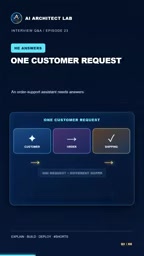
MCP: Letting AI Applications Discover and Invoke Capabilities
In the Model Context Protocol model, the support agent acts as an MCP client. It connects to an MCP server, discovers which tools the server exposes, and then calls the order query tool among them to retrieve the authorized order details.
The keywords here are "discovery" and "invocation." MCP exposes tools, resources, and prompts in a standardized way, so AI applications don't need to write a custom integration for every backend API. The video's author emphasizes that MCP connects "AI systems to capabilities"—starting from the AI application and reaching outward.
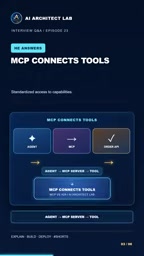
MCP was open-sourced and proposed by Anthropic in November 2024. It uses JSON-RPC 2.0 as its message format, and its specification defines three core primitives: Tools (functions that can be called by the model), Resources (data or context that can be read), and Prompts (reusable prompt templates). For communication, it supports stdio and HTTP-based transports, enabling both local processes and remote services to connect in a unified way. Notably, MCP itself only specifies "how to discover and invoke"; the actual authentication and authorization are still determined by the transport layer and server implementation. For example, remote MCP servers typically use OAuth 2.1 to complete the authorization flow, which is also the technical background behind the article's emphasis that "engineering requirements don't disappear just because the protocol is different."
A2A: Letting Agents Delegate Tasks to Each Other
The logistics investigation is different in nature. The support agent doesn't want to manage every tool in the logistics system itself; it just needs to hand off the task. In the A2A model, the support agent delegates the delay investigation to a remote logistics agent, which manages its own tools, executes on its own, and finally returns a task result.
A2A covers agent discovery and task coordination—who has the capability to do this, how the task is dispatched, and how results are returned. It coordinates "independent agents," not "one application and a pile of tools."
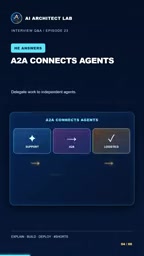
A2A was initially released by Google in April 2025 and donated to the Linux Foundation for hosting. Its core abstractions include Agent Card (a metadata document describing an agent's capabilities, endpoints, and authentication methods), Task (a task object that can be dispatched, can run for a long time, and can stream progress), and Artifact (the output of a task). Agents complete "discovery" by fetching each other's Agent Cards, and then implement task lifecycle management through standardized message exchange. Unlike MCP, which is oriented toward "single tool calls," A2A's task model naturally supports asynchronous, long-running, multi-turn clarification, which exactly corresponds to what the article describes as "handing off the task, letting the other party execute autonomously, and returning the result."
The Capability Boundaries of the Two
According to the video's summary, MCP's scope is accessing tools, resources, and prompts; A2A's scope is agent discovery and task coordination. Both require authentication, authorization, timeout control, and audit trails—these engineering-level requirements don't disappear just because the protocols differ.
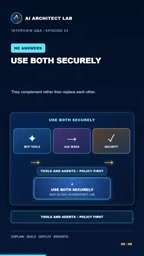
The point most easily overlooked is that the two are not mutually exclusive. The video clearly states that an A2A agent can absolutely use MCP tools internally. In other words, A2A handles the "diplomacy" between agents, while MCP handles a single agent's "invocation" of internal capabilities. They operate at different layers and can be stacked.
Remember the division of labor in one sentence: MCP connects AI systems with capabilities, A2A coordinates independent agents.
It's important to distinguish that both MCP and A2A belong to the "protocol layer," not to specific agent orchestration frameworks. The former specifies the interface contract between applications and capability providers, while the latter specifies the communication contract between agents. Neither specifies the internal reasoning logic, planning strategy, or memory management of an agent—those are usually handled by orchestration frameworks such as LangGraph, AutoGen, and CrewAI. Therefore, in real architectures, a three-layer structure of "orchestration framework + A2A (cross-agent) + MCP (cross-tool)" often emerges. Understanding this helps avoid mistaking protocols for frameworks and thus choosing the wrong level of abstraction when designing systems.
Practical Implications for Architecture Selection
This distinction has direct value for teams implementing AI applications. If your scenario is having an AI application connect to databases, search, and internal APIs, MCP is the more natural abstraction layer; if you're building a system where multiple agents collaborate to complete long-process tasks, A2A handles the layer of task dispatch and result collection.
Confusing the two often leads to common consequences: a simple integration that should be solved with tool calls gets over-engineered into a multi-agent system; or a task that should be executed autonomously by independent agents gets crammed into a single application that manages all the tools. At the end, the video's author recommends following their channel for more architecture interview content—this kind of clarification of "protocol layering" is precisely what's relatively scarce in current agent engineering.
The video itself is short and doesn't dive into specific protocol fields and implementation details, but as a starting point for architectural understanding, the division it provides is clear enough.
One-line Summary
MCP connects AI systems with tool capabilities, A2A coordinates independent agents, and the two can be layered and stacked.
Paragraph Summary
Using a customer service scenario, the article clarifies the division of labor between MCP and A2A: when a customer queries an order, the support agent acts as an MCP client connecting to an MCP server, discovering and invoking the order query tool—this is the "AI system to capability" connection; when a package delay requires a logistics agent to step in, the support agent delegates the task to a remote logistics agent via A2A, which executes autonomously and returns the result—this is "agent-to-agent" coordination. The article emphasizes that the two are not mutually exclusive: an A2A agent can absolutely use MCP tools internally. It also notes that both share the same engineering requirements around authentication, authorization, timeouts, and audit trails. Confusing the two leads to simple integrations being over-engineered into multi-agent systems, or tasks that should be autonomous being crammed into a single application.
Related articles

Last Week Tonight Exposé: The Dangerous Ties Between Politicians and White Supremacy
Last Week Tonight investigates Georgia Senate candidate Mike Collins and Florida candidate Marshall Rawson, exposing their multiple ties to white supremacists and the Republican Party's silent response.
AI Buzz Weekly: GPT-6.5 Leak, New Claude Model, and MiniMax's Cost-Effectiveness
This week's AI buzz roundup: suspected GPT-6.5 leak, Microsoft configs showing GPT-6.1 Tera, Anthropic's new model that can identify entire classes of bugs, disappointing early Gemini 4 Carbon results, and MiniMax M3.1 Flash beating Claude Opus 5 and GPT-5.6 Sol in benchmarks at extremely low cost.

AI Briefing: Gemini 4 Carbon Released, Ant Open-Sources Ling-3.1
AI Briefing: Google releases Gemini 4 Carbon qubit model, claiming to surpass Opus 5.5 with half-price tokens; Ant open-sources Ling-3.1-1019 for real-task Personal Agents; domestic AI drug discovery succeeds in 18 of 19 projects, hitting all 6 GPCR targets; zero-revenue company valued at $20B raises another $1B; Sichuan convenience store robot sales fail.