Megatron-LM MoE Training Handbook: A Practical Guide, Setting by Setting

A practical handbook covering MoE training, layer breakdown, and inference deployment, based on 800K GH200 GPU hours.
Hugging Face engineer Nouamane released *The Ultimate MoE Training Handbook*, a hands-on guide for researchers with dense-model training experience who want to advance to Mixture-of-Experts (MoE) models. Based on roughly 800,000 GH200 GPU hours of MoE training on the Alps cluster, all charts, scripts, and recommended configurations are open-sourced. The four-chapter handbook focuses on Chapters 2–4: Chapter 2 is a runbook from hardware testing and image building to training a dense baseline and running a first MoE on a single node; Chapter 3 breaks down the MoE layer component by component—routing, load balancing, experts, block layout, training process, and system implementation—with Megatron-LM code, monitoring metrics, and recommended settings; Chapter 4 covers serving and RL pipelines. The methodology is transparent, clearly distinguishing experimental results, citations of frontier models, and toy simulations, with all 55 charts and scripts public—suitable as a desk reference for readers with distributed training fundamentals.
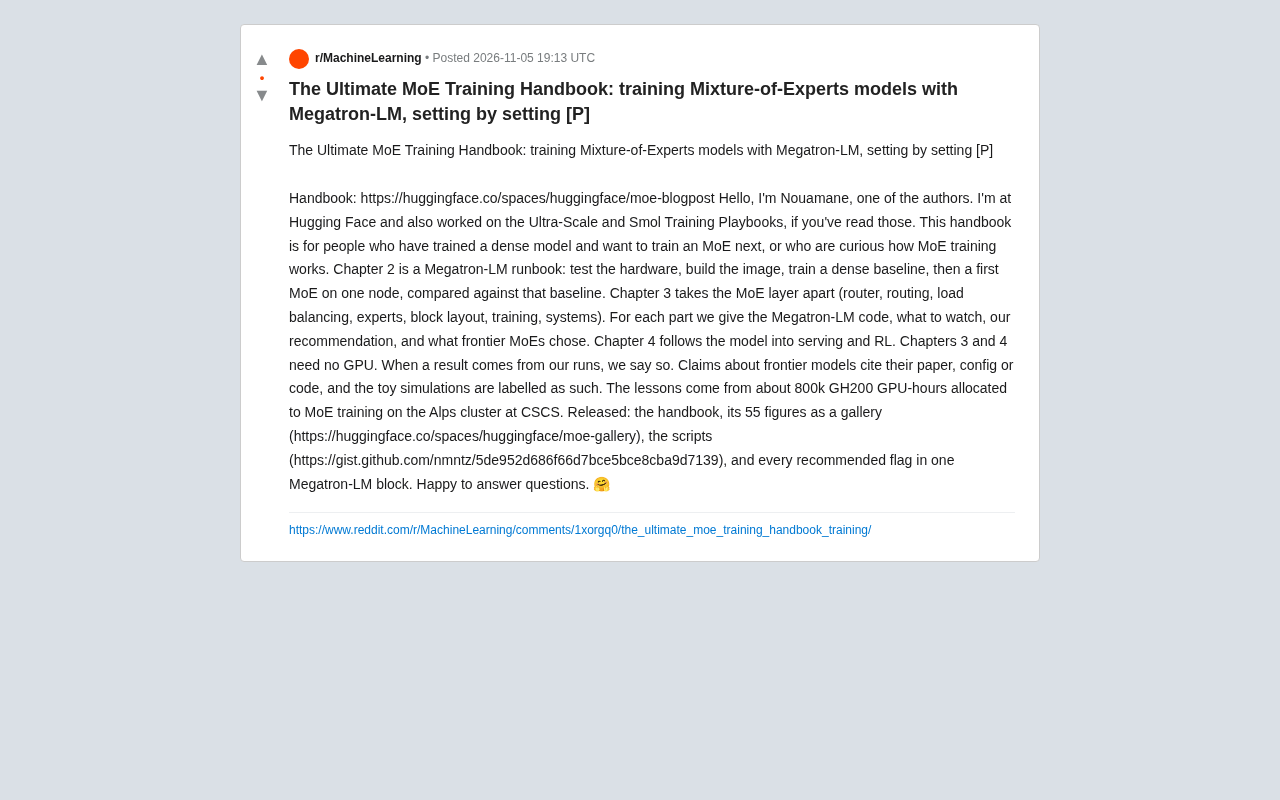
Hugging Face engineer Nouamane has released The Ultimate MoE Training Handbook, a hands-on guide for researchers who already have experience training dense models and want to move up to Mixture-of-Experts (MoE) models. The handbook draws on roughly 800,000 GH200 GPU hours of MoE training experience on the Alps cluster, and all charts, scripts, and recommended configurations have been open-sourced.
Structure and Core Content
The handbook has four chapters, with Chapters 2–4 being the main focus:
- Chapter 2: The Megatron-LM Runbook — Covers hardware testing, building the image, training a dense baseline, and then training your first MoE on a single node and comparing it against the baseline. This is the most practical section, essentially a checklist for "getting MoE running from scratch."
- Chapter 3: Deconstructing the MoE Layer — Analyzes the router, routing algorithms, load balancing, experts, block layout, training process, and system implementation one by one. Each component comes with Megatron-LM code, monitoring metrics, recommended configurations, and the choices made by frontier MoE models.
- Chapter 4: Serving and RL — Brings MoE models into inference serving and reinforcement learning pipelines.
The author emphasizes that Chapters 3 and 4 can be read without a GPU, which is friendly to readers who want to understand the principles before getting hands-on.
Why It's Worth Your Attention
MoE has become one of the mainstream architectures for scaling large models, but public end-to-end training guides are scarce. What makes this handbook unique:
- Based on real large-scale training: Practical lessons from roughly 800,000 GH200 GPU hours — not armchair theory.
- Setting by setting: It doesn't just tell you what to use; it explains why and which metrics to watch.
- Transparent methodology: Results from the author's own experiments are clearly labeled; claims about frontier models cite their papers, configurations, or code; toy simulations are also labeled separately.
- Reproducible resources: 55 charts are published as a gallery, and all scripts and recommended parameters are consolidated into a single Megatron-LM config block.
Who Should Read It
If you've already trained dense models and are about to try MoE, or you're curious about how routing, load balancing, and expert parallelism are actually configured in MoE training, this handbook works well as a desk reference. For readers with no distributed training experience at all, the hardware and image sections in Chapter 2 may require some foundational background first.
The author, Nouamane, has previously contributed to the Ultra-Scale and Smol Training Playbooks, continuing a track record in training-handbook content. The handbook, chart gallery, scripts, and recommended configurations are all public and can be accessed directly on Hugging Face Spaces.
Background
Megatron-LM is NVIDIA's open-source distributed training framework for large models. It supports tensor parallelism, pipeline parallelism, data parallelism, expert parallelism, and other parallel strategies, making it one of the mainstream tools for training MoE models in the industry. Its core design goal is efficient scaling on thousand-GPU clusters, which means it has a large number of configuration options and a steep learning curve. The handbook's choice of Megatron-LM as the practical framework means readers need a basic understanding of its parallel group partitioning, checkpoint format, and launch scripts in order to smoothly transition from a dense baseline to MoE.
The core component of the MoE layer is the router, which computes affinity scores for each expert for every token and selects the top-k experts accordingly. Common routing algorithms include Top-k gating, expert choice, and hash-based static routing. The hard part of routing is load balancing: if tokens concentrate on a few experts, it creates computational hotspots and wastes memory, so auxiliary load-balancing losses or a capacity factor are usually introduced as constraints. Expert parallelism distributes different experts across different GPUs and uses All-to-All communication to dispatch and gather tokens, which is key to implementing MoE training systems.
Related articles
 Tech Frontiers
Sherlock: An Open-Source Tool for Tracking Usernames Across Social Networks
Sherlock is an open-source Python tool that tracks social accounts across networks by username. This article covers its core features, why developers love it, typical use cases, and privacy compliance considerations.
 Tech Frontiers
GitHub Daily·Nov 07: Agent-Ready and Context Compression
GitHub Trending Nov 07: meta's agent-ready design system astryx, billion-context's 5x context compression, sherlock nearing 100k stars, plus local-first localthings and bare-metal GPU orchestration nvke.
 Tech Frontiers
Buoyant Open-Sources Kinference: An Inference Control Plane for vLLM on K8s
Buoyant open-sources Kinference, an inference control plane for vLLM on Kubernetes, with declarative routing, KV-cache-aware load balancing, and per-tenant metrics—claiming 95% lower median TTFT in official benchmarks.