Meta's $25 Billion Verdict Lands, Reshaping Legal Risk for Tech Giants

A New Mexico judge orders Meta to pay $25 billion, far exceeding the prior $17 billion settlement and signaling tighter platform regulation.
A New Mexico judge has ordered Meta to pay $25 billion to resolve allegations of misleading users—a figure far exceeding the earlier $17 billion multistate settlement and setting a new record. The ruling's core finding is that Meta engaged in systematic misrepresentation in its user disclosures, providing important precedent for similar future lawsuits. The article uses the metaphor "blood in the water" to describe the chain reaction this ruling could trigger: a high-damages precedent will raise other plaintiffs' and regulators' expectations, force Meta to reassess its strategy in pending litigation, and prompt the entire tech industry to reprice legal risk. Regulators and the judiciary are forming tighter alignment, and platform language in user agreements and privacy policies will face stricter compliance scrutiny.
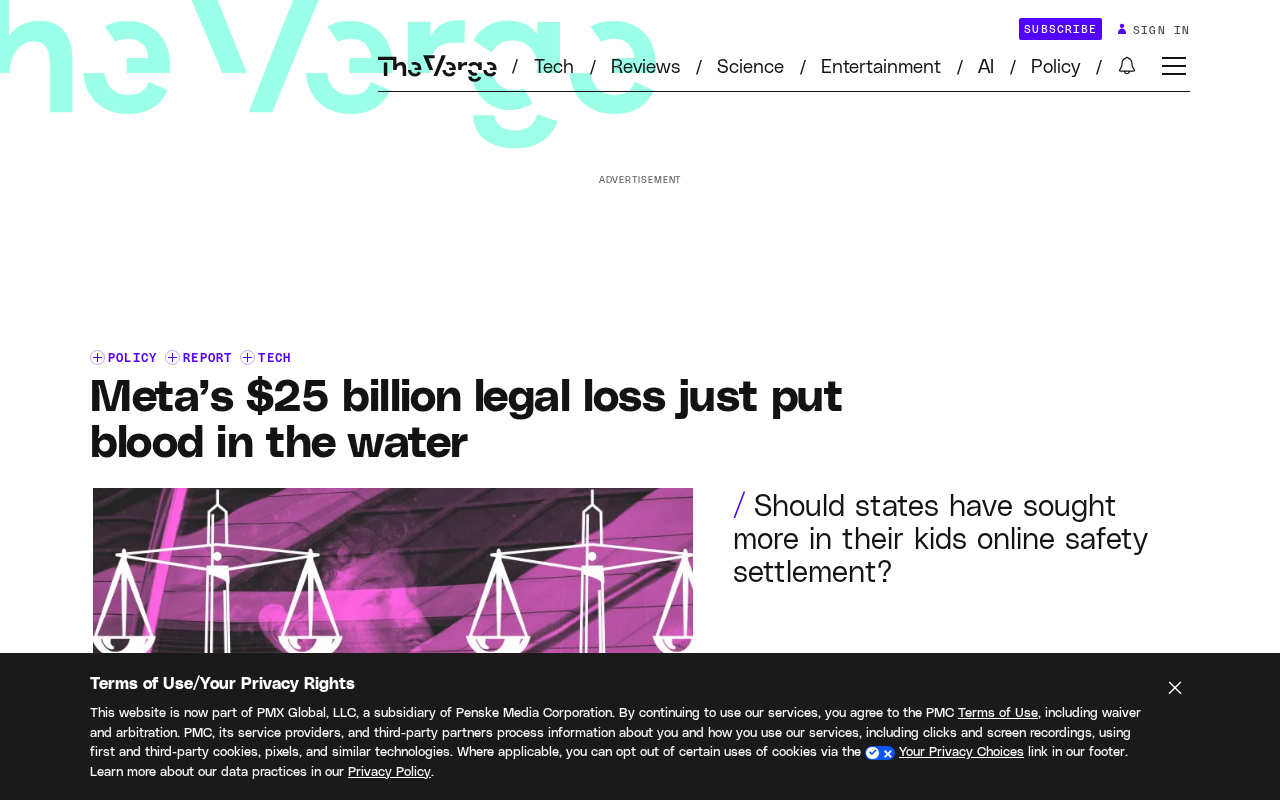
Meta has lost another lawsuit, and this time the price tag is $25 billion.
When a coalition of U.S. state attorneys general announced a $17 billion settlement with Meta this summer, the figure was already being called "unprecedented." But a New Mexico judge's ruling last week rendered that record obsolete—ordering Meta to pay $25 billion to resolve allegations that it misled users.
From $17 Billion to $25 Billion: The Signal Behind the Numbers
In a short span, Meta's legal bill has ballooned from $17 billion to $25 billion. This isn't just a numbers game—it sends a clear signal: regulators' and courts' tolerance for big tech is dropping sharply.
The earlier $17 billion settlement already shook the industry and was seen as a major finding on platform liability. The New Mexico judge's ruling goes further still, raising the claim amount by an order of magnitude. The judge found that Meta engaged in systematic misrepresentation in its disclosures to users—a judgment that provides important precedent for similar lawsuits to come.
What's worth noting is that these two figures aren't isolated events but different waves of the same regulatory tide. The state attorneys general's joint action and the state court's independent ruling have combined forces, putting Meta under dual pressure from both the executive and judicial branches at the legal level.
State AG Joint Litigation and Settlement Mechanisms: U.S. state attorneys general hold independent enforcement authority and can file suits against interstate businesses under their state consumer protection laws. Multistate actions are typically resolved through a "settlement agreement," in which a company pays a fine and commits to reforms, but a settlement does not constitute a judicial finding of wrongdoing. The New Mexico judge's ruling, by contrast, is a court judgment with precedential effect, offering far greater reference value for future litigation than a settlement agreement. This is the institutional reason why the $25 billion verdict carries more deterrent force than the $17 billion settlement.
"Blood in the Water": Why This Is Only the Beginning
The original headline used a vivid metaphor—"blood in the water." In shark-infested waters, the smell of blood signals that the hunt is on. Applied to Meta, the metaphor points to a broader chain reaction.
Once a court establishes a high-damages precedent, other plaintiffs and regulators who have been watching from the sidelines now have a benchmark to reference. For Meta, the $25 billion verdict is not only a financial blow but a turning point in legal strategy—it may be forced to reassess its willingness to settle and its defense strategy across all pending litigation.
For the tech industry as a whole, the precedent's impact should not be underestimated. Other platforms with vast troves of user data will be watching closely how Meta responds to this ruling and whether subsequent lawsuits cite this case as a basis. The way legal risk is priced may undergo a structural shift.
Case Law and the "Precedent Effect": The U.S. operates under a common law system, where court judgments (especially high punitive damages awards) become citations for future similar cases. Once a jurisdiction issues a $25 billion-scale verdict, plaintiff attorneys and regulators in other states can cite the case in their pleadings to argue "industry practice" or a "reasonable punishment standard." This "precedent effect" significantly raises companies' litigation risk and settlement costs, and is the legal mechanism behind what the original article calls "the smell of blood."
The New Normal of Platform Liability Under Tightening Regulation
From a broader perspective, Meta's predicament is a microcosm of the regulatory cycle shift in the platform economy. In recent years, legislation and enforcement around user data use, disclosure obligations, and platform liability have all accelerated.
The core of the New Mexico judge's ruling lies in the finding of "misleading users." This means that platform representations in user agreements, privacy policies, and feature descriptions are being scrutinized under stricter standards. For tech companies that rely on complex terms to manage user expectations, this is a compliance warning that must be taken seriously.
The $25 billion figure is stunning, but what has lasting impact is the liability logic established behind the ruling. When courts are willing to respond to platform misrepresentation with economic penalties of this magnitude, the compliance cost curve for the entire industry will be redrawn.
Legal Standard for Finding "Misleading Users": The core of the original article lies in the finding of "misleading users." Under U.S. law, this typically involves the standard for "deceptive acts or practices" under Section 5 of the Federal Trade Commission Act—namely, that a platform's representations to users are unlawful if they are likely to materially mislead a reasonable consumer, regardless of subjective intent. The New Mexico judge's ruling means courts are applying stricter scrutiny to vague language in platforms' privacy policies and feature descriptions; platforms cannot escape liability merely by claiming "the user consented" or "the terms were disclosed"—they must demonstrate that their disclosures were clear and not misleading.
Final Thoughts
Meta's $25 billion legal loss may look on the surface like one company's financial setback, but in essence it is a bellwether for the changing legal environment of the tech industry. A $25 billion verdict following close on the heels of a $17 billion settlement—this escalating pressure shows that regulators and the judicial system are forming a tighter alignment.
For Meta and its peers, the question is no longer "will there be another lawsuit" but "what will the next lawsuit be priced at."
Related articles

LLM Application Development: A High-Paying Career Guide for Ordinary People
LLM application development offers fresh graduates up to 35K/month, with SP offers reaching 600K. This article explains the core skills, how to break in, and how ordinary people can seize AI opportunities through learning by doing.

Say Goodbye to AI Influencer Faces: A Complete Guide to Creating Visual Assets for AI Comic Dramas from Scratch
Bilibili creator shares a full workflow for zero-basics AI comic drama visual assets: use Doubao Work skills with script-first, visual references, and real-person texture to escape AI influencer faces, then lock character and scene consistency with asset sheet layouts, weapon detail images, scene nine-grids, and cinematic color palettes.

The AI Production Pipeline Behind Great Videos: From Research to Agent Validation
AI video production isn't just a model race. This article breaks down a transferable four-step pipeline: researching professional workflows, organizing a skill checklist, configuring agents, and experimental validation—and explains how general-purpose LLMs like DeepSeek can replace paid tools to run the entire process.