Meta's Attempt to Smear Haidt Backfires: Even His Critics Are Fed Up
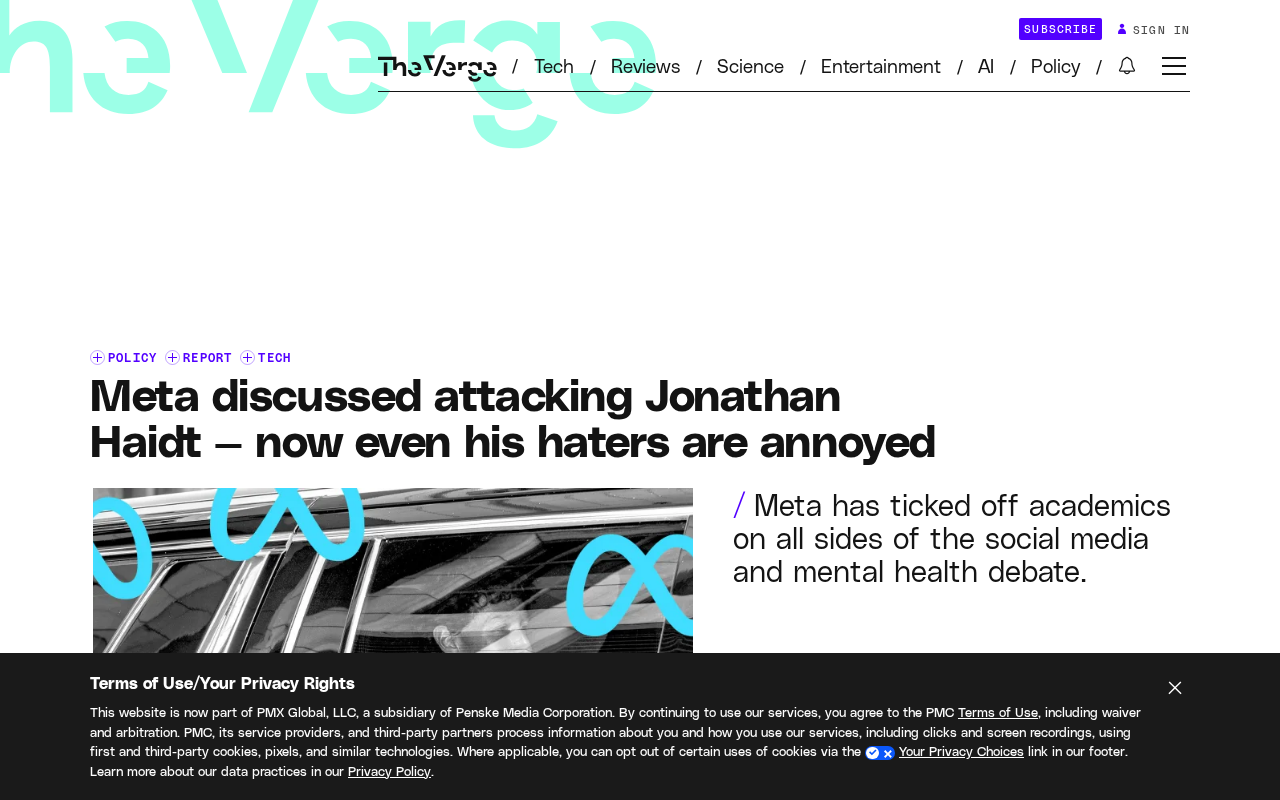
Meta secretly plotted to shift opinion against Haidt, but the exposure pushed even his critics to his side.
Court documents revealed that three years ago Meta considered a plan to shift public perception of its critic, social psychologist Jonathan Haidt. After the proposal was exposed last month, it backfired: critics who had reservations about Haidt's views ended up supporting him out of anger at a tech giant intervening in public discussion. The article notes the core irony: once Meta's strategic manipulation was exposed, the cost far exceeded the original criticism itself, creating a "reverse solidarity" effect. The episode is a warning to the tech industry: when facing legitimate public criticism, trying to "deal with" the people raising the problems is often more dangerous than the problems themselves—especially on sensitive issues like adolescent mental health, where a confrontational posture only deepens distrust.
An Exposed Opinion-Manipulation Plan
According to court documents, three years ago Meta considered a plan to shift public perception of one of its most influential critics — Jonathan Haidt. But when the proposal came to light last month, it backfired. Funnily enough, if there's one thing the author of The Anxious Generation and his critics can agree on, it's their anger at Meta.
Haidt gained widespread attention for his critique of social media and adolescent mental health, and his book The Anxious Generation sparked intense debate about the responsibility of tech platforms. Meta, as one of the main targets of that criticism, clearly tried to fight back. But the exposure of this strategy not only failed to weaken Haidt's credibility — it plunged Meta into an even deeper crisis of trust.
Jonathan Haidt is a social psychologist at NYU's Stern School of Business. He started out in moral psychology research and later entered the public eye through his critique of social media and adolescent mental health. In The Anxious Generation, he argues that the spread of smartphones and social media is a major driver of the sharp rise in anxiety, depression, and other psychological problems among adolescents in recent years, and advocates delaying adolescents' access to social media and strengthening platform accountability. This view has provoked polarizing reactions in academia and among the public: supporters believe he has identified a key variable, while critics argue his attribution is overly simplistic and ignores multiple factors such as family and economic conditions. Because of this, Haidt has become one of the most visible critics of tech platforms, giving the tension between him and Meta a public significance that goes beyond a personal dispute.
Why Even His Critics Sided with Haidt
The core irony of this episode is that Meta's intervention plan made people who had reservations about Haidt's views start questioning Meta's motives. Among Haidt's critics are no shortage of scholars and commentators who believe his attribution to social media is overly simplistic. But when a tech giant is exposed as trying to use opinion-manipulation tactics against an academic critic, the nature of the issue changes — it is no longer merely an academic debate, but a question of whether corporate power has overstepped into public discussion.
This "reverse solidarity" effect is not new. When companies try to suppress critical voices, they often trigger a broader backlash, sometimes pushing people who were neutral or even opposed onto the critic's side. The Meta case once again proves that once a lack of transparency and strategic manipulation are exposed, the cost far exceeds the original criticism itself.
What is called "reverse solidarity" or the "backlash effect" has something in common in social psychology with the "backfire effect": when an external force tries to suppress or manipulate a certain view, the audience may instead hold more firmly to their original position or feel sympathy for the side being suppressed. In the context of corporate PR, this mechanism is especially evident — once the public perceives that information is being strategically manipulated, even if the manipulator is trying to convey "correct" information, it loses credibility because its motives are suspect. Meta's plan backfired precisely because it touched the sensitive boundary of "whether companies have the right to intervene in public discussion," reframing what had been an academic disagreement as a conflict between power and speech.
A Warning for the Tech Industry
This episode is a reminder for all tech companies: when facing legitimate public criticism, trying to "deal with" the people raising the problems through PR tactics is often more dangerous than the problems themselves. The release of the court documents left Meta's intentions with nowhere to hide, and the public reaction shows that on sensitive issues such as adolescent mental health, a confrontational posture only deepens distrust.
For content creators in AI and tech, this episode also reminds us to pay attention to the tension between platform power and public discussion. When tech giants are both the target of criticism and the gatekeepers of information dissemination, how to ensure the public can access diverse and authentic voices is a question worth continuing to ask.
(Note: This article is based on public court documents and media reports, and does not add specific data not mentioned in the original sources.)
Related articles

Van Hollen on Holding Trump Accountable: Hearings and Building the Evidentiary Record
Senator Chris Van Hollen on holding the Trump administration accountable: focused hearings to expose corruption and wrongdoing, plus building an evidentiary record now to preserve space for future criminal charges.

Generating SVG and 3D Models with the Codex Plugin: A Hands-On Guide for Developers with Zero Art Background
Codex's SVG & 3D Design plugin lets developers with zero art background generate vector graphics and 3D models via code—editable, Blender-ready, with best practices built in.

Why Recursive Self-Improvement Holds Up: Responding to Six Major Objections One by One
Dwarkesh Patel responds point by point to six major objections about recursive self-improvement and superintelligence by 2030: whether verifiable proxy metrics exist, the human-link threshold for RSI, whether the math explosion can be analogized to AI research, the experimental compute bottleneck, reward hacking and the motivation for power-seeking, and whether METR acceleration rates can be extrapolated.