Microsoft Cloud Revenue Surpasses $63 Billion as AI Agent Wave Accelerates
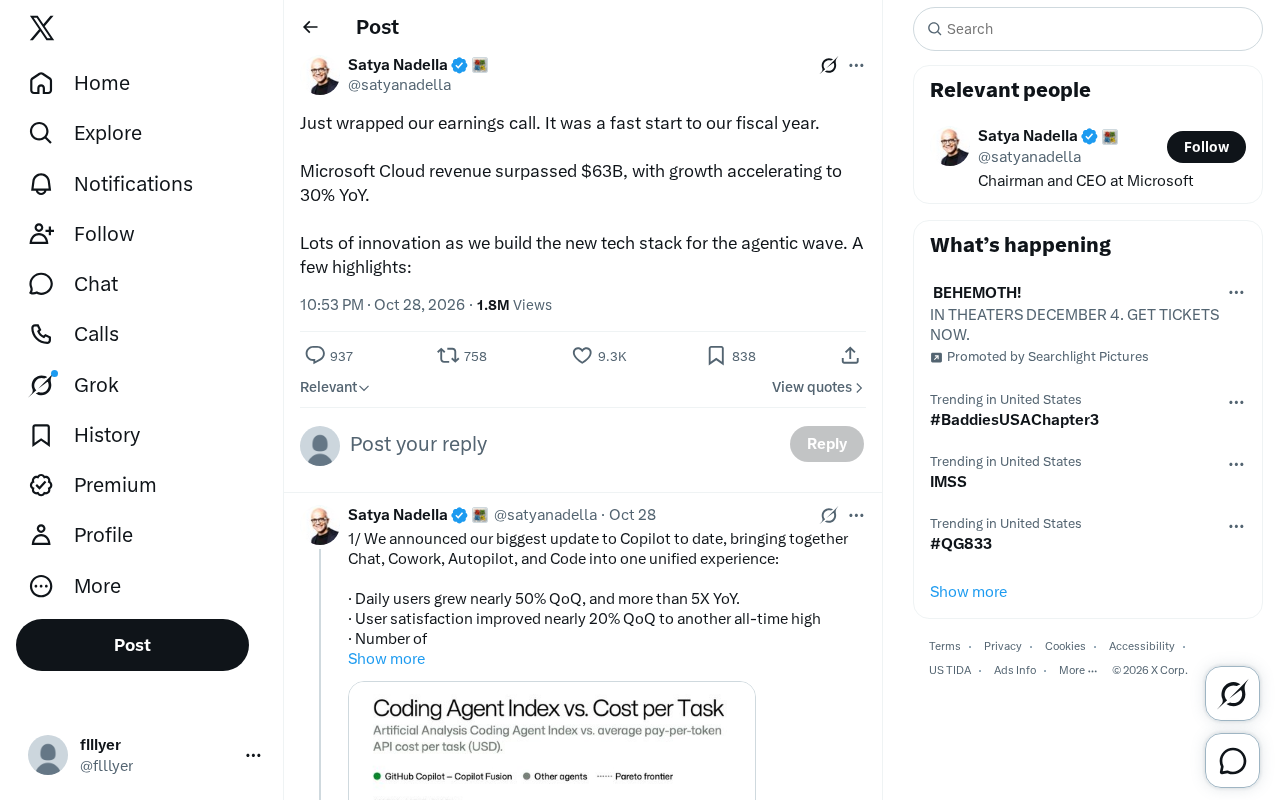
Microsoft Cloud quarterly revenue tops $63 billion as growth reaccelerates to 30%, with the agent wave becoming a new growth engine.
Microsoft's latest earnings call shows Microsoft Cloud quarterly revenue exceeded $63 billion for the first time, with year-over-year growth accelerating to 30%. Achieving acceleration on a massive base indicates that AI demand is providing structural support for cloud consumption. Executives repeatedly emphasized the "agentic wave," with Microsoft building a new tech stack around agents, shifting investment focus from Copilot features to infrastructure including long context, tool invocation, permission auditing, and compute scheduling. These capabilities ultimately translate into cloud consumption, explaining the synchronization between the agent narrative and cloud revenue growth. For enterprises, cloud budgets need to reserve space for inference compute and agent runtime; for developers, priority should be given to validating reliability in high-value, clearly bounded scenarios. The article also notes that this information comes from executive social media sharing, and details such as Azure's standalone growth rate should be based on official financial filings.
Microsoft's latest earnings call sent a clear signal: the cloud business is not only massive, but its growth curve is steepening again. Microsoft Cloud quarterly revenue exceeded $63 billion for the first time, with year-over-year growth accelerating to 30%. Achieving acceleration on such a high base shows that AI-related demand for cloud consumption is not a short-term spike but is forming structural support.
Microsoft Cloud Growth Reaccelerates: The Signal Behind $63 Billion
The opening message of the earnings call was direct—this is a "fast start" to Microsoft's new fiscal year. Microsoft Cloud covers Azure, Microsoft 365 commercial cloud, LinkedIn commercial business, and other segments, and its $63 billion quarterly scale keeps it firmly in the top tier of the global cloud market.
More noteworthy is the word "accelerate." The larger the cloud business, the harder it is to maintain high growth. The 30% year-over-year growth was achieved on a larger base, making it more valuable than the same growth rate at a smaller scale. This usually means two things: existing customers are expanding cloud consumption, and new workloads (especially AI inference and training) are ramping up quickly.
From a competitive standpoint, this growth rate also puts direct pressure on rivals. Competition in the cloud market is no longer a simple price war but a comprehensive contest around AI compute, model services, and developer ecosystems. The reacceleration of revenue growth is a direct reflection of this combined strategy working.
The relationship between Microsoft Cloud and Azure is easily confused and needs clarification. Microsoft Cloud is a Microsoft-defined aggregate metric that includes Azure and other cloud services, Microsoft 365 commercial cloud, LinkedIn commercial business, and Dynamics 365 commercial cloud, representing total "commercial cloud" revenue; Azure is only the infrastructure and platform services portion, and Microsoft typically discloses only its growth rate rather than absolute amount. Therefore, "Microsoft Cloud grew 30%" cannot be directly equated with "Azure grew 30%," as the bases and compositions differ. When reading cloud vendors' financial reports, distinguishing between aggregate and individual product metrics, and between constant-currency and floating-currency growth rates, is a prerequisite for judging the true quality of growth.
What the "Agent Wave" Tech Stack Means
Microsoft executives repeatedly mentioned one term on the call: agentic wave. Around this direction, Microsoft is building a "new tech stack," which represents a clear progression from the Copilot-centric product narrative of the past two years.
Copilot addresses "AI assisting humans in completing work," while agents point to "AI autonomously completing multi-step tasks." The latter places completely different demands on infrastructure: longer context management, more reliable tool invocation, finer-grained permissions and auditing, and compute scheduling capable of supporting large numbers of concurrent tasks. These capabilities ultimately translate into cloud compute and storage consumption, explaining why the agent narrative and cloud revenue growth appear simultaneously.
For developers, this means platform-layer APIs, agent orchestration frameworks, and identity and security systems will become key competitive areas. Microsoft's positioning of "building the tech stack for a new wave" as core earnings communication indicates that its internal resource investment focus has expanded from single Copilot features to complete agent infrastructure.
The essential difference between agents and Copilot lies in autonomy and task closure capability. Copilot is essentially a "human-in-the-loop" augmentation tool: users issue commands, AI generates suggestions, and humans make final decisions. Agents, by contrast, are designed to receive a goal, autonomously plan steps, invoke external tools (search, databases, code execution, third-party APIs), observe intermediate results, and iterate until the task is completed or human intervention is triggered. This paradigm shift brings several hard technical requirements: multi-turn tool calls require stable function-calling protocols and structured outputs; long tasks require context compression and memory management; autonomous execution requires sandbox isolation, least-privilege permissions, and full-chain audit logs. These capabilities all depend on cloud runtimes, so large-scale agent deployment will directly translate into cloud vendors' compute and platform service revenue.
The cost structure difference between inference compute and training compute deserves separate mention. Training is a one-time, centralized, large-scale investment, while inference is ongoing, distributed operational expenditure that scales linearly with user requests. Agent applications often trigger dozens of model calls and tool round-trips per task, making inference costs far higher than single-turn Q&A. This shifts cloud consumption from "project-based" to "usage-based," binding cloud vendors' revenue more closely to customers' business activity. When evaluating agent ROI, enterprises should incorporate the number of inference calls and tool invocation overhead per task into their unit economics model, rather than merely comparing model unit prices.
Practical Impact on Developers and Enterprises
From an enterprise IT decision-making perspective, the practical message from this earnings report is that the AI-related share of cloud spending will likely continue to rise, and the cost structure will shift more clearly from "storage and general compute" to "inference compute and agent runtime." Enterprises need to reserve space in their annual cloud budgets for piloting and scaling agent-type applications.
For developers, platform vendors making agents a strategic direction usually means toolchains will iterate rapidly. Early investment can yield first-mover advantage but also carries migration costs from API changes and best practices not yet being settled. A more pragmatic approach is to first validate agent reliability in high-value, clearly bounded scenarios (such as customer service ticket handling and internal process automation), then gradually expand scope.
It should be noted that this earnings communication was a bullet-point sharing by executives on a social platform, and did not disclose complete segment breakdown data. Therefore, information such as Azure's standalone growth rate and AI's specific contribution share should still be based on official financial filings.
A Fast Start to the Fiscal Year, and the Beginning of a Long Race
Delivering over $63 billion in cloud revenue with growth accelerating to 30% in the first quarter of the new fiscal year sets a positive tone for Microsoft's full year. However, the agent wave is still in its early stages, and the maturity of the tech stack, the pace of enterprise adoption, and constraints on compute supply will all affect the sustainability of this growth curve. What is certain is that the competitive focus among cloud vendors has clearly shifted to AI infrastructure and agent platforms, and the coming quarters will be a key window to observe who truly turns narrative into revenue.
Related articles

Anthropic Releases Fable 5.2 and Mythos 5.2: Benchmark Dominance and Biorobotics Breakthroughs
Anthropic launches Claude Fable 5.2 and Mythos 5.2, leading nearly all benchmarks and breaking ground in protein design, gene therapy, and robot control.

Anthropic Launches Dual Flagships Claude Fable 5.2 and Mythos 5.2, Topping Coding and Science Benchmarks
Anthropic releases Claude Fable 5.2 and Mythos 5.2 dual flagships, with full upgrades in coding, 3D interaction, and life sciences, topping third-party intelligence index, integrated by GitHub Copilot and Cursor, API pricing lower than competitors.
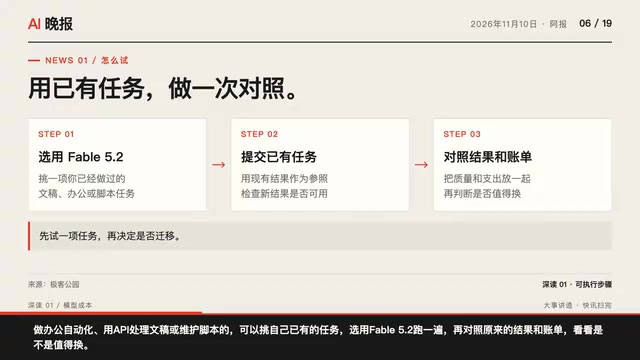
Claude Code Reportedly Leaks Secrets to GitHub, Sounding the Alarm for AI Coding Security
Claude Code reportedly exposed passwords and API keys to GitHub, per Ars Technica. We recap the incident alongside Claude Fable 5.2's 20% price cut and Meta Muse Ember, urging developers to check commit settings before granting permissions.