Microsoft Earns $10 Billion from OpenAI in a Single Quarter: The Revenue Truth Behind a Deep Partnership

Microsoft earned $10B from OpenAI commercial arrangements in one quarter, quantifying their deep financial ties.
In the quarter ending September 30, Microsoft earned $10 billion from commercial arrangements with OpenAI, including revenue-sharing payments—the first quarterly-level quantification of their vast financial dependence. The revenue covers Azure cloud consumption, model licensing, and revenue sharing, and is operating revenue rather than investment income. The article analyzes the "investment + cloud + revenue share" structure: OpenAI's success lifts Microsoft's cloud and sharing revenue, but concentration risk and fixed-cost pressure persist. The $10B quarterly figure shows leading model companies now have substantial commercialization capability.
Microsoft earned $10 billion in revenue from its commercial arrangements with OpenAI in the quarter ending September 30, including revenue-sharing payments. This figure quantifies the massive financial interdependence between the two companies at the quarterly level for the first time, and reveals the increasingly tight alignment of interests between tech giants and model companies in the AI wave.
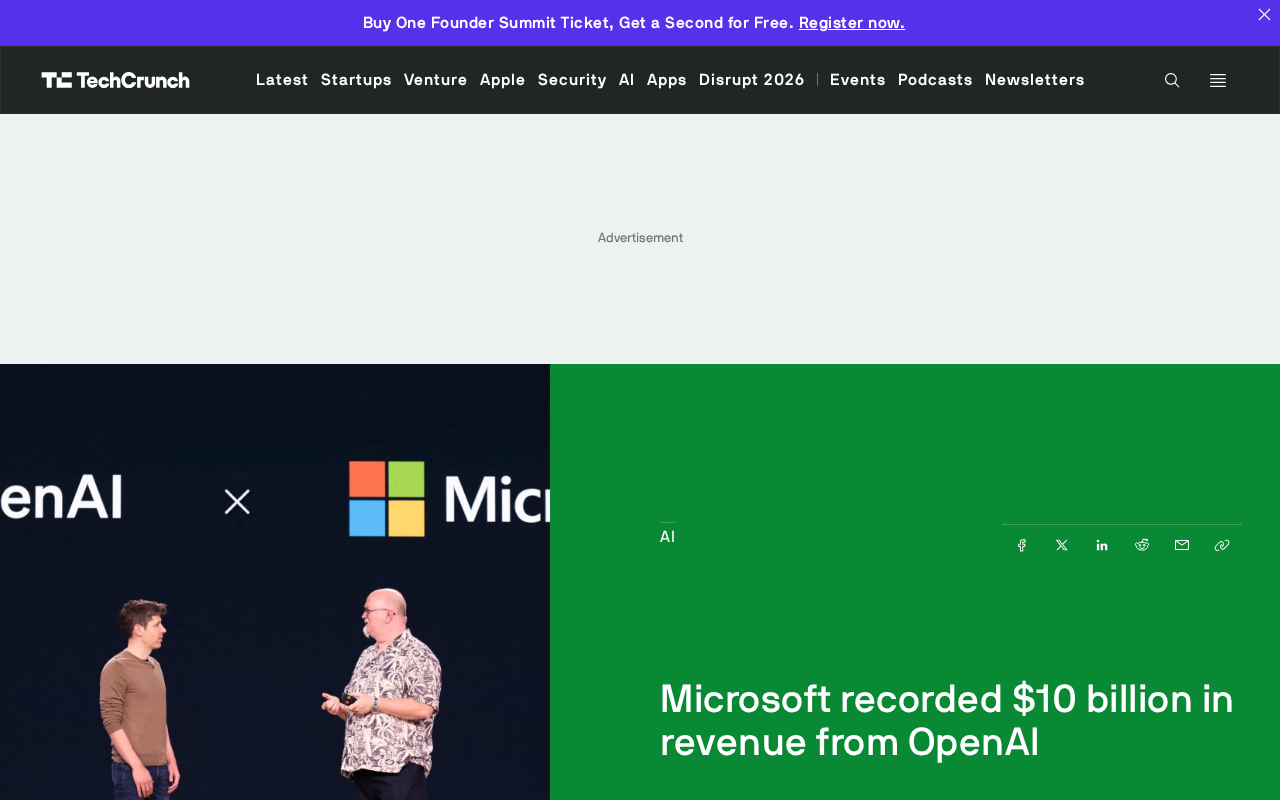
Where the $10 Billion Comes From
According to disclosed information, the $10 billion does not come from a single source but is the combined result of multiple commercial arrangements between Microsoft and OpenAI, explicitly including revenue-sharing payments. This means Microsoft, as OpenAI's largest investor and cloud service provider, has obtained considerable direct financial returns from OpenAI's commercialization process.
It is important to distinguish that this $10 billion is revenue recognized by Microsoft, not investment gains or equity appreciation. It reflects real cash flows generated in the day-to-day commercial dealings between the two parties, including Azure cloud resource consumption, model licensing, and revenue-sharing mechanisms.
What makes this disclosure rare is that Microsoft had not previously broken out OpenAI-related revenue separately. Making the number public this time is both a response to investor demands for transparency and indirect confirmation of the growth rate of OpenAI's business scale.
The revenue share mechanism is key to understanding the $10 billion. Under the agreement between Microsoft and OpenAI, Microsoft, as an early investor and exclusive cloud provider, is entitled to a contractually agreed share of the revenue OpenAI generates from selling products such as APIs and ChatGPT subscriptions; at the same time, the fees OpenAI pays for using Azure compute also flow back in some form. Therefore, the $10 billion includes both the cloud service fees Microsoft charges OpenAI and Microsoft's share of OpenAI's end-user revenue—both of which are recorded as Microsoft's operating revenue in accounting terms, rather than investment income under the equity method. This also explains why the figure can be recognized quarterly: it corresponds to cash flows from actual commercial transactions, not paper gains from valuation changes.
An Interdependent Financial Structure
The Microsoft-OpenAI relationship is often described as a three-layer structure of "investment + cloud + revenue share." Microsoft has invested enormous sums in OpenAI, while OpenAI has committed to placing most of its compute consumption on Azure, and Microsoft obtains the right to a share of some of OpenAI's revenue. This arrangement deeply intertwines the two financially: the more successful OpenAI is, the higher Microsoft's cloud revenue and revenue-sharing income; and Microsoft's compute support is a prerequisite for OpenAI to maintain its model training and inference capabilities.
This interdependence is not without risk. For Microsoft, the concentration of OpenAI-related revenue means its AI business performance is highly tied to the fate of a single partner. For OpenAI, revenue sharing and cloud commitments constitute a fixed cost structure that may compress its profit margins.
Interestingly, while disclosing this figure, Microsoft is also advancing its own in-house models and diversifying its AI partnerships. This may suggest that even with such a deep current dependence, both sides are preparing for greater independence in the long run.
The accounting and commercial implications of the three-layer "investment + cloud + revenue share" structure deserve elaboration. Microsoft's capital injections into OpenAI have largely taken the form of cash and Azure compute credits; the latter is essentially Microsoft taking an equity stake at a discount using its own cloud resources, which both reduces OpenAI's cash pressure and locks in its compute procurement flows. Revenue sharing typically has caps or recoupment-period arrangements, and Microsoft's share may be adjusted after it recovers its principal investment and agreed returns. This design means Microsoft's returns come from two lines simultaneously—equity appreciation and operating income—while OpenAI trades a portion of its future revenue for current compute and funding support. Only by understanding this structure can one judge how much of the $10 billion in revenue is sustainable operating revenue sharing and how much is tied to compute consumption, thereby assessing its significance as an indicator of the true profitability of Microsoft's AI business.
Implications for the AI Industry Landscape
A quarterly revenue scale of $10 billion accounts for a limited share of Microsoft's overall revenue, but in the context of the AI industry it is highly significant. It shows that leading model companies are already capable of generating considerable commercial revenue, rather than merely burning cash on R&D. It also shows that the binding relationship between cloud providers and model companies is becoming the infrastructure layer of the AI economy.
For other companies trying to replicate this model, the Microsoft-OpenAI case demonstrates both the financial power of deep binding and the potential fragility of over-dependence. How to maintain bargaining power and technological autonomy within a partnership will be a question every AI player needs to answer.
As regulators scrutinize the relationships between tech giants and AI companies more strictly, this kind of revenue disclosure may also become an important basis for outsiders to assess market concentration and competitive fairness. Microsoft's proactive disclosure this time may set a precedent for stricter financial transparency requirements to come.
One-line Summary
Microsoft earned $10 billion in revenue from OpenAI commercial arrangements in a single quarter, quantifying the deep financial ties between the two for the first time.
Paragraph Summary
In the quarter ending September 30, Microsoft earned $10 billion in revenue from its commercial arrangements with OpenAI, including revenue-sharing payments—the first time the vast financial dependence between the two has been quantified at the quarterly level. The revenue covers multiple arrangements including Azure cloud resource consumption, model licensing, and revenue sharing, and represents operating revenue recognized by Microsoft rather than investment income. The article analyzes the three-layer "investment + cloud + revenue share" binding structure between Microsoft and OpenAI: the more successful OpenAI is, the higher Microsoft's cloud revenue and revenue share—but concentration risk and fixed-cost pressure exist simultaneously. The $10 billion quarterly revenue shows that leading model companies already have considerable commercialization capability, and that the binding of cloud providers and model companies is becoming the infrastructure layer of the AI economy; meanwhile, Microsoft's push for in-house models and diversified partnerships suggests both sides are preparing for long-term independence.
Related articles
9Router Tutorial: A Free AI Token Solution for Claude Access
Complete 9Router tutorial: deploy an open-source AI routing proxy in two commands, aggregate free providers like KiRo AI, Gemini, and OpenCode, and use AI tokens free in the Claude client via Combo multi-model scheduling.

Cursor Agent SDK Released: Build Your Own AI Agents with Code
Cursor opens its Agent SDK: Agent-as-Code with Markdown instructions and TypeScript tools, one-command deploy, or self-host as a Node process. Pricing and independent testing still missing.

Cloudflare Open-Sources Security Audit Skill: Turning AI Agents into Code Auditors
Cloudflare open-sources Security Audit Skill, letting AI Agents run six-stage security audits with adversarial validation to cut false positives and output structured findings.json.