MicroZig Announces Strict No LLM / No AI Policy
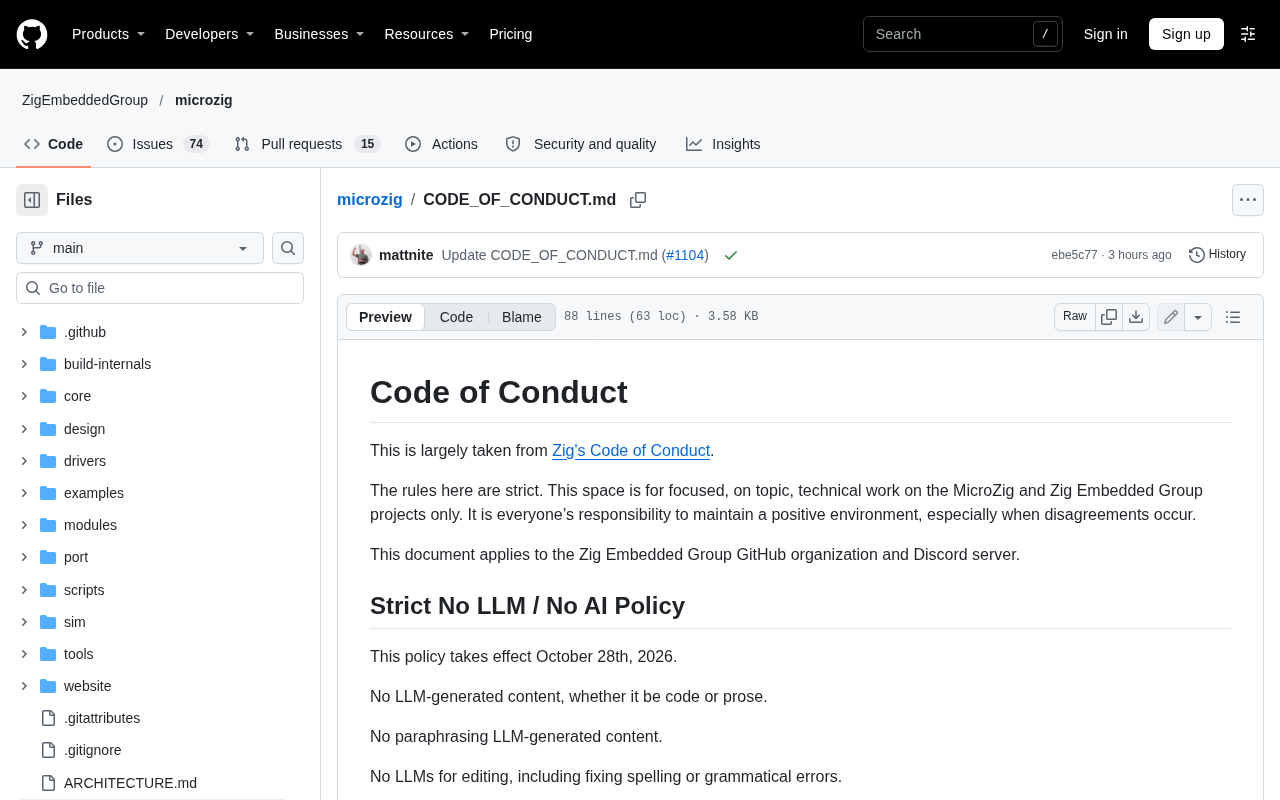
MicroZig announces a strict No LLM / No AI policy, sparking open source community debate over the boundaries of AI-assisted development.
MicroZig is a Zig-language toolchain project for embedded development. It recently announced on Hacker News that it will adopt a strict "No LLM / No AI" policy, explicitly prohibiting the use of large language models or AI-assisted tools in project contributions. This stance contrasts with the current trend of the open source community broadly embracing tools like Copilot and ChatGPT. The article analyzes that the policy's motivations may include ensuring code quality and accountability traceability, avoiding copyright and license compliance risks from AI-generated content, and preserving contributors' understanding of the code and the quality of community discussion. Community reactions are polarized: supporters see it as a responsible commitment to transparency and quality, while opponents question its enforceability and worry it will exclude contributors who use modern tools. Defining the scope of "using AI" is the main difficulty in implementing the policy. The event reflects the possibility that the open source community may split into AI-friendly and AI-excluding projects.
Event Overview
According to a discussion on Hacker News, the MicroZig project has announced it will adopt a strict "No LLM / No AI" policy. The news was published under the title "MicroZig to Adopt Strict No LLM / No AI Policy" and has drawn attention within the technical community.
Policy Core: Explicit Rejection of AI-Generated Code
MicroZig is a Zig-language toolchain project for embedded development. According to the discussion title on Hacker News, the project plans to explicitly prohibit the use of large language models (LLMs) or any AI-assisted tools in project-related work. This means contributors, when submitting code, documentation, or other content, may be required to guarantee that the content is entirely human-produced and not AI-generated or substantially AI-modified.
This policy stands in sharp contrast to the current trend of the open source community broadly embracing AI-assisted development. More and more projects and companies are integrating tools like Copilot and ChatGPT into their workflows, making MicroZig's choice appear notably conservative—even counter to the current.
MicroZig is an embedded development framework built on the Zig language, designed to provide hardware abstraction layers, peripheral drivers, and toolchain support for microcontrollers (such as ARM Cortex-M, RISC-V, etc.). Zig itself is a systems programming language that emphasizes compile-time execution, manual memory management, and seamless interoperability with C; its build.zig build system and package manager are gradually gaining attention in embedded scenarios. MicroZig's goal is to simplify the initialization and cross-compilation process of embedded projects, allowing developers to replace traditional vendor SDKs and Makefile combinations with a unified Zig toolchain. Precisely because embedded software runs directly on resource-constrained devices that are difficult to update in the field, code determinism, auditability, and long-term maintainability become the attributes project maintainers care about most—which also explains their cautious attitude toward AI-generated content.
Possible Underlying Motivations
Although the original discussion did not elaborate on the rationale for the policy, several directions can be inferred based on common debates in the technical community.
Quality and accountability are the primary considerations. AI-generated code is sometimes difficult to trace to its source, and in fields like embedded systems that demand extremely high reliability and safety, maintainers may want every line of code to have a clear human author so that responsibility can be assigned if problems arise.
Copyright and license compliance is another sensitive point. LLM training data often contains large amounts of open source code, and generated content may inadvertently reproduce copyrighted fragments, bringing legal risks to the project. An explicit ban on AI can avoid such hidden dangers.
Project culture and contributor experience should not be overlooked either. Some maintainers believe that over-reliance on AI weakens contributors' understanding of the code, lowers the quality of community discussion, and can even make code review a formality.
LLM (Large Language Model) refers to neural network models trained on massive text data that can predict and generate text such as code and documentation based on context. In programming scenarios, tools such as GitHub Copilot and ChatGPT use LLMs to provide code completion, function generation, and explanation features. However, LLM output is probabilistic and may contain content that appears plausible but is actually wrong (i.e., "hallucinations"), and its training corpus mixes large amounts of open source code from varied sources, making it difficult to precisely determine the similarity between generated fragments and existing code. For fields like embedded systems that have safety certification requirements (such as ISO 26262, IEC 61508), the traceability of the origin of every line of code in the toolchain is often a prerequisite for compliance audits—this is precisely the most direct technical and legal consideration behind MicroZig's policy.
Community Reaction and Controversy
Although the Hacker News discussion did not have many comments, policies of this kind are inherently controversial. Supporters view it as a responsible attitude toward code quality and project transparency; opponents may consider the approach impractical and difficult to enforce, and believe it will shut out contributors willing to use modern tools.
How to define "using AI" is itself a difficult problem. Using AI to check syntax, polish comments, or generate test cases versus letting AI write core logic—the boundary is not clear. If the policy lacks actionable details, it can easily become a dead letter or spark pointless arguments.
Open source license compliance is a key backdrop for understanding controversies of this kind. Mainstream open source licenses (such as GPL, MIT, Apache 2.0) impose different conditions on copying, modification, and redistribution of code, and whether LLM-generated content constitutes a "derivative work" currently has no unified legal conclusion. If an AI tool has absorbed GPL code during training and outputs similar fragments without indication, the project may face risks of license contagion or missing attribution obligations. Explicitly prohibiting LLM-generated content essentially moves the burden of compliance proof forward to the contributor declaration stage, sparing maintainers from bearing the burden of unverifiable provenance during code review. This also explains why some projects sensitive to legal risk prefer a "no AI" stance rather than relying on after-the-fact detection tools.
Impact on the Embedded and Zig Ecosystems
The embedded development field in which MicroZig operates has inherently high requirements for determinism and auditability. If the policy is properly enforced, it may attract contributors who value hand-written code quality and create a differentiated positioning. On the other hand, however, the Zig language itself is still in a growth stage, and its ecosystem needs a large number of contributors; overly strict restrictions may shrink the talent pool.
This event also reflects a broader industry tension: AI tools have become standard productivity equipment, but not all projects are willing to accept them unconditionally. The open source community may gradually split into "AI-friendly" and "AI-excluding" projects, and contributors will need to understand a project's stance before participating.
Conclusion
MicroZig's "No LLM / No AI" policy is a clear statement of position. Regardless of how effective its implementation ultimately proves to be, it raises a question worth considering for every technical team: between efficiency and controllability, where are we willing to draw the boundary?
Related articles

Ollama Local Deployment Guide: Run Open-Source LLMs with Zero Experience
Ollama local deployment tutorial: what Ollama is, why choose it, how to download, install, and run open-source LLMs, and use its API for custom development. Beginner-friendly.

n8n: The 187K-Star Open-Source Automation Powerhouse That Turns Repetitive Work into Workflows
n8n is a 187K-star open-source visual workflow automation engine with 400+ nodes, Webhook/schedule/polling triggers, self-hosting for data security, and AI Agent support. Here's a guide to its core concepts, use cases, and pitfalls.

Self-Hosting n8n in Practice: Docker + PostgreSQL + Caddy Deployment Guide
A step-by-step guide to deploying a self-hosted n8n instance with Docker Compose, PostgreSQL, and Caddy automatic HTTPS, including env var pitfalls, Feishu alerting, and backup/upgrade/rollback tips.