Milvus 2.6 in Practice: From Vector Fundamentals to High-Performance RAG Q&A

A Bilibili technical course systematically covers Milvus 2.6 architecture, deployment, and high-performance RAG optimization.
Based on a Bilibili technical open class, this article covers Milvus 2.6 and high-performance RAG in practice. It explains the infrastructure role of vector databases in RAG, analogous to MySQL for Java development, for millisecond-level similarity retrieval over massive high-dimensional vectors. It then reviews core concepts like vectors, vectorization, cosine similarity, and embedding, and analyzes Milvus 2.6's cloud-native architecture with Stream, Query, and Data nodes plus the Coordinate coordinator enabling storage-compute separation, relying on ETCD, Kafka/Pulsar, and object storage. It also introduces the Python lightweight version and standalone deployment hardware requirements, and highlights tiered storage, eviction policies, warm-up, and index optimization for high-performance RAG, along with a bottom-up learning path from Java to AI architecture.
In the process of deploying large AI models in real-world applications, vector databases are playing an increasingly critical role. If large models are like the business code in Java development, then vector databases are like MySQL—they are the indispensable infrastructure for any intelligent Q&A system. In a technical open class on Bilibili, an instructor with over 13 years of Java development experience gave a systematic walkthrough of Milvus 2.6 and high-performance RAG in practice, covering vector fundamentals, architecture selection, deployment approaches, and key challenges in interviews and projects.
Why RAG Projects Can't Do Without a Vector Database
Traditional relational databases like MySQL excel at exact matching and range queries, at most adding LIKE fuzzy matching. But when faced with massive volumes of images, documents, or semantic text, such query methods are almost useless. What vector databases solve is the similarity retrieval problem: finding, among billions of high-dimensional vectors, the one closest to a target at millisecond speed.
The instructor used a vivid example to illustrate this capability: given a large collection of images and told that one of them contains a cat, you are asked to find it among billions of images in an extremely short time. This is precisely why vector databases like Milvus are built for high-dimensional vector retrieval, and it is also the foundation that enables RAG systems to retrieve first and generate afterward.

Among comparable products, Milvus is officially defined as the world's most popular open-source vector database, a claim backed by its tens of thousands of GitHub stars. For developers, choosing an open-source solution means lower cost and room to understand the underlying principles more deeply, and studying Milvus's architecture and tuning is a necessary path toward AI architecture roles.
RAG (Retrieval-Augmented Generation) is a technical architecture that combines information retrieval with large model generation. Its basic flow is: after a user asks a question, the system first vectorizes the question, retrieves the most relevant knowledge chunks from the vector database, then feeds those chunks as context together with the question into the large model, which composes an answer based on real materials. Compared with letting a large model answer "from memory", RAG significantly reduces hallucinations, supports updates to private knowledge bases, and requires no model retraining. The vector database therefore plays the role of "external long-term memory", and its retrieval quality directly determines the ceiling of the final answer.
Embedding is a specific form of vectorization, referring to mapping text into fixed-dimension dense vectors through pre-trained models (such as BGE, OpenAI Embedding, etc.), so that semantically similar content is closer in vector space. The choice of embedding model, the dimension size, and whether to normalize all affect the recall quality of subsequent similarity retrieval, making this a key area in RAG engineering that must be tuned in coordination with the vector database.
Core Concepts of Vector Retrieval
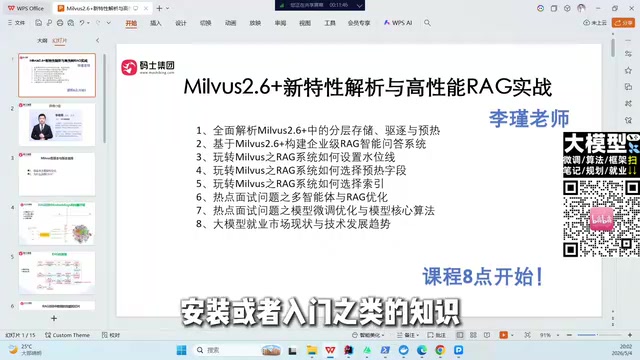
To truly make good use of Milvus, you must first understand several key concepts: what a vector is, what vectorization is, what cosine similarity is, what vector storage is, and how embedding and vector storage work together in RAG projects.
Simply put, vectorization is the process of converting unstructured data such as text and images into high-dimensional numeric arrays, while similarity computation uses measures like cosine similarity to judge how semantically close two vectors are. RAG systems leverage this mechanism to first retrieve the chunks most semantically relevant to the user's question from the knowledge base, then hand them to the large model to generate an answer, thereby significantly reducing hallucinations and improving accuracy.
Only after understanding these principles can you discuss advanced topics such as tiered storage, eviction policies, and warm-up. These concepts are common stumbling blocks in interviews and real projects, and they mark the dividing line between "can use" and "uses well".
Cosine similarity measures directional closeness by computing the cosine of the angle between two vectors, with values ranging from -1 to 1; the closer to 1, the more semantically similar. It is insensitive to vector length and is suitable for measuring semantic similarity of text; alongside it are Euclidean distance (L2) and inner product (IP). Different measures suit different scenarios, and Milvus requires explicitly specifying the metric type when creating a collection, with the index type needing to match the metric.
High-dimensional vector retrieval faces the "curse of dimensionality": exact brute-force scanning cannot meet millisecond-level response at billion-scale data, so practical systems generally adopt approximate nearest neighbor (ANN) algorithms such as IVF, HNSW, and DiskANN. These indexes trade a small amount of recall accuracy for order-of-magnitude speed gains, and they are also the technical premise for the index optimization and warm-up mechanisms discussed later.
Milvus 2.6's Cloud-Native Architecture
Why choose version 2.6 rather than older versions? The answer lies in its architectural evolution. Milvus 2.6 adopts a fully cloud-native design, where multiple node roles are clearly visible: Stream nodes, Query nodes, Data nodes, and the Coordinate coordinator responsible for overall orchestration. Different operations are routed to different nodes, enabling storage-compute separation and elastic scaling.
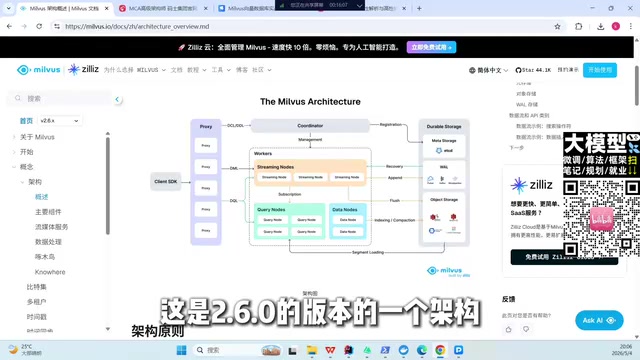
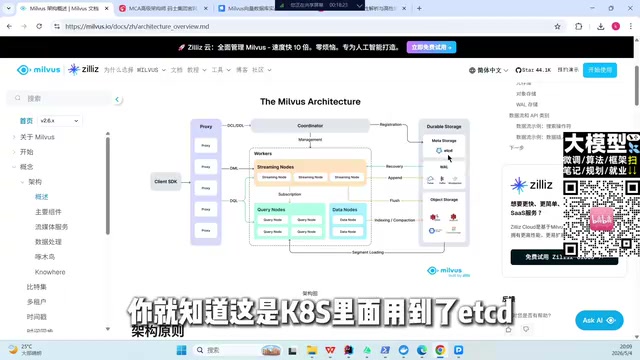
In terms of dependencies, Milvus integrates ETCD for metadata management, uses message middleware such as Kafka and Pulsar to handle log streams, and supports object storage including Amazon object storage, MinIO, and various cloud storage services. This design allows it to be deployed on a single machine or smoothly scaled to the cloud, covering scenarios from personal experiments to enterprise-grade production.
Worth mentioning is the relationship between Milvus and the commercial Zilliz. You can think of Milvus as the Linux system, while Zilliz Cloud is a commercial online cloud service built on Milvus, similar to the relationship between Red Hat and CentOS. The commercial version saves you operational hassle and is faster, but the open-source version is already sufficient for individual developers and self-hosted teams.
Storage-compute separation is the core design principle of Milvus 2.x architecture: data is persisted in object storage, while nodes such as Query, Data, and Stream only handle computation and scheduling, passing log streams to each other through message queues. The direct benefit is that each type of node can scale independently—if query pressure is high, scale Query nodes; if write volume is large, scale Data nodes—without migrating data as a whole.
ETCD handles metadata management and service discovery in Milvus, storing collection schemas, node states, coordinator leader election, and other information; message middleware (Kafka/Pulsar, or Woodpecker used in the lightweight version) ensures persistence of log streams and multi-consumer subscription. Understanding these two types of dependencies helps quickly pinpoint whether a deployment issue lies in the metadata layer or the messaging layer.
Deployment Paths from Lightweight to Standalone
Milvus offers multiple ways to get started. The simplest is the Python lightweight version: just install the pymilvus library, start a local instance in Python code, and then create a Milvus client connection—ideal for quickly validating ideas and learning the principles.
If you need a more production-like experience, you can choose standalone deployment. Note that the standalone version has certain hardware requirements: at least 8G of memory is recommended, an Intel second-generation Core or higher CPU with support for the relevant instruction sets, and a solid-state drive is strongly recommended. The instructor particularly emphasized that Milvus basically won't run well on a non-SSD drive, a point that is easily overlooked during selection.
What Optimization Points Matter for High-Performance RAG
Building a working RAG Q&A system is not hard; what's hard is making it high-performance and maintainable. The course mentioned that when building RAG systems with Milvus, key optimization areas include watermarks, warm-up fields, and indexes. Tiered storage and eviction policies determine how efficiently data flows between storage tiers, while warm-up mechanisms affect query response speed.
These optimization points are not isolated but closely tied to Milvus's architectural design. Only by understanding the responsibilities of the Stream, Query, and Data nodes can you determine where the bottleneck lies and then adjust parameters and index strategies accordingly.
Tiered storage refers to Milvus dividing data by hotness into hot data in memory and cold data in object storage, loaded on demand during queries; eviction policies determine when cold data is swapped out of memory to control memory usage. Together they can significantly reduce hardware costs while maintaining query performance.
Warm-up means proactively triggering loading and caching for newly created or just-loaded indexes, avoiding high latency on the first query due to cold start. Combined with watermark monitoring, you can tell whether writes and index building are lagging, thereby maintaining stable retrieval response in RAG scenarios with continuous data writes. These mechanisms together constitute the key tuning techniques that take a vector database from "working" to "working well".
Capability Building in the AI Large Model Boom
When discussing the job market, the instructor offered some directional judgments: large models remain hot, but to find related jobs you need to shore up capabilities in multi-agent systems, RAG optimization, model fine-tuning, and core algorithms. As infrastructure, vector databases are the first building block among these capabilities.
Transitioning from Java architecture to AI architecture actually has a traceable path: first master foundational components like Milvus, then go deep into RAG system optimization and engineering practice, and finally extend upward to multi-agent systems and model fine-tuning. This bottom-up learning path makes it easier to build competitiveness than blindly chasing hot trends.
For developers, Milvus 2.6 is more than just a new version number—it represents the maturation of vector databases in the cloud-native direction and means RAG applications now have a more solid foundation. Understanding vector principles, thoroughly grasping architectural details, and hands-on running a Q&A project are the three most practical steps at the current stage.
One-line Summary
A Bilibili technical course systematically explains Milvus 2.6 architecture, deployment approaches, and key optimization points for high-performance RAG in practice.
Paragraph Summary
The article is based on a technical open class on Bilibili, centered on Milvus 2.6 and high-performance RAG in practice. It first explains the infrastructure role of vector databases in RAG, analogous to MySQL for Java development, solving millisecond-level similarity retrieval over massive high-dimensional vectors. It then covers core concepts such as vectors, vectorization, cosine similarity, and embedding, and analyzes Milvus 2.6's cloud-native architecture: Stream, Query, and Data nodes plus the Coordinate coordinator enable storage-compute separation, depending on ETCD, Kafka/Pulsar, and object storage. For deployment, it introduces the Python lightweight version and the hardware thresholds for standalone deployment. Finally, it points out that high-performance RAG requires attention to tiered storage, eviction policies, warm-up, and index optimization, and offers a bottom-up learning path from Java architecture to AI architecture.
Related articles
 Tech Frontiers
Google Omni 1.2 Flash: 15-Second AI Video at Just $0.07 per Second
Google DeepMind releases Gemini Omni 1.2 Flash: 15-second video, 720p at $0.07/sec (30% cheaper), multi-turn editing without regeneration, draft upscaling to 4K.
 Tech Frontiers
No AI Ghostwriting: Writer's Quarter Reinvents Novel Writing with a Visual Workbench
The Writer's Quarter is an AI-free novel writing and planning tool that unifies character building, story planning, and manuscript writing in one visual workbench. This article analyzes its positioning, target users, and differentiated value amid the rise of AI writing tools.
 Tech Frontiers
Fleeep: A Unified Inspiration Collection Notes App for Creatives
Fleeep is a notes app for creatives that unifies screenshots, bookmarks, saved posts, and inspiration into one calm, cross-device, offline-capable space. This article analyzes its positioning, differentiation, and target users.